

AI CERTS
2 months ago
WD 40TB UltraSMR HDD Transforms Storage Cloud Infrastructure
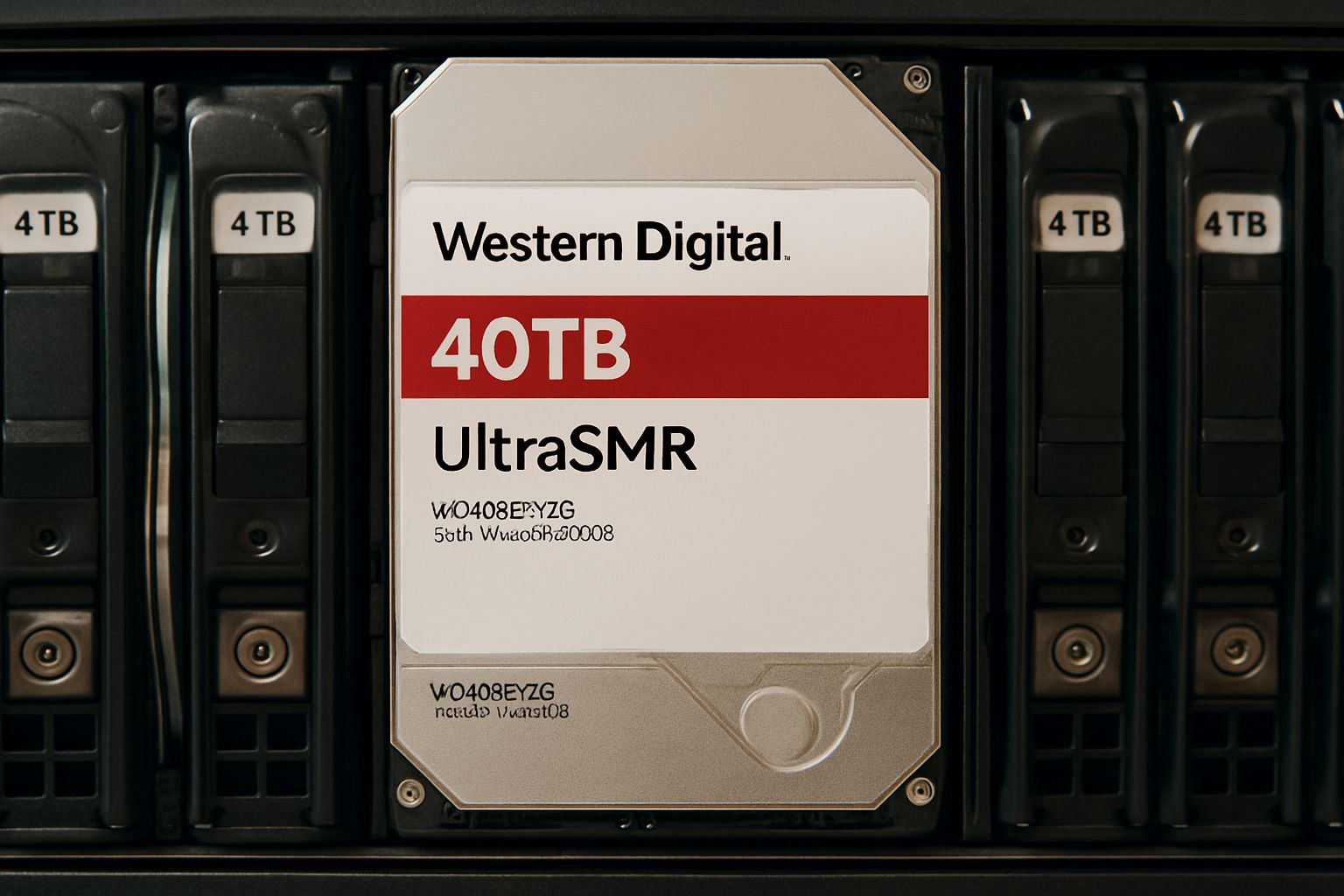
The company unveiled a 40 TB UltraSMR ePMR HDD and an ambitious roadmap toward 100 TB. This breakthrough positions Storage Cloud Infrastructure for its next capacity leap.
AI Workloads Drive Demand
Market Growth Metrics
Gartner expects datacenter spending to accelerate through 2027. Moreover, Mordor Intelligence pegs the 2026 HDD market at USD 51.8 billion. In contrast, flash forecasts grow more slowly due to cost per bit. Analysts therefore see HDD capacity as essential for Storage Cloud Infrastructure. Rising AI model sizes amplify this need.
These forecasts underscore immediate opportunities for density gains. However, operators will only deploy drives that also lower watts per terabyte. The new WD unit claims to deliver both benefits. Consequently, demand momentum appears strong.
The sector’s growth story primes the technical discussion that follows.
WD 40TB Launch Details
Capacity Roadmap Highlights
WD revealed the 40 TB UltraSMR drive on 3 February 2026. Two unnamed hyperscalers now qualify samples, and volume production targets the second half of 2026. Furthermore, WD outlined a 60 TB ePMR step and a 100 TB + HAMR goal by 2029. The vendor insists this cadence aligns with customer rack refresh cycles.
Irving Tan, WD’s CEO, stated that the firm is “meeting demand for capacity, scale, quality, enhanced performance, and ease of technology adoption.” Such language resonates with Storage Cloud Infrastructure planners who juggle cost, performance, and timing.
These roadmap checkpoints set expectations. Subsequently, customers will evaluate execution rigor and delivery dates.
Performance Features Explained Simply
Power Efficiency Gains Shown
Three architectural enhancements headline the release. First, High Bandwidth Drive technology doubles sequential bandwidth today and could scale eightfold. Secondly, Dual Pivot dual-actuator design offers up to twice sequential I/O. Thirdly, a power-optimized mode trims energy by roughly 20 percent relative to prior platforms.
UltraSMR firmware combines OptiNAND, larger sector sizes, and stronger error correction. Consequently, the drive pushes tracks closer together without crippling random writes. Therefore, operators gain capacity while preserving predictable throughput. These traits matter when Storage Cloud Infrastructure must feed GPUs without costly flash tiers.
Performance gains complement capacity. However, real-world benchmarks will confirm marketing claims.
Competitive Landscape and Timelines
Seagate And Toshiba Moves
Seagate already ships limited 40 TB HAMR samples and eyes volume in 2027. Toshiba pursues MAMR and high-platter approaches targeting similar capacities. Additionally, smaller suppliers experiment with component innovations supporting next-generation HDD designs. In contrast, WD leverages ePMR as an interim step before HAMR mass production.
Competition ensures buyers avoid single-source risk. Nevertheless, WD’s existing share and deep customer integrations give it leverage. The winner will combine capacity, reliability, and total cost. Storage Cloud Infrastructure owners remain pragmatic; they will adopt any vendor meeting strict service-level agreements.
Competitive pressure accelerates timelines. Consequently, watchers should track qualification milestones closely.
Economic Impact for Hyperscalers
Total Cost Reduction Path
Higher drive capacity lowers rack count. Moreover, fewer enclosures reduce cooling, networking, and real-estate expenses. Analysts estimate every rack removed can save tens of thousands of dollars annually. Therefore, a 40 TB HDD can shrink floor space by nearly 40 percent versus today’s 24 TB units.
Further savings derive from the 20 percent power cut WD advertises. Consequently, operators improve PUE scores and meet sustainability pledges. Western Digital positions these factors as direct contributions to Storage Cloud Infrastructure profit margins.
Economic benefits look clear on paper. However, procurement teams will request verified field data before large purchase orders.
Implementation Challenges and Risks
SMR Adoption Hurdles Key
SMR yields capacity by overlapping tracks. Nevertheless, random write penalties can degrade performance unless the host software cooperates. WD’s UltraSMR stack claims to mask much complexity. Yet, integration still demands firmware updates and workload analysis.
HAMR introduces different risks, including new head assemblies and thermal controls. Manufacturing yields could fluctuate, affecting delivery schedules. Consequently, buyers must balance adoption timing with acceptable risk exposure within Storage Cloud Infrastructure.
Risk management remains central. Subsequently, firms should pilot early before green-lighting fleet rollouts.
Outlook and Next Steps
Certification Pathways Forward Now
Watch for WD’s formal datasheet release and public benchmark results later this year. Additionally, independent labs such as StorageReview plan comparative tests against Seagate and Toshiba alternatives. Procurement teams can meanwhile upskill staff. Professionals can enhance their expertise with the AI Architect™ certification.
Storage Cloud Infrastructure strategy does not stop at hardware. Therefore, experts suggest revisiting tiering policies, erasure coding schemes, and rack power budgets ahead of 40 TB drive adoption. WD’s promised timeline allows adequate preparation.
Upcoming verification data will clarify performance claims. Consequently, early dashboards should track throughput, IOPS, watts, and failure rates.
These forward-looking tasks set the stage for informed procurement. Meanwhile, market observers await volume production confirmations.
Storage Cloud Infrastructure now stands at a pivotal upgrade moment. WD’s 40 TB UltraSMR HDD, coupled with future 100 TB ambitions, signals rapid density growth. Furthermore, dual-actuator and power-optimized advances aim to align capacity with performance and efficiency. Nevertheless, integration diligence and competitive vetting remain prudent. Consequently, readers should monitor qualification progress and pursue relevant certifications to stay ahead of the curve.


