

AI CERTs
2 months ago
Upland and Amazon Q Elevate Conversational Search Intelligence
Generative AI is reshaping how employees surface answers from sprawling repositories of Enterprise Knowledge. Consequently, vendors are racing to embed natural language interfaces directly into enterprise search products. Upland Software joined that contest on 3 February 2026 with a notable platform update. The company added native Amazon Q Business capabilities to its BA Insight search suite. This release promises Conversational Search Intelligence that feels as immediate as chatting with a colleague. However, the announcement also spotlights the rising stakes around security, governance, and cloud alignment. Our analysis unpacks the integration, market context, benefits, and risks for technical decision makers. Moreover, we provide practical guidance for evaluating deployments in complex information environments. Read on to understand whether Upland’s latest move can accelerate your organization’s knowledge workflows. The following sections deliver concise insights, statistics, and expert commentary for informed planning.
Upland Integration Announcement Details
On launch day, Upland revealed the refreshed BA Insight Platform during a BusinessWire press briefing. Additionally, the release confirmed more than 1,100 enterprise customers already rely on BA Insight for search. Amazon Q Business, marketed by AWS as an AWS Assistant for workplace tasks, now embeds within the platform. Through this union, users can ask questions in plain language and receive grounded answers generated from indexed content. Upland positions the feature as a leap forward for Conversational Search Intelligence across heterogeneous repositories.
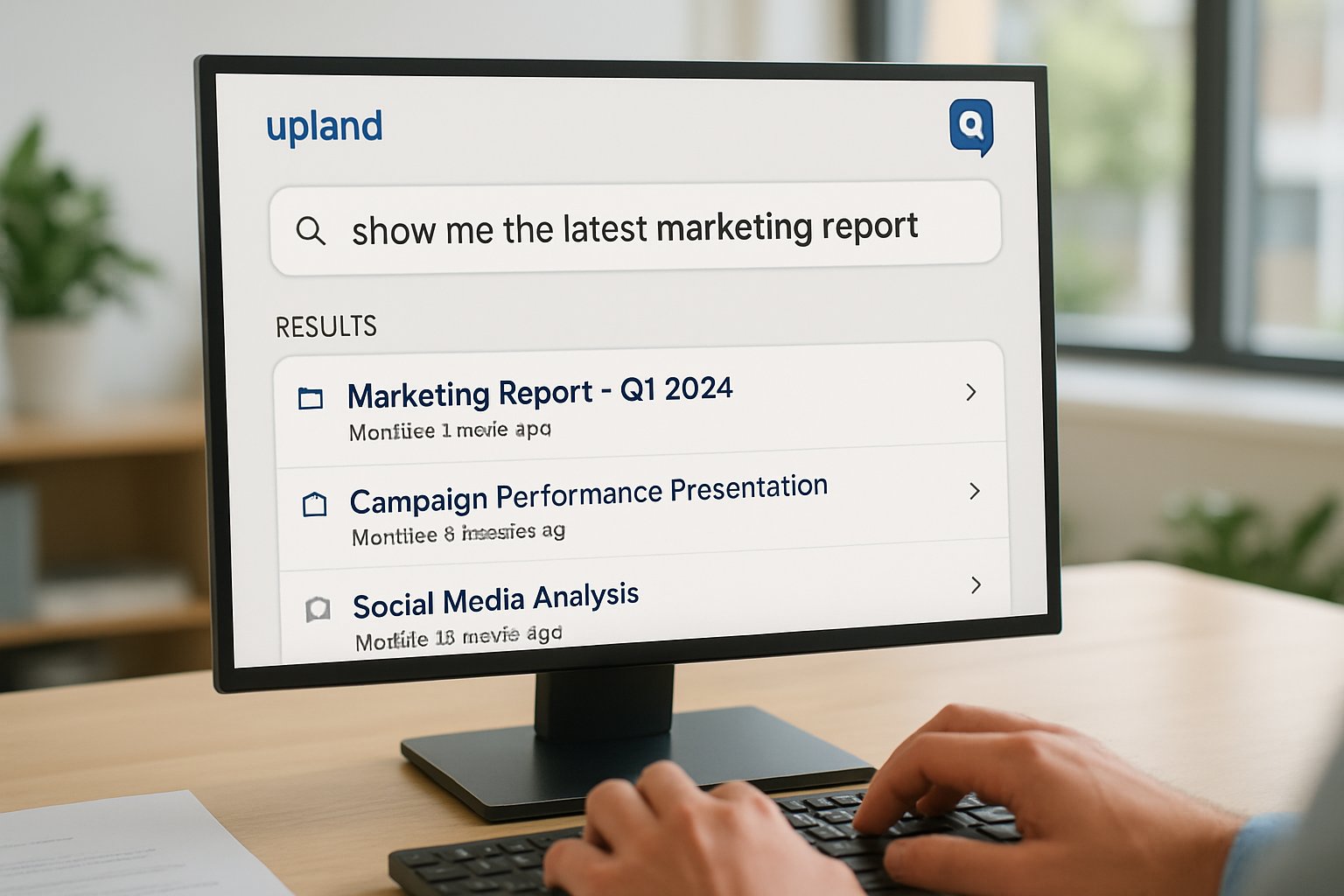
The update ships alongside other modules such as Knowledge Graphs, SmartHub, ConnectivityHub, and AutoClassifier. Furthermore, more than ninety-five connectors link file shares, CRM, chat logs, and ticketing systems. These connectors feed high-quality context into the Retrieval-Augmented Generation pipeline powering Amazon Q responses. In contrast, earlier deployments required costly custom integration work before teams could test generative search. Therefore, procurement through AWS Marketplace aims to shorten pilots to weeks, not months.
Dan Doman, Upland’s product chief, called the partnership a gamechanger for regulated industries. He argued that managing connector complexity, not simply counting connectors, distinguishes BA Insight from rivals. Nevertheless, independent validation of performance metrics remains pending. Consequently, early adopters should request benchmark data before proceeding to production. Doman claimed customers will realize "true Conversational Search Intelligence at enterprise scale" once the rollout completes.
The announcement combines established connectors with a powerful generative assistant. However, deeper technical proofs are still required before widespread endorsement. Next, we examine how Amazon Q actually generates answers.
How Amazon Q Works
Amazon Q Business sits within the AWS Bedrock portfolio as a configurable generative AI service. It functions as an AWS Assistant that can ingest documents, dashboards, and code snippets. Moreover, developers can extend Q with Q Apps, enabling task-specific chat experiences. When paired with BA Insight, Q retrieves relevant passages via vector search before producing an answer. Therefore, the architecture follows the Retrieval-Augmented Generation pattern endorsed by many security researchers.
The process begins when a user asks a question through the SmartHub interface. Subsequently, BA Insight connectors pass metadata into an enrichment pipeline that builds knowledge graphs. Those graphs preserve entity relationships, boosting precision for context windows requested by the language model. Consequently, Amazon Q grounds its draft using factual snippets rather than speculative text. The result delivers Conversational Search Intelligence without sacrificing traceability or audit trails.
Amazon Q orchestrates retrieval and generation steps behind a simple chat panel. This design promises speed plus transparency, which are essential for regulated workloads. Understanding the mechanics is helpful, yet economic forces still drive adoption choices.
Market Context And Growth
Enterprise search spending continues climbing, fueled by hybrid work and data sprawl. PrecedenceResearch valued the sector at USD 5.34 billion in 2025, projecting USD 12.7 billion by 2035. Meanwhile, MarketsandMarkets expects Retrieval-Augmented Generation revenue to surge from USD 1.94 billion to 9.86 billion by 2030. Consequently, vendors that blend search, connectors, and generative AI occupy a lucrative intersection. Upland aims to capture that intersection through its Conversational Search Intelligence roadmap.
Key Statistics Snapshot Data
- Enterprise search CAGR: 8.7% through 2035 (PrecedenceResearch).
- RAG market CAGR: 38% through 2030 (MarketsandMarkets).
- Upland customer base: 1,100 organizations across industries.
- Connector library: 95+ integrations covering CRM, ECM, chat, and code repositories.
In contrast with monolithic suites, connector-centric offerings let buyers avoid rip-and-replace projects. Moreover, AWS Marketplace listings simplify procurement via existing cloud budgets, easing CFO approvals. These financial dynamics reinforce why Amazon Q aligned partnerships are proliferating.
Growth projections indicate sustained demand for solutions that tame information overload. Therefore, competition will intensify among search vendors courting AWS Assistant integrations. Escalating demand also magnifies security and governance stakes, which we examine next.
Security And Governance Considerations
Generative assistants inherit the classic confidentiality, integrity, and availability triad risks. Prompt-injection incidents against Amazon Q Developer in 2025 underline those dangers. Nevertheless, Upland asserts that connector permissions mirror native source system ACLs. Furthermore, audit logs capture each retrieval call, providing forensic visibility. Organizations seeking more assurance can earn the AI Security Compliance™ certification.
Identity mapping remains another critical task when exposing sensitive Enterprise Knowledge to an AWS Assistant. Therefore, architects must enforce least privilege, session expiry, and human approval for high-risk actions. Moreover, retrieval pipelines should sanitize HTML, scripts, and hidden macros before embedding. Continuous red-team testing can reveal emergent prompt vulnerabilities before attackers exploit them. Nevertheless, no technical control fully replaces diligent human oversight and multi-layer reviews.
Robust governance frameworks reduce, but never abolish, conversational AI risk. Consequently, mitigation planning should start well before any production rollout. With precautions outlined, we now consider tangible business outcomes.
Business Value For Enterprises
Early customer pilots highlight three recurring value themes. First, employees locate policy documents in seconds rather than minutes, boosting service desk velocity. Second, marketing teams request instant summaries of competitive filings, freeing analysts for strategic tasks. Third, finance staff generate first-draft compliance narratives directly from Enterprise Knowledge stores.
- Shortened time-to-answer for complex policies.
- Reduced onboarding costs through self-service guidance.
- Improved decision speed during incident response.
Moreover, project managers report fewer context-switches because chat responses cite source links automatically. Such gains embody the promise of Conversational Search Intelligence beyond simple keyword lookup. Consequently, stakeholders enjoy higher confidence because answers include permission-checked citations. Analysts estimate that each minute saved compounds into significant yearly productivity gains.
Rising efficiency, reduced swivel-chair research, and richer insights drive strong ROI narratives. In contrast, projects lacking Conversational Search Intelligence often stall due to poor adoption. Translating promise into reality depends on disciplined deployment, which we address next.
Deployment And Next Steps
Most firms will begin by purchasing BA Insight through AWS Marketplace under existing spend commitments. Subsequently, teams configure connectors for SharePoint, Salesforce, ServiceNow, and code repositories. Moreover, admins map identity providers to preserve document-level permissions across chat responses. Pilot groups should measure baseline search times before enabling Conversational Search Intelligence features.
Upland recommends a staged rollout that adds high-value departments first, then scales horizontally. Therefore, overseers can monitor costs tied to vector storage, model tokens, and inference traffic. Meanwhile, governance councils review conversation logs to refine retrieval rules and prompt templates. After acceptance tests pass, organizations can expose Conversational Search Intelligence to the wider workforce.
Looking forward, Upland plans additional analytics that score answer usefulness and detect hallucinations. AWS also signals continued investment in the AWS Assistant family, promising deeper integrations. Consequently, buyers should monitor the roadmap to align contract terms with forthcoming capabilities.
Structured pilots, governance checkpoints, and iterative tuning remain central to success. These practical steps pave a secure path toward production scale. We close with final recommendations for technology leaders.
Conclusion And Recommendations
Upland’s Amazon Q integration arrives at a pivotal moment for enterprise information management. Market forecasts show accelerating investment in search, RAG, and AWS Assistant ecosystems. However, only disciplined deployments will unlock the full power of Conversational Search Intelligence. Security hardening, human oversight, and phased rollouts mitigate emerging agentic threats. Moreover, quantifying time savings can secure executive sponsorship and budget continuity.
Evaluate connector coverage, access controls, and cost models before signing agreements. Then pilot the solution with measurable success criteria. Consider earning the AI Security Compliance™ certification to strengthen governance. Subscribe for updates on emerging tools and deployment insights.


