

AI CERTs
3 months ago
Semiconductor Market Shift: Intel’s Battlemage Targets Nvidia
Intel’s latest Battlemage announcement lands amid fierce hardware realignment. Analysts tie this turbulence to a broader Semiconductor Market Shift reshaping competitive priorities. Consequently, executive teams across gaming and data centers watch Intel’s posture with renewed curiosity. Nvidia Competition intensifies as price sensitive buyers evaluate alternatives. Meanwhile, AMD’s Instinct push adds fresh pressure on market margins. This article dissects key developments, opportunities, and risks behind Intel’s renewed graphics ascent. Additionally, we explore roadmap intersections with Panther Lake and Core Ultra CPU families. Professionals can deepen market insight via the AI Researcher™ certification aligned to emergent AI workloads. By reading on, strategists will gain actionable context for the coming fiscal cycles. Therefore, understanding Intel’s trajectory is crucial for procurement and R&D planning. The following sections provide concise, data-driven analysis and future signals. Let us begin with a snapshot of current industry dynamics.
Semiconductor Market Shift Overview
Market researchers note that demand for high performance GPUs rose 34% year on year. However, supply chain concentration has favored one vendor, creating price elasticity challenges. Consequently, the Semiconductor Market Shift now hinges on alternative suppliers competing on efficiency. Intel, AMD, and start-ups exploit this window to court gaming and AI buyers. In contrast, hyperscalers seek multi-vendor strategies to limit single source risk. Fortune Business Insights pegs the datacenter GPU segment at roughly USD 20 billion for 2025. Moreover, analysts project a 30% compound annual growth rate into the next decade.
- Nvidia held 98% datacenter GPU share in 2023, TechInsights reports.
- Desktop add-in board share for Nvidia was 92% in Q1 2025, JPR notes.
- Intel Arc B580 launched at $249, offering 1440p performance gains of 24% over A750.
These figures illustrate Nvidia’s dominance alongside a widening appetite for alternatives. Consequently, sustained momentum could reallocate billions during the next budget cycle. Against this backdrop, Intel’s strategic push warrants closer inspection.
Intel’s Bold GPU Push
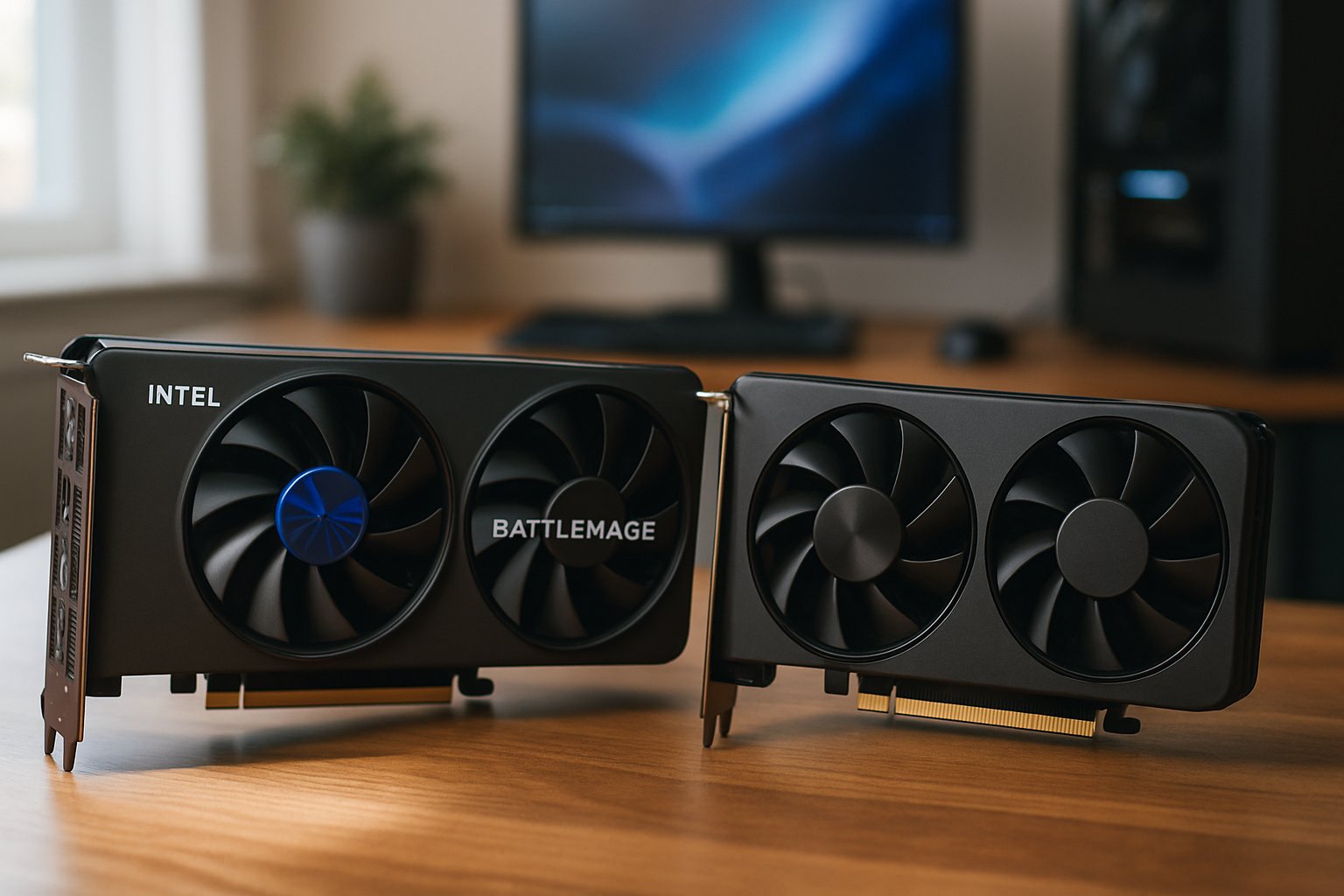
Intel’s discrete GPU history began modestly with Alchemist, yet lessons proved invaluable. Subsequently, the Battlemage B-Series launched on 3 December 2024 targeting price conscious 1440p gamers. The flagship B580 shipped first, followed by the lower cost B570 in January 2025. Intel priced these cards at $249 and $219 respectively, undercutting similar RTX 4060 offerings. Reviews from PCWorld and TechPowerUp praised performance-per-dollar and improved drivers. Nevertheless, software confidence remains a work in progress within enthusiast circles. Intel executives publicly acknowledged past flaws and invested heavily in driver maturation. Moreover, XeSS 2 support expanded quickly, validating the XMX engine’s potential. Such progress signals a tangible Semiconductor Market Shift toward multi-supplier gaming ecosystems. Intel’s price aggression gains attention, yet sustaining mindshare demands relentless software iteration. Hardware specifics provide deeper clarity.
Battlemage Hardware Deep Dive
Battlemage builds on Xe2 architecture with 36 compute units and enhanced ray tracing blocks. XMX acceleration doubles AI throughput versus Alchemist, aiding both gaming and local inference. Therefore, XeSS frame generation delivers smoother 100+ FPS experiences on mainstream monitors. AV1 encode and decode features remain fully hardware accelerated, benefiting streamers. Core clocks peak near 2.5 GHz under typical gaming loads while drawing 185 watts. Panther Lake laptops will integrate similar engines alongside Core Ultra graphics tiles. Consequently, mobile battlegrounds could witness another Semiconductor Market Shift as OEMs broaden configurations. Memory bandwidth rises thanks to 18 Gbps GDDR6 and a wider 256-bit interface.
- Improved efficiency per watt through refined shaders.
- Dedicated XMX blocks for AI workloads and XeSS.
- Competitive raster performance against Nvidia Competition midrange offerings.
Collectively, these upgrades underpin Intel’s most credible gaming silicon to date. The platform’s balanced specifications reinforce value narratives and feed channel enthusiasm. Next, software integration merits review.
Software And AI Stack
Software consistency historically limited Intel’s graphics ambitions. However, 2025 driver releases demonstrated measurable frame time stability across major engines. XeSS 3 targets multi frame generation, promising 80% frame rate boosts in select titles. Additionally, Intel opened the XeSS SDK, encouraging broader adoption even on rival hardware. Developers appreciate AGESA style documentation and frequent sample updates. Meanwhile, XMX units accelerate Stable Diffusion and small LLM models locally. Core Ultra workstations leverage those blocks to reduce cloud inference spending. Furthermore, Battlemage B580 delivered MLPerf inferencing results competitive with RTX 4060 baseline scores. These software wins nurture the ongoing Semiconductor Market Shift within independent developer communities. Sustained SDK momentum remains pivotal for lasting differentiation. Enterprise traction, however, depends on datacenter credibility.
Datacenter Ambitions Under Review
Intel’s Ponte Vecchio already powers select supercomputing clusters, yet AI dominance eludes the company. Battlemage Pro rumors mention 24 GB VRAM cards targeting creators and inference workloads. Nevertheless, no hyperscaler has publicly committed to large deployments of these variants. In contrast, Nvidia Competition maintains entrenched CUDA pipelines and dedicated AI SDK leadership. AMD’s MI300 family also wins notable cloud instances, complicating procurement decisions. Analysts forecast Nvidia retaining most shipments through 2026 barring abrupt Semiconductor Market Shift events. Therefore, Intel must secure benchmark proof and reference wins quickly. Specifically, Gaudi accelerators or Battlemage Pro boards could anchor mixed CPU-GPU offerings. Until such wins emerge, enterprise buyers may remain cautious. Competitive reactions add another layer of complexity.
Competitive Responses Emerging Now
Nvidia Competition increased bundling incentives, offering DLSS licenses and Grace CPU discounts to OEMs. Moreover, the company accelerated H200 memory options to safeguard margins. AMD responded by highlighting MI300A’s unified memory advantages for LLM training clusters. Consequently, procurement teams now evaluate multi-vendor scenarios more seriously. Panther Lake references appear in several OEM roadmaps, hinting at balanced CPU-GPU packages. Additionally, Core Ultra generations bundle low power XMX blocks for lightweight inferencing at the edge. These moves collectively underscore a broad Semiconductor Market Shift that could dilute Nvidia hegemony. Competitive posturing is intensifying across pricing, memory, and software ecosystems. Future strategy deserves closer projection.
Strategic Outlook For 2026
Industry watchers expect Intel to reveal Battlemage Pro details during Computex 2026. Subsequently, XeSS 4 may introduce vendor agnostic frame interpolation, widening developer interest. Panther Lake desktop chips should sample in late 2025, pairing naturally with Arc boards. Meanwhile, Core Ultra refreshes focus on energy efficiency, freeing more thermal budget for GPUs. Moreover, Intel has hinted at Falcon Shores updates blending CPU and GPU tiles. If execution holds, a decisive Semiconductor Market Shift could materialize by fiscal 2027. Nevertheless, ecosystem inertia and software mindshare remain formidable obstacles. Success will depend on aggressive driver cadence, reproducible benchmarks, and visible cloud deployments. Implications for stakeholders are substantial.
Intel’s Battlemage campaign demonstrates credible momentum across gaming, AI, and potential professional segments. However, Nvidia Competition and AMD innovations ensure the contest remains fluid. Consequently, procurement leaders must monitor software maturity, roadmap execution, and pricing trends. A sustained Semiconductor Market Shift will hinge on verifiable datacenter wins and robust developer adoption. Meanwhile, Panther Lake and Core Ultra integrations offer unique total cost advantages for mixed workloads. Therefore, executives should pilot small deployments, validate toolchains, and reevaluate volume contracts before 2026 budgets lock. Professionals seeking deeper competitive intelligence can pursue the AI Researcher™ certification for structured analytical skills. By acting decisively, organizations can turn the coming Semiconductor Market Shift into a strategic advantage.
Disclaimer: Some content may be AI-generated or assisted and is provided ‘as is’ for informational purposes only, without warranties of accuracy or completeness, and does not imply endorsement or affiliation.


