

AI CERTs
2 months ago
Faraday Future Bets Big on Embodied AI Robotics at NADA 2026
Las Vegas witnessed a bold announcement at the automotive gathering today. Faraday Future revealed its pivot towards Embodied AI Robotics. The company connected the reveal to the bustling dealer floor of NADA 2026. Industry followers expected vehicle news, yet the spotlight shifted to intelligent machines. Consequently, investors and engineers weighed the significance for autonomous mobility. The unveiling aligns with rising forecasts that place embodied systems at multibillion valuations by 2030. Moreover, executives promised cross-platform synergies between robots, cars, and cloud services. Skeptics, however, pointed to Faraday Future’s fragile finances. This article examines the launch, market context, and execution hurdles in detail. Readers gain actionable insights for strategic planning.
Global Market Momentum Rise
Global forecasts reinforce the excitement generated by Faraday’s showcase. MarketsandMarkets projects the embodied segment to reach 23.06 billion dollars by 2030. In contrast, The Business Research Company suggests a still significant 7.24 billion dollar opportunity. Consequently, compound growth estimates swing between 25 and 40 percent annually. Moreover, Nvidia CEO Jensen Huang proclaimed a coming "ChatGPT moment" for physical AI. His statement buttresses startup pitches and investor decks worldwide.
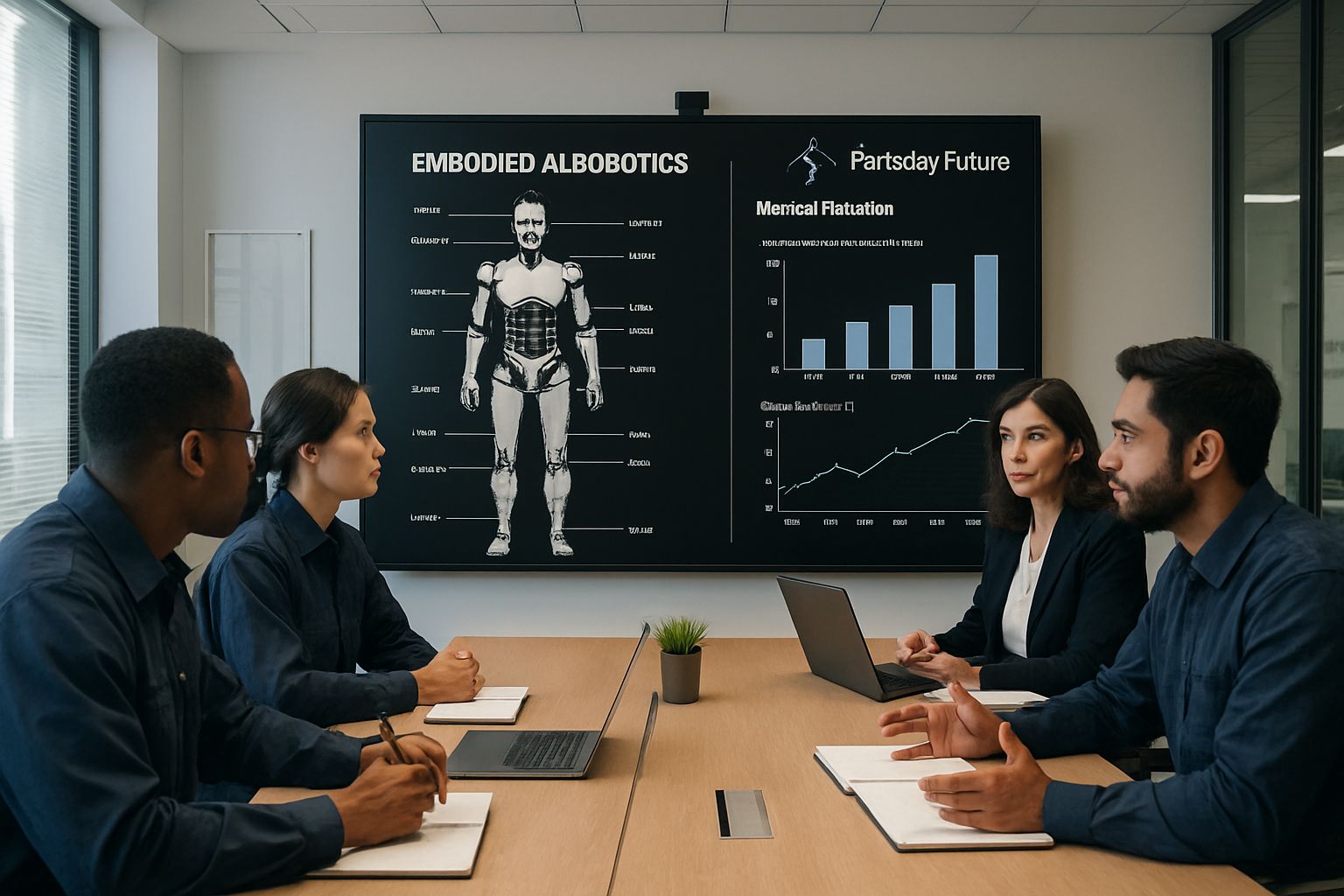
Robotics suppliers respond by accelerating simulation, battery, and actuator roadmaps. Meanwhile, venture funds have directed fresh capital toward warehouse, healthcare, and consumer prototypes. Embodied AI Robotics now occupies boardroom agendas alongside data privacy and generative AI.
The market momentum appears undeniable despite methodological variance. However, projections alone cannot guarantee Faraday’s triumph; strategy remains crucial. Therefore, examining Faraday Future Strategy Shift becomes essential.
Faraday Future Strategy Shift
Faraday Future positions its robotics line as a flywheel for vehicle demand. Furthermore, executives tied the robots to the proprietary EAI Agent platform controlling upcoming FX Super One electric vans. Company materials describe three robot categories serving retail, logistics, and residential customers. Embodied AI Robotics, according to leadership, will share batteries, sensors, and software with the vehicles. Moreover, the dual track could help amortize research spending over larger production volumes.
The plan depends heavily on the FX Partner dealer ecosystem. Dealers are promised co-marketing funds, telematics data access, and cloud analytics revenue sharing. Additionally, Faraday says partner enrollment will begin at NADA 2026 with an app based contract flow. Skeptics note prior dealer rollouts from EV startups often stalled after initial enthusiasm.
Faraday’s strategy merges hardware scale with channel reach. Nevertheless, execution hinges on operational discipline, which history has not favored. Next, we assess product specifics to judge feasibility.
Product Details Spotlight Revealed
The Las Vegas presentation introduced three distinct machines under the Robot Vehicle Plus family. Moreover, each variant targets a different environment. The service model resembles a waist-high cart with lidar, depth cameras, and articulating shelves. Meanwhile, the humanoid unit stands 160 centimeters tall and carries 25 kilograms. A compact delivery rover completes the trio.
- Peak walking speed equals 4 km/h for warehouse lanes.
- Battery swap time averages 90 seconds in stage demos.
- Safety compliance reportedly meets UL-1740 guidelines.
Embodied AI Robotics powers these devices through the company’s 6x4 agent architecture. Consequently, perception, planning, and speech modules mirror those used inside the FX Super One cockpit. Faraday claims OTA updates will synchronize enhancements across robots and vehicles. Additionally, cloud offload is optional, allowing offline operation during network outages.
Technical highlights appear competitive on paper. However, independent laboratories have not yet confirmed specifications. Core Technical Stack Explained will dissect the architecture next.
Core Technical Stack Explained
The 6x4 stack spans perception, localization, planning, control, dialogue, and security. Moreover, Nvidia Orin chips execute real-time vision at 200 TOPS. Torch-based models fine-tune voice commands using multilingual datasets. Consequently, Faraday touts seamless cross-device skill sharing. Nevertheless, battery endurance remains limited to three hours under heavy loads.
The architecture mirrors automotive compute with modest tweaks. Therefore, production scaling hinges on supplier capacity, as we examine next.
Critical Financial Reality Check
Faraday Future’s quarterly filings reveal accumulated deficits exceeding two billion dollars. Furthermore, auditors inserted going-concern language during recent reviews. Cash on hand covered roughly six months of planned burn at September 2025 levels. Consequently, management outlined a five-year ramp funded by staggered equity lines and supplier credits. Embodied AI Robotics development therefore competes with vehicle tooling for limited resources. The FX Partner model promises joint marketing rebates offsetting dealer capital commitments. However, rebate liabilities will increase cash requirements if robot adoption lags. Robot Vehicle Plus units add further manufacturing complexity, especially for actuators sourced overseas.
Financial pressures remain the clearest execution risk. In contrast, timely funding rounds could stabilize operations before mass production. Subsequently, we compare rivals to gauge competitive heat.
Competitive Landscape Overview Today
The embodied segment already hosts heavyweight engineers and deep-pocketed conglomerates. Boston Dynamics markets Spot for inspection work across energy and telecom sites. Meanwhile, Agility Robotics readies commercial humanoids for warehouse sorting at Amazon pilots. Consequently, Faraday must differentiate beyond price wars. Embodied AI Robotics integration with luxury vehicles offers one narrative advantage. However, established brands enjoy multi-year safety validation cycles and ISO certifications.
Partnership depth also matters. Nvidia supplies compute to almost every competitor, equalizing core inference performance. Faraday touts FX Partner exclusivity for cross-selling robots, cars, and subscription features. Nevertheless, rivals like ABB own entrenched industrial channels unswayed by NADA 2026 theatrics.
Competitive forces will squeeze margins and talent pools. Therefore, strategic opportunities and risks demand balanced evaluation. Future Opportunities And Risks explores that balance.
Future Opportunities And Risks
Opportunities arise from converging advances in perception, battery density, and additive manufacturing. Moreover, Faraday can cross-license Embodied AI Robotics modules to suppliers lacking software depth. Subscription teleoperation could deliver recurring revenue without heavy production scaling. Additionally, the Robot Vehicle Plus lineup may broaden addressable tasks as tool payloads evolve. Professionals can enhance technical governance using the AI+ Cloud Architect™ certification. However, execution risks remain acute. Embodied AI Robotics hardware demands stringent supply quality to avoid safety recalls. Subsequently, funding gaps could delay deployment, harming FX Partner confidence. Regulatory scrutiny may intensify once humanoids leave controlled floor spaces. Consequently, Faraday must provide transparency on certification documents and safety audits.
Opportunities tempt investors with diverse revenue levers. Nevertheless, layered risks demand disciplined governance before scale. Ultimately, stakeholder vigilance will shape the program’s destiny.
Faraday Future has reignited debate around human-machine convergence. Its Embodied AI Robotics vision intertwines hardware, software, and retail channels. Market forecasts suggest appetite, yet capital scarcity and technical hurdles linger. Consequently, leadership must validate claims through independent testing and audited certifications. NADA 2026 momentum may secure early FX Partner commitments if robot demos impress. Moreover, sustained transparency will ease investor concerns over Robot Vehicle Plus production. Embodied AI Robotics could thrive if Faraday marries ambition with discipline. Readers should monitor funding milestones and pursue specialized learning paths. Therefore, consider deepening skills through accredited programs and stay alert for upcoming field evaluations.


