

AI CERTs
5 months ago
Claude Agents Accelerate Life Sciences at Allen and HHMI
Claude is leaving chat windows and heading for bench tops. On 2 February 2026, Anthropic announced twin research alliances with the Allen Institute and HHMI. The goal is direct integration of Claude agents into complex laboratory workflows. Consequently, the company positions the move as a watershed for Life Sciences productivity. Furthermore, Allen researchers will test multi-agent orchestration across vast multimodal datasets. Meanwhile, HHMI’s Janelia campus plans instrument connectors that let Claude observe experiments in real time. Analysts frame the announcement as Anthropic’s boldest push beyond textual tools toward embodied Scientific AI. However, independent experts warn that speed must not eclipse transparency or reproducibility. Moreover, market studies place the AI healthcare segment above 36 billion dollars, indicating strong commercial incentives. Subsequently, investors may see these partnerships as templates for future domain-specific deployments. This article unpacks the strategy, benefits, and challenges behind Anthropic’s latest scientific expansion. Consequently, readers gain a balanced roadmap for adopting responsible AI in research.
Anthropic Partnership Overview Details
Anthropic calls the Allen Institute and HHMI "founding partners" for its Claude for Life Sciences program. Therefore, both organizations receive early access to new model releases, connectors, and agent tooling. In return, they supply real biological problems that stress-test Claude’s reasoning and multimodal capabilities. Consequently, Anthropic gathers feedback that shapes future algorithm updates.
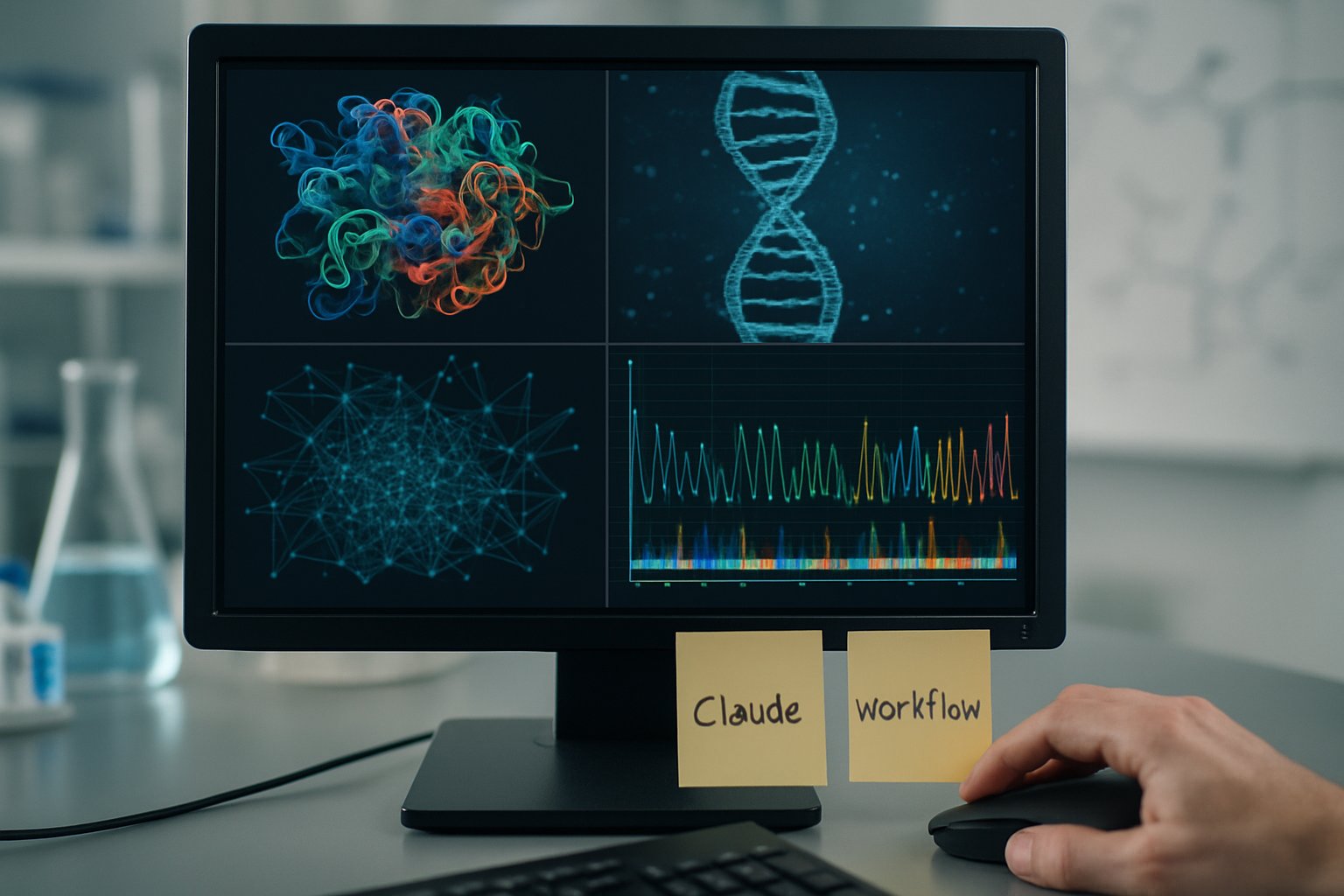
Jonah Cool, leading the initiative, says the intent is augmentation rather than replacement. In contrast, some automation vendors pitch full end-to-end lab autonomy. Allen’s Grace Huynh echoed that stance during a Fortune interview. She highlighted analysis bottlenecks as the prime target for early prototypes.
These reciprocal commitments tie technical development to immediate laboratory value. Meanwhile, the next section explores how agents reshape daily bench routines.
Agents Enter Lab Workflows
HHMI’s Janelia campus will wire imaging microscopes to Claude through standardized connectors. Consequently, agents will ingest raw images, annotate cellular features, and suggest follow-up experiments for Life Sciences teams. Additionally, researchers can request natural-language explanations for each annotation step. Anthropic argues that traceable reasoning distinguishes its approach from opaque black-box tools.
At the Allen Institute, multiple agents will collaborate across omics, imaging, and connectomics datasets. Moreover, a knowledge-graph agent will maintain relationships among genes, cells, and circuits. Subsequently, an experimental-design agent ranks hypotheses by expected insight versus resource cost. Researchers access the results through a single chat interface inside existing lab software.
These workflow changes aim to compress months of manual analysis into hours. Therefore, the following section examines the data emphasis of the Allen collaboration.
Allen Institute Data Acceleration
The Allen Institute generates terabytes of single-cell and neuroimaging data each week. However, manual annotation often lags collection by months. Scientific AI agents promise parallel processing across modalities, thereby reducing latency. Consequently, researchers can test hypotheses while data remain fresh.
A multi-agent stack divides responsibilities into integration, graph maintenance, temporal modeling, and prioritization. Meanwhile, a supervisory agent reconciles conflicts and surfaces uncertainties for human review. Grace Huynh says early prototypes already flag rare neuronal events previously buried in noise. Therefore, the institute expects faster publication cycles and broader data reuse.
These acceleration gains could ripple across allied Life Sciences consortia. The next section reviews HHMI’s instrument integration journey.
HHMI Instrument Integration Impact
Janelia’s microscopes, electrophysiology rigs, and behavioural arenas will stream data directly to Claude. Consequently, Scientific AI routines can align images, segment cells, and store metadata automatically. Additionally, agents will generate next-day experiment suggestions based on observed anomalies. Lab staff remain in control because every recommendation includes step-by-step justification.
HHMI aims to publish validation protocols alongside early case studies. Moreover, external auditors will monitor error rates and reproducibility metrics. Such governance aligns with EU advisory guidance on responsible AI in biology.
These safeguards seek to balance speed with scientific rigour. Consequently, stakeholders can trust automated recommendations before scaling adoption across wider Life Sciences programs. Next, we assess the broader commercial landscape influencing such deployments.
Market Forces And Context
Grand View Research places the 2025 AI healthcare market near 36 billion dollars. Furthermore, some analysts forecast a jump toward 100 billion by 2030. Generative tools targeting Life Sciences currently constitute a modest slice but enjoy steep growth curves. Reporters estimate the niche may reach two billion dollars within eight years.
- AI healthcare market was 36 billion dollars in 2025, Grand View Research reports.
- Generative AI for drug discovery could reach two billion dollars by 2034, GlobeNewswire states.
- Compound annual growth rates exceed 35 percent in several analyst projections.
Consequently, vendors scramble to secure anchor customers with large public datasets. In contrast, Anthropic pursues fewer partnerships but invests deeper technical support. Such focus could deliver stronger reference implementations for Scientific AI. However, closed model licensing may limit access for smaller academic labs.
These market pressures incentivize both speed and exclusivity. The governance section unpacks resulting ethical tensions.
Governance Challenges Still Remain
EU advisers caution that opaque AI pipelines undermine reproducibility. Therefore, they recommend audit trails, artifact disclosures, and independent validation studies. Anthropic addresses part of the critique with traceable reasoning and model context protocols. Nevertheless, governance gaps persist around data sovereignty and long-term archiving.
Stakeholders also debate power concentration when elite labs receive privileged access. Consequently, policy groups push for public infrastructure and shared benchmarks. Scientific AI proponents counter that early adopters must fund risky experimentation.
These unresolved issues require collaborative standards development. Next, we explore milestones that could shape the coming year for Life Sciences automation.
What Comes Next Steps
Anthropic promises public case studies within three months. Additionally, Allen scientists plan to release benchmark notebooks for Life Sciences labs comparing agent workflows with traditional scripts. HHMI expects its first instrument-integrated pilot to appear at the Society for Neuroscience meeting. Consequently, observers will soon judge real-world merit rather than press claims.
Industry analysts also watch for cloud marketplace listings that simplify procurement. Moreover, compliance auditors may publish guidance on acceptable AI-assisted experimental reports. Professionals can enhance their expertise with the AI Marketing Strategist™ certification.
These forthcoming events will indicate whether early optimism translates into durable scientific change. Therefore, continued observation remains essential for any Life Sciences leader considering adoption.
Anthropic’s alliances mark a pragmatic turn toward domain-embedded AI agents. Early pilots focus on tangible bottlenecks rather than speculative automation. Consequently, researchers may gain faster insights while retaining experimental oversight. Nevertheless, rigorous governance must accompany every new workflow component. For Life Sciences executives, the message is clear: innovation and responsibility should advance together. Interested professionals should monitor upcoming benchmarks, participate in standards efforts, and pursue relevant skills. Moreover, earning specialized credentials like the linked AI Marketing Strategist™ certification can strengthen internal advocacy. Take proactive steps now, and your teams will navigate the coming Scientific AI wave with confidence.
Disclaimer: Some content may be AI-generated or assisted and is provided ‘as is’ for informational purposes only, without warranties of accuracy or completeness, and does not imply endorsement or affiliation.


