

AI CERTs
4 months ago
Nvidia, Custom Chips, and Competition
Surging demand for generative AI has sharpened global Competition among chip designers. Consequently, analysts ask whether hyperscalers will switch to home-grown accelerators and sideline Nvidia’s GPUs. Jensen Huang has rejected that notion repeatedly. Moreover, he argues that flexibility, ecosystem depth, and scale sustain Nvidia’s edge. The debate intensified after GTC 2025 and continued through early 2026, framing a critical inflection point for enterprise computing.
However, investors need numbers, not slogans. Nvidia’s fiscal 2025 revenue reached $130.5 billion. Data‐center sales alone hit $35.6 billion in the fourth quarter. Meanwhile, R&D spending topped $12.9 billion, funding 27,100 engineers. These figures clarify the company’s expansive R&D Moat. Consequently, the conversation now pivots from hype to comparative economics.
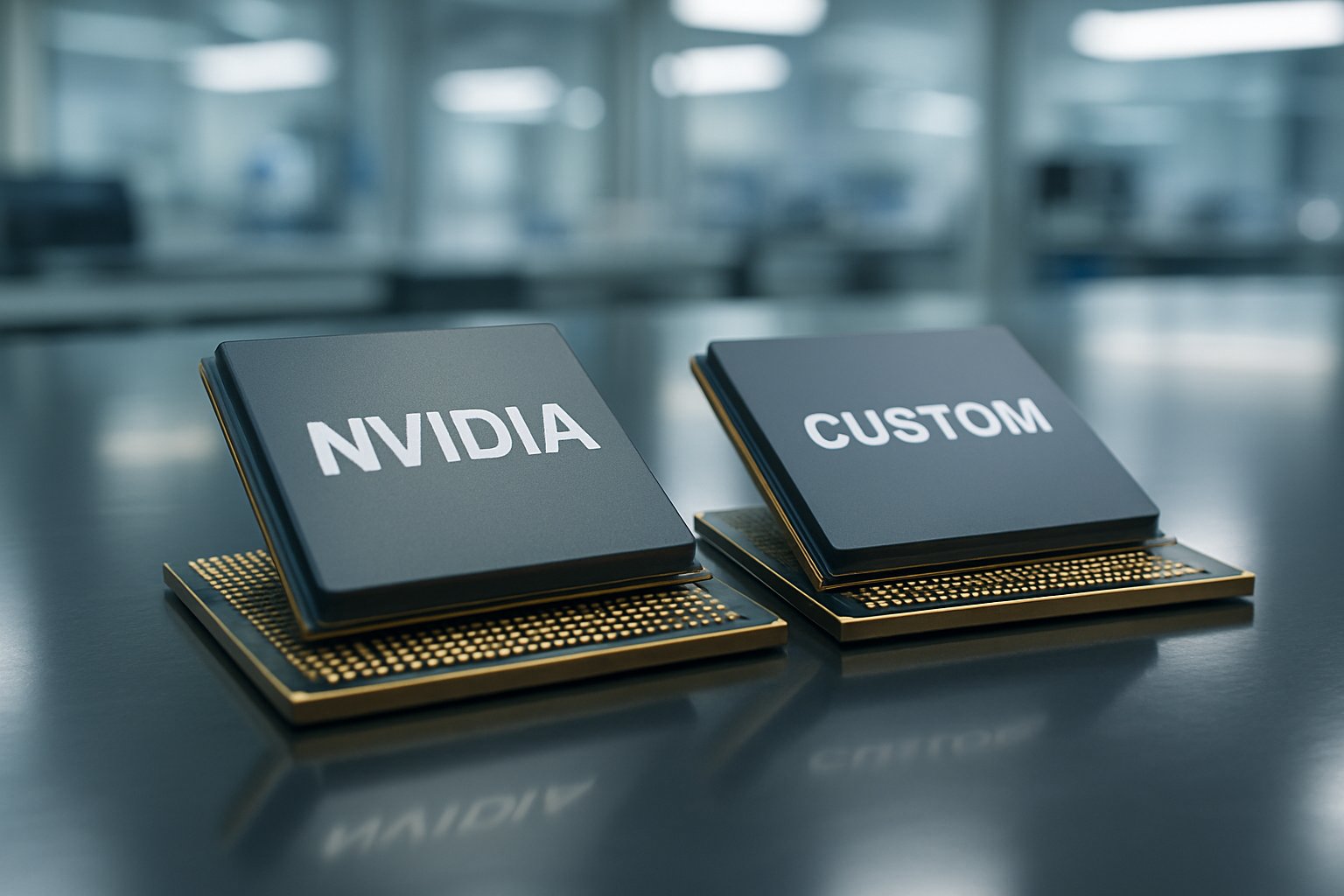
Custom Chips Debate Unfolds
Nvidia’s dominance invites constant challenges. In contrast, hyperscalers tout tailored ASICs for cost control. AWS pushes Trainium3, while Broadcom secures multi-cloud deals worth billions. Nevertheless, Huang remains unmoved. “A lot of ASICs get canceled,” he warned at GTC 2025. He added that each ASIC “still has to be better than the best.”
Key statistics sharpen the narrative:
- 3.6 million Blackwell GPUs reportedly ordered by the four largest clouds.
- $4.1 billion Q1 FY25 AI revenue declared by Broadcom.
- Tens of billions forecast for custom accelerator TAM by mid-decade.
These data points confirm intense Competition yet highlight different playbooks. Broadcom pursues narrow workloads; Nvidia supplies flexible “AI factories.” Consequently, observers debate which model scales faster. These contrasting strategies set the stage for Nvidia’s full-stack argument.
Custom accelerators appeal where workloads rarely change. However, generative models evolve weekly. Therefore, risk of obsolescence looms. The section shows why market dynamics remain fluid. Subsequently, we examine Nvidia’s integrated defense.
Nvidia Full-Stack Edge Case
Huang’s thesis centers on vertical integration. Additionally, CUDA, cuDNN, and NVLink bind developers to the platform. Customers gain a ready ecosystem, not just silicon. Meanwhile, Nvidia’s DGX and HGX systems bundle networking, software, and support.
Scale amplifies the effect. Consequently, the R&D Moat deepens. Twenty-seven thousand engineers iterate annual roadmaps—Blackwell today, Rubin tomorrow. Moreover, billions in simulation hours polish kernels before tape-out. Competitors struggle to match that cadence.
This integrated stack lowers total deployment risk. Furthermore, flexibility lets enterprises pivot when algorithms shift. Hyperscalers may accept higher NRE to save OPEX; smaller firms cannot. Hence, Nvidia continues shipping record volumes despite growing Competition.
Integration drives margin resilience. However, cost advantages alone cannot settle future share splits. The next section addresses hyperscaler economics directly.
Hyperscaler Silicon Economics Realities
Amazon, Google, and Microsoft operate massive, repetitive inference fleets. Therefore, custom chips can amortize R&D quickly. AWS claims Trainium halves training cost per model. In contrast, Nvidia argues faster GPUs also cut total spend by shortening runtime.
Broadcom CEO Hock Tan cites 77 percent year-over-year AI revenue growth. Consequently, silicon suppliers see fertile ground. Nevertheless, GPU deployment remains mainstream. Analysts note that GPUs fill heterogeneous clusters when workloads vary.
Pricing further complicates forecasts. A Blackwell Ultra lists near $40,000 per GPU. However, bundled software reduces integration cost. Conversely, ASIC programs demand multi-year commitments before savings materialize. The trade-off fuels ongoing Competition.
Economic modelling shows niche wins for ASICs yet confirms GPU breadth today. Subsequently, our focus shifts to the ecosystem and R&D Moat supporting that breadth.
Ecosystem And R&D Moat
CUDA’s two-decade legacy underpins millions of workflows. Moreover, libraries such as TensorRT, Megatron, and Nemo accelerate deployment. Developer lock-in persists because porting code consumes scarce talent.
Meanwhile, the R&D Moat widens through partnerships. TSMC 3 nm nodes, SK hynix HBM4, and advanced packaging sustain performance gains. Huang stresses that supply chain coordination is a core asset. Furthermore, Nvidia offers services like NIM microservices and Omniverse simulations.
Competitors counter with open standards like ROCm or oneAPI. Nevertheless, ecosystem gravity favors incumbents. Consequently, many startups target specialty niches instead of head-on fights. The entrenched platform thus moderates Competition impact.
Strong ecosystem benefits appear durable. However, market forces still evolve. The following section surveys potential risks.
Market Outlook And Risks
Analysts foresee heterogeneous data centers. GPUs, ASICs, XPUs, and even wafer-scale engines will coexist. Moreover, sovereign compute agendas push diversification. Consequently, Nvidia may surrender share in stable inference segments.
Three principal threats could narrow the gap:
- Rapid model stabilization enables highly optimized ASICs.
- Advanced packaging boosts non-GPU architectures beyond current efficiency gaps.
- Open-source software matures, lowering switching frictions.
Nevertheless, early evidence suggests gradual change. Short-term capex still favors flexible systems. Additionally, many cloud buyers lack resources for internal silicon teams. Therefore, Competition coalesces around select mega-clouds rather than the broader market.
Near-term revenue projections support that view. Nvidia’s backlog and Blackwell orders remain robust. Consequently, investors anticipate sustained growth despite louder challenges. The final section distills strategic guidance.
Final Thoughts And CTA
Continuous innovation defines semiconductor leadership. Nvidia leverages an expansive R&D Moat, ecosystem lock-in, and speed to market. Meanwhile, hyperscalers pursue targeted ASIC programs to trim specific costs. The resulting Competition will likely produce a mixed hardware landscape rather than a winner-take-all outcome.
Professionals can enhance their strategic insight with the AI Legal™ certification. Moreover, deeper legal fluency helps leaders evaluate procurement, IP, and compliance risks in this dynamic field. Consequently, informed stakeholders will navigate upcoming shifts with confidence. Act now and future-proof your expertise.
Disclaimer: Some content may be AI-generated or assisted and is provided ‘as is’ for informational purposes only, without warranties of accuracy or completeness, and does not imply endorsement or affiliation.


