

AI CERTs
3 hours ago
Applied AI shrinks plasma mirror design cycles
Laser engineers chase mirrors that withstand petawatt pulses. However, iterative plasma mirror design once demanded millions of expensive simulations. Consequently, projects stalled or ballooned in cost. A new Communications Physics paper reports a radical alternative. The Strathclyde team combines deep-kernel Bayesian optimisation with particle-in-cell simulations. Their pipeline finds >99% reflective transient plasma photonic structure mirrors in about 20 iterations. Moreover, the algorithm even discovered an unforeseen pulse-compression regime. These results showcase how Applied AI can accelerate both engineering and scientific discovery. The breakthrough draws attention across Plasma Physics and high-power laser communities. This article unpacks the methods, numbers, benefits, and caveats for technical decision-makers.
Design Cycles Reimagined Fast
Traditional plasma mirror design treats each simulation as a costly prototype. Ivanov estimates hundreds of thousands of runs were previously routine. In contrast, the new approach reaches convergence after roughly 20 guided evaluations. That figure includes eight Sobol initial samples and twelve further optimisation steps. Consequently, design time compresses by four or five orders of magnitude.
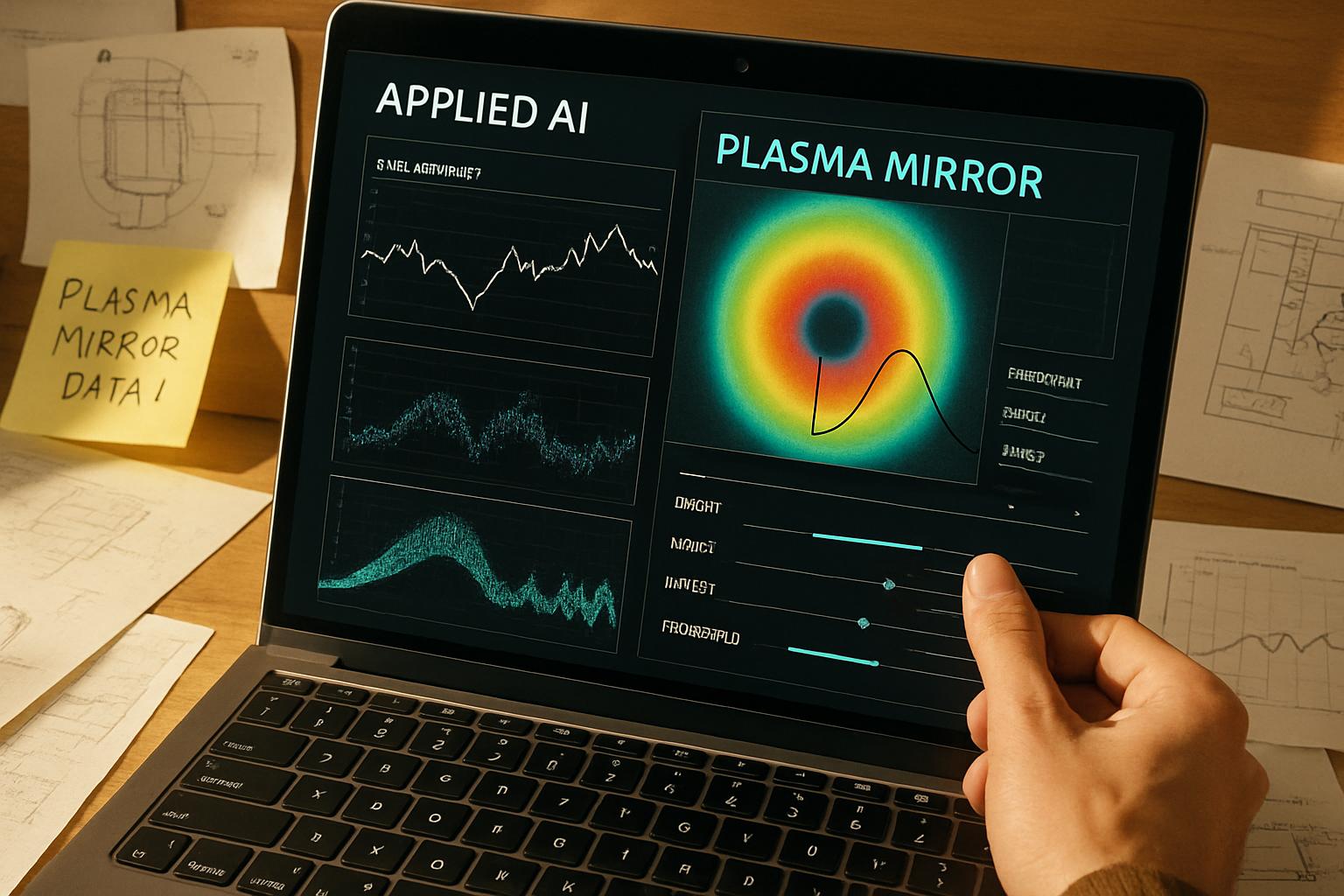
Fewer evaluations release valuable compute budgets for additional physics fidelity. Meanwhile, project managers gain faster iteration loops for risk mitigation. The next section details the algorithm that delivers this speed.
Deep Kernel Optimisation Technique
Bayesian optimisation builds a probabilistic surrogate of the expensive objective. Deep-kernel extensions feed neural features into the Gaussian process for richer representations. Therefore, uncertainty estimates remain trustworthy even in high-dimensional spaces. The study tuned seven design parameters, including plasma layer density and thickness. Moreover, acquisition functions balanced exploration and exploitation each iteration.
Each candidate design then ran through the EPOCH particle-in-cell code for ground-truth physics. Subsequently, the surrogate updated using observed reflectance and intensity metrics. This application exemplifies Applied AI at the intersection of simulation science and statistical learning. This learned kernel strategy underpins the dramatic sample efficiency. Next, we examine the quantitative performance achieved.
Key Performance Data Insights
The authors targeted total reflectance as the primary objective. Optimised designs consistently surpassed 99% reflectance. Some configurations returned 173% peak intensity because of temporal compression at the plasma boundary. Furthermore, the framework could constrain outcomes to 50% reflectance, creating beam-splitter behaviour.
Notable Numerical Results Summary
- >99% average reflectance after ≈20 iterations powered by Applied AI.
- 173% peak reflected intensity observed through pulse compression.
- Seven-parameter space explored with only 20-50 total simulations.
These statistics demonstrate orders-of-magnitude efficiency against brute-force grids. However, numbers alone cannot capture broader benefits.
Major Benefits And Applications
Faster optimisation unlocks agile discovery. Dino Jaroszynski calls the method an engine of discovery, citing the unexpected compression effect. Moreover, plasma mirrors can shrink from metre-scale glass to millimetre gas targets, reducing facility footprints. Consequently, laser labs, fusion start-ups, and attosecond light-source teams all benefit.
Safety and governance remain essential when automating physics discovery. Professionals can enhance their expertise with the AI Ethics Professional™ certification. Such credentials help teams deploy Applied AI responsibly inside high-energy laboratories. Meanwhile, commercial sectors envision compact plasma optics for industrial machining and medical isotope production.
Benefits span speed, size reduction, and new physical insights. Nevertheless, important limitations still need attention, as discussed next.
Current Study Limitations Noted
The published optimisation relies on one-dimensional particle-in-cell simulations. Three-dimensional effects, noise, and material imperfections remain untested. Furthermore, each simulation still consumes noticeable compute hours despite lower counts. Transferability from simulation to experiment therefore warrants caution.
The authors plan two-dimensional extensions before laboratory validation. Subsequently, real-time optimisation will need fast diagnostic feedback, not just simulation outputs. Plasma Physics experts outside the team request sensitivity studies to gas variability and pulse contrast.
These caveats underscore the gap between algorithmic promise and operational readiness. Consequently, the roadmap section outlines practical next steps.
Roadmap Toward Practical Deployment
First, researchers will port the optimisation loop to two-dimensional PIC codes. Parallel GPU back ends can cut wall-clock evaluation time further. Moreover, collaborative experiments at Strathclyde aim to fire terawatt pulses onto DKBO-designed plasma layers in 2026. Industry partners can contribute diagnostic hardware and funding. Such collaboration ensures Applied AI remains aligned with safety norms.
Execution of this roadmap will validate the optimisation approach under real experimental stress. Therefore, stakeholders should track upcoming conference presentations and preprints.
Rapid progress has transformed mirror design culture. Earlier multi-year cycles now compress into weeks thanks to Applied AI. Moreover, the same framework can guide other laser-plasma components, deepening links between data science and Plasma Physics. Nevertheless, experimental proof remains the decisive milestone.
In summary, deep-kernel Bayesian optimisation reduces iteration counts from millions to mere dozens. High reflectance, pulse compression, and flexible beam-splitting emerge with minimal compute expenditure. Limitations include one-dimensional simulations and pending lab validation. However, a clear roadmap and governance initiatives point toward deployment. Teams eager to harness these gains should pursue rigorous modelling, secure experimental access, and complete relevant certifications. Explore the linked program, master ethical considerations, and lead the next wave of Applied AI breakthroughs.


