

AI CERTS
4 months ago
AI Education Surge: Amaravati’s New University
At its core, the project aims to reshape AI Education across India. Officials promise 10,000 trained engineers, 500 accelerated startups, and a research ecosystem by 2028. Consequently, investors and academics are watching the February 19, 2026 launch date with heightened interest. Furthermore, rival institutions like BITS Pilani have announced parallel campuses, intensifying regional competition.
This article examines the vision, timelines, benefits, and unresolved questions surrounding the Amravati venture. Moreover, it explores how the model could influence national policy on digital skilling. Read on for an in-depth, evidence-based briefing designed for decision makers.
Vision For AI Amravati
Andhra Pradesh leaders frame the campus as a lighthouse for inclusive innovation. Nara Lokesh declared that the state will position itself as a national leader in artificial intelligence. Therefore, the chosen location in Amravati aligns with ongoing plans to build a greenfield administrative capital. Officials say the riverfront plot offers room for laboratories, dormitories, and high-density data centres. Moreover, early master plans show dedicated GPU clusters connected to statewide fibre networks. The ultimate objective remains straightforward: deliver world-class AI Education to students who previously lacked such access. These aspirations set an ambitious tone. In summary, the vision marries regional development with human capital creation. However, a vision needs structure, and that structure depends on the NVIDIA partnership.
Campus Concept Fully Explained
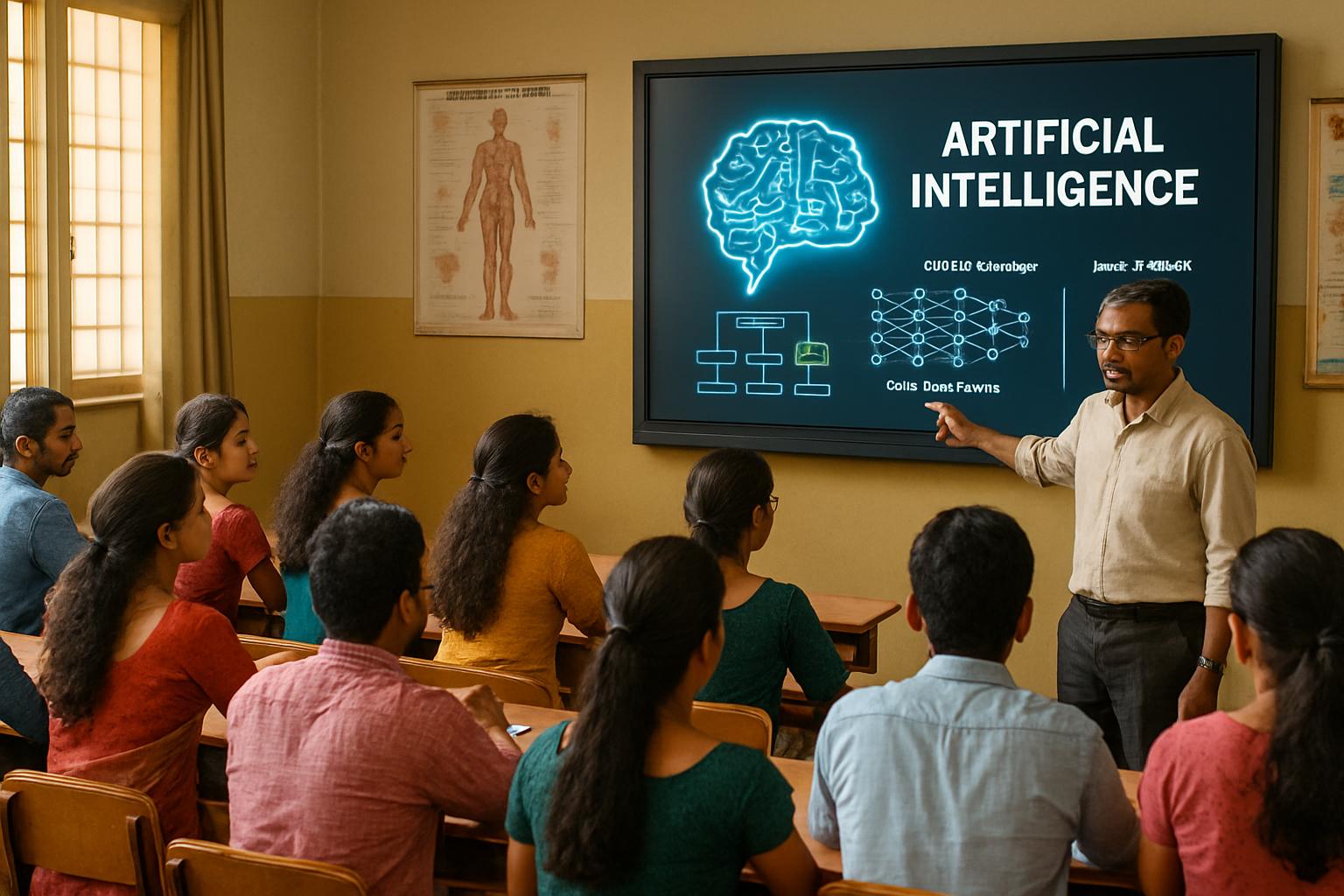
Project documents describe the institution as an AI Factory rather than a dedicated college. Consequently, academic programs will integrate research labs, startup incubation, and government problem statements under one roof. Curricula will span machine learning, data engineering, ethics, and domain-specific AI applications in agriculture and healthcare. Additionally, the model anticipates faculty drawn from global universities and industry research groups. The state still must clarify accreditation pathways and degree-granting authority.
Nevertheless, planners insist that students will receive recognised qualifications aligned with national frameworks. Professionals can enhance their expertise with the AI Educator™ certification, complementing classroom instruction. Such blended learning strengthens the pipeline for advanced AI Education research programs. Together, these design choices illustrate the concept’s breadth. Consequently, attention shifts to how NVIDIA will operationalise them.
NVIDIA Partnership Key Details
The June 6, 2025 memorandum outlines NVIDIA’s responsibilities across curriculum, infrastructure, and skilling. Vishal Dhupar called the collaboration evidence of a commitment to democratising access to AI Education. Specifically, NVIDIA will help train 10,000 engineering students within two years. Moreover, the company will facilitate up to 500 startups through its Inception programme. Hardware contributions include GPU clusters optimised for large-scale model training. Meanwhile, the state government pledges land allocation and operational funding. Consequently, both parties claim the arrangement shares risk and benefit.
Key MoU commitments:
- Train 10,000 engineering students across India by 2028.
- Enable 500 Andhra Pradesh startups to join NVIDIA Inception.
- Deploy high-performance GPU infrastructure on the Amravati campus.
- Co-develop curricula covering core and applied AI Education topics.
Furthermore, officials state that existing engineering colleges will feed students into the skilling program. Subsequently, graduates may enter the onsite AI Factory or partner companies. These promises elevate expectations, yet timelines demand scrutiny. Therefore, a closer look at milestones becomes necessary.
Skilling Targets And Timeline
The first cohort is scheduled to begin coursework in August 2026, six months after the ceremonial opening. Preparatory bridge modules will start earlier through online platforms. Additionally, faculty onboarding and infrastructure testing run from March through July 2026. Subsequently, a second intake will double capacity by mid-2027. Nevertheless, officials have not disclosed contingency plans for construction delays or power shortages. Those gaps warrant monitoring as the deadline approaches. In short, the timeline is aggressive. However, aggressive schedules can succeed when funding flows predictably.
Startup Acceleration Strategy Detailed
Beyond students, the MoU emphasises entrepreneurial growth. Consequently, an incubation wing will match research teams with venture capital and government grants. NVIDIA Inception members receive cloud credits, mentorship, and marketing exposure. Moreover, access to on-premise computing shortens prototype cycles for vision, language, and robotics solutions. AP officials believe 500 successful admissions could seed a self-sustaining cluster in Amravati. In contrast, critics warn that selection bias may favour established founders. Therefore, transparent criteria will influence public perception of the University initiative and reinforce AI Education goals. Transparent processes will also support long-term legitimacy. Next, we examine the macroeconomic case underpinning the investment.
Future Economic Impact Outlook
National think-tank NITI Aayog projects that accelerated AI adoption could add up to US$600 billion to GDP by 2035. Therefore, states race to build talent pipelines and research capacity. India aims to capture a significant slice of this value by nurturing specialised hubs. Moreover, Amaravati’s project dovetails with digital public goods such as Aadhaar and India Stack. Supporters argue that clustering University, startups, and agencies within one district multiplies spillovers.
Projected five-year outcomes:
- Direct employment for 3,000 researchers, faculty, and support staff.
- Indirect employment for 15,000 contractors and service providers in Amravati.
- Up to ₹8,000 crore in data-centre and real-estate investments.
- Boost regional AI Education enrolment by 25% within five years.
- Exportable AI solutions for agriculture, health, and public safety.
Consequently, policymakers present the campus as a catalyst for regional development. However, economic multipliers materialise only when graduates remain local and startups scale globally. Retention incentives and infrastructure reliability will determine those outcomes. Overall, the economic logic appears sound yet contingent. Attention now turns to governance and risk management.
Governance And Project Risks
Every transformative project carries uncertainties. Vendor dependence ranks high among analysts’ concerns. Heavy reliance on NVIDIA hardware could create long-term lock-in. Nevertheless, officials claim competitive procurement will continue for ancillary components. Additionally, energy demand for GPU clusters may strain regional grids during summer peaks. Therefore, the state plans new substation capacity and renewable offsets.
Academic independence represents another open question. The government has not disclosed which statutory body will award degrees. In contrast, BITS Pilani’s private campus already holds national accreditation. Consequently, observers urge clear governance charters and transparent hiring processes. Distributional equity also matters. Stakeholders must ensure women, rural applicants, and low-income groups gain fair access to AI Education. Without inclusion, the initiative risks reinforcing existing divides across India.
In brief, risk mitigation will define the project’s sustainability. Nevertheless, proactive governance could convert vulnerabilities into competitive advantages. That prospect offers a fitting close to our analysis.
Dedicated compliance teams will track ethical research and data security.
Conclusion And Next Steps
Amravati’s upcoming campus signals a decisive moment for AI Education in South Asia. Government ambition, NVIDIA technology, and private interest have converged around one bold experiment. Furthermore, training 10,000 students and supporting 500 startups could reshape India’s innovation landscape. However, success depends on timely construction, transparent governance, and equitable student selection.
Energy planning and vendor diversification must also remain priorities. Professionals worldwide should monitor outcomes and benchmark against their own AI Education strategies. Meanwhile, aspiring educators can upskill through the previously mentioned AI Educator™ certification. Stay informed, engage stakeholders, and help craft responsible, high-impact AI futures.
Disclaimer: Some content may be AI-generated or assisted and is provided ‘as is’ for informational purposes only, without warranties of accuracy or completeness, and does not imply endorsement or affiliation.


