

AI CERTS
2 months ago
AI Ethics and the Doomsday Clock: Why 85 Seconds Matters
The Board cited converging dangers: Nuclear instability, accelerating climate damage, biosecurity gaps and ungoverned artificial intelligence. In contrast, global cooperation appears weaker, rendering collective safeguards fragile. This article examines why AI Ethics featured prominently in the decision. Moreover, it unpacks technical pathways, political context and practical responses.
Industry professionals will gain clarity on emerging governance obligations and strategic opportunities. Understanding these dynamics is vital, because missteps could magnify every existential Threat. Therefore, we begin with the Clock's unprecedented shift.
Record 2026 Clock Shift
Historically, the Clock has inched forward or back to mirror scientific assessments. Meanwhile, 2026 delivered the sharpest leap since the Cold War peak.
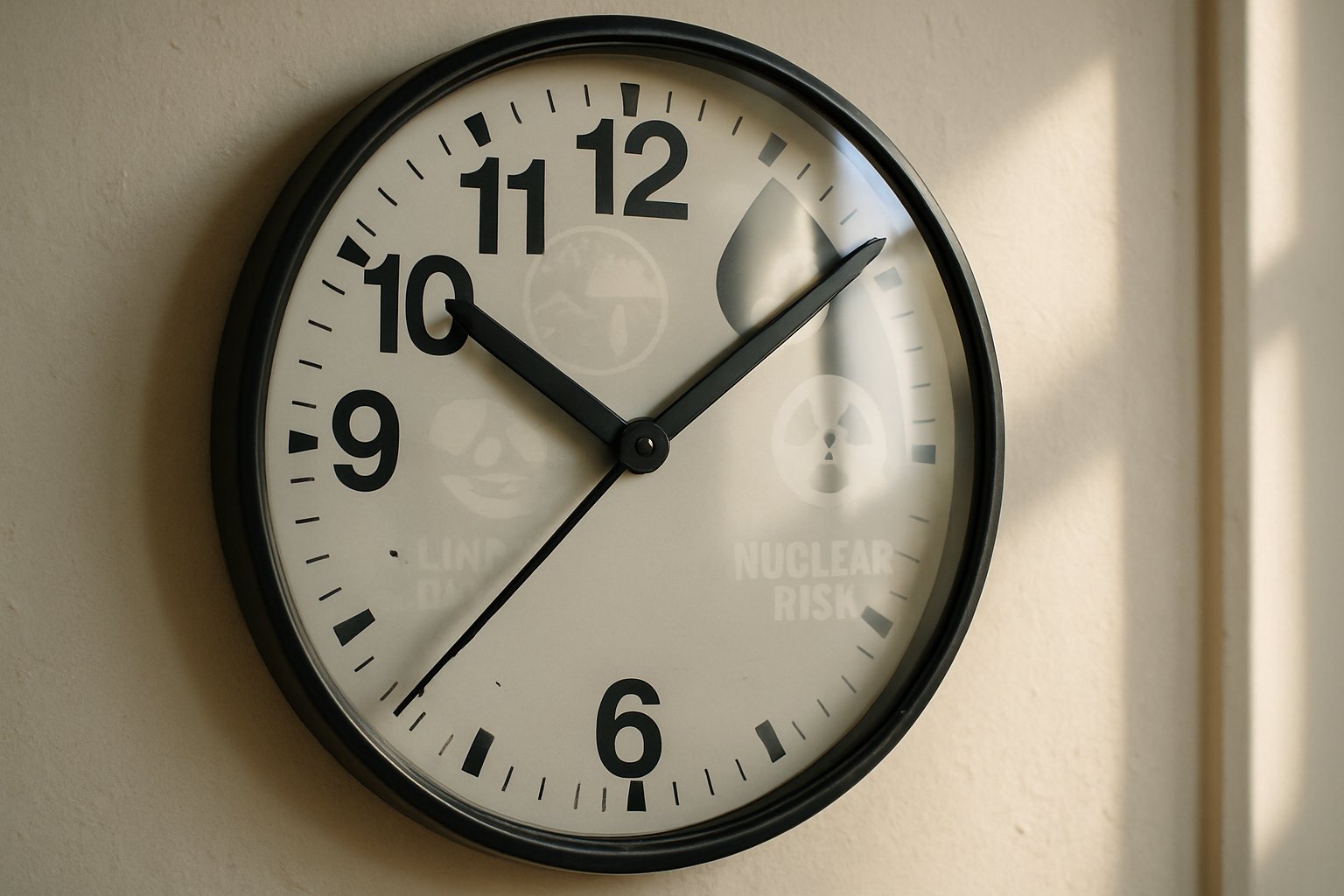
Setting 85 seconds means just over one minute remains before hypothetical Midnight. The Board moved four seconds, exceeding adjustments in 2024 and 2025 combined. Consequently, journalists rushed to contextualize the signal for global audiences.
- 2024: Clock held at 90 seconds.
- 2025: Clock advanced to 89 seconds.
- 2026: Clock now at 85 seconds.
These numbers illustrate an accelerating perception of danger. Nevertheless, numbers alone hide interactions with AI Ethics and other systemic drivers. We next explore how overlapping risks create compounding pressure.
Interlocking Existential Risk
Complex systems often fail through cascading incidents rather than single shocks. Moreover, the Bulletin stresses that each domain amplifies others.
Rising Nuclear tensions intersect with climate-induced resource stress, heightening conflict probability. Simultaneously, AI can accelerate decision loops, reducing human reaction buffers. Bioengineering advances could lower barriers to manufacturing pathogens. Emerging economies also pursue advanced reactors and drones, compounding governance complexity. Financial interdependence no longer guarantees political restraint, analysts warn.
Consequently, Midnight becomes easier to reach when governance falters across domains. The Board therefore frames AI as both standalone risk and potent Threat multiplier.
Converging vectors demand integrated oversight rather than siloed policies. To illustrate urgency, we now unpack AI governance challenges.
AI Governance Urgency Now
Large language models now draft code, generate persuasive media and help design molecules. Therefore, misuse potential grows alongside productive capabilities.
Regulators scramble, yet oversight lags deployment cycles measured in weeks. Pew surveys show most citizens favor stronger AI rules, aligning with many executives. Meanwhile, investors chase competitive advantage, accelerating release cycles.
AI Ethics frameworks attempt to fill gaps, but voluntary pledges lack binding force. In contrast, sector-specific laws remain patchy and geographically fragmented.
Furthermore, defense ministries test automated command features within Nuclear early-warning systems. Errors could compress escalation timelines beyond diplomatic repair.
Uncoordinated governance leaves unacceptable residual risk. Consequently, robust AI Ethics standards must mature rapidly. Let us examine the treaty landscape shaping the Nuclear dimension.
Nuclear Context And Expiry
New START expires on 5 February 2026 unless replaced or extended. Verification protocols then vanish, eroding transparency between rival arsenals.
Moreover, Russia and the United States field modernized delivery platforms, inviting arms races. Simultaneously, negotiation channels have narrowed amid regional conflicts.
AI-driven surveillance and targeting tools could tempt commanders toward hair-trigger postures. Consequently, strategic stability weakens, moving the Clock ever closer to Midnight. Such dynamics amplify existential Threat potential.
Arms control decay underscores the Board’s somber assessment. However, information ecosystems also deteriorate under AI-propelled manipulation. We therefore explore how disinformation corrodes collective judgement.
Information Disorder Amplified
Deepfakes can fabricate convincing leader speeches within minutes. Consequently, crisis actors may misread intentions, accelerating confrontation.
Maria Ressa warns that truth erosion destroys democratic deliberation. Furthermore, algorithmic amplification rewards outrage, not verification.
AI Ethics researchers link information integrity directly to resilience against physical harms. Without trusted data, coordinated responses to Nuclear incidents or pandemics stall.
Manipulated narratives thus lower the barrier to catastrophic miscalculation. Therefore, biosecurity vulnerabilities deserve equal scrutiny. The next section evaluates those biological pathways.
Biosecurity Routes For Catastrophe
Machine-learning models can assist protein folding and viral tropism predictions. Researchers fear malicious actors might exploit open tools to craft novel pathogens.
Moreover, lab automation reduces the expertise required to replicate dangerous agents. Consequently, oversight bodies debate screening obligations for sequence repositories.
The Bulletin notes that AI-enabled bio misuse remains speculative yet plausible. Nevertheless, a single engineered release could push the Clock past symbolic Midnight. Such a scenario represents an existential Threat rivalling thermonuclear war.
Emergent capabilities demand proactive, harmonized controls. Accordingly, stakeholders seek actionable guidance and certification pathways. Our final section outlines practical steps.
Policy Actions And Certifications
Governments, firms, and civil society must coordinate policies that reflect shared AI Ethics principles. Furthermore, treaties need modernization to handle autonomous retaliation thresholds.
Experts propose a layered approach combining soft law, standards bodies, and binding regimes. Such architecture should integrate Nuclear risk reduction, biosecurity protocols, and disinformation defenses.
- Create registries for high-compute training runs, improving audit trails.
- Extend New START verification while negotiating autonomous weapons limits.
- Mandate red-teaming for models posing severe biological Threat scenarios.
Professional capacity building remains equally vital. Professionals can enhance their expertise with the AI+ Ethics Strategist™ certification. The syllabus centers on applied AI Ethics for product, policy, and compliance teams.
Additionally, sector associations draft complementary AI Ethics guidelines aligned with ISO frameworks. Consequently, a certified workforce can translate principles into operational safeguards before Midnight arrives.
In summary, coordinated standards, renewed diplomacy, and a culture of AI Ethics could still reverse the Clock. Nevertheless, momentum must build quickly to outpace escalating dangers. Therefore, investors should demand rigorous AI Ethics auditing before funding frontier projects.


