

AI CERTS
5 months ago
AI Policy Shake-Up: Trump’s Rescission Sparks Industry Storm
The clash exposes the nation’s unresolved AI Policy trajectory. Moreover, the dispute will shape investment, compliance budgets, and global partnerships. This article dissects origins, motivations, risks, and likely outcomes. Additionally, it highlights strategies for enterprises navigating the new landscape. Throughout, AI Policy implications remain the guiding lens for analysis.
Origins Of The Rescission
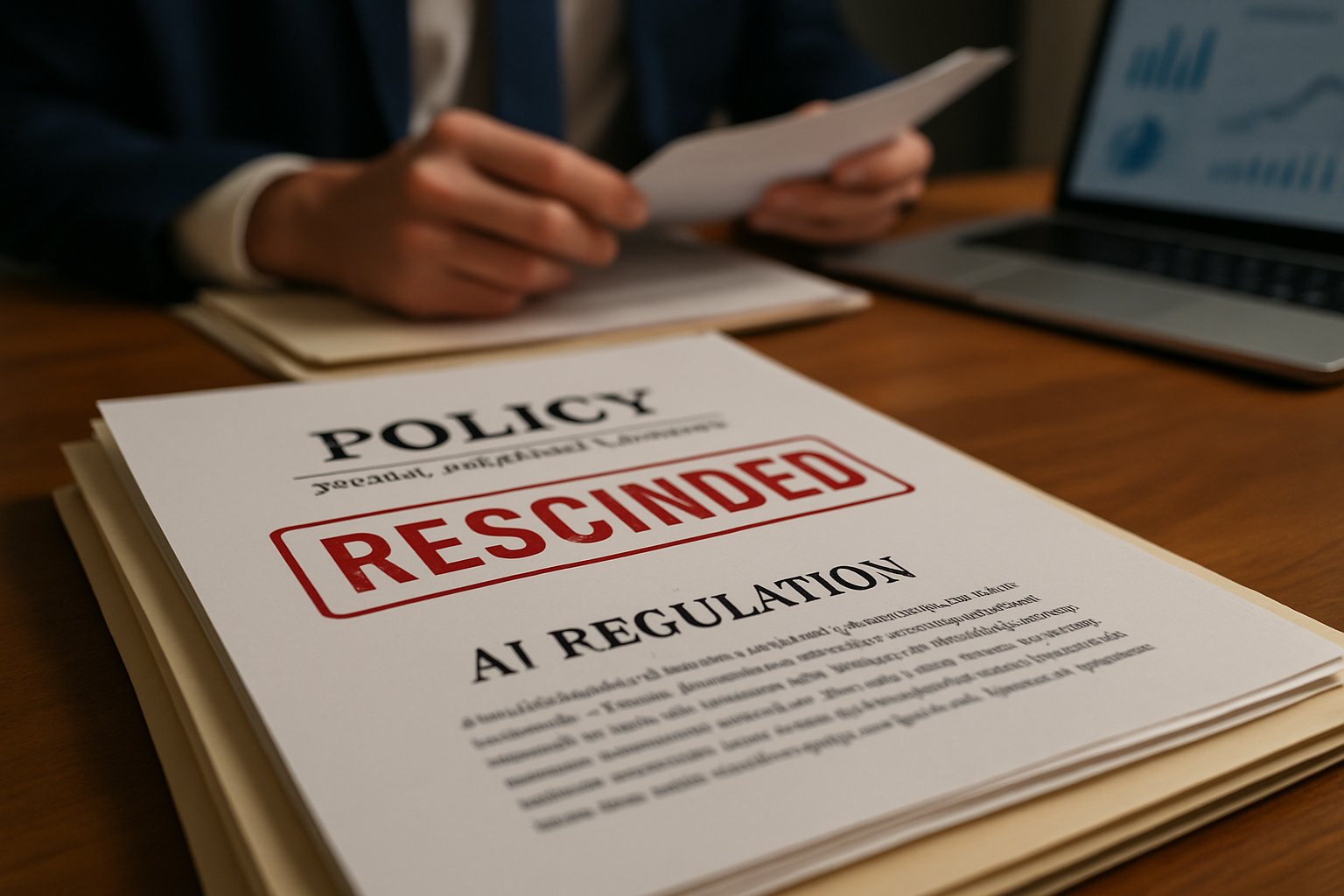
Trump signed EO 14148 on Inauguration Day, branding earlier orders as burdensome. The document listed around 70 Biden actions for immediate rollback. Furthermore, follow-on directives such as EO 14179 promised an innovation-first approach. Officials argued that slow permitting and safety paperwork hampered American competitiveness. In contrast, critics viewed the move as a swift Rescission lacking public consultation. Historical context matters because EO 14110, signed in 2023, had only begun implementation. Therefore, agencies were still building compliance systems when the reversal arrived. These facts illustrate rapid policy pendulum swings.
The White House acted with unusual speed. However, understanding EO 14110’s substance clarifies what now disappears.
What EO 14110 Did
Biden’s landmark order mandated risk assessments for high-impact models. Moreover, it required developers of frontier systems to notify Commerce before training. Testing provisions pushed NIST toward structured red-team exercises and watermarking standards. The plan also proposed a U.S. AI Safety Institute for continuous oversight. Consequently, many agencies budgeted staff and contracts around those duties.
- Foundation model reporting within 90 days
- Mandatory red-team results before deployment
- Annual public transparency summaries
- Cross-agency civil-rights coordination
Collectively, these guardrails formed the backbone of federal AI Policy safety architecture. Rescission supporters argued the architecture overlapped existing laws. Nevertheless, early agency data showed minimal compliance delays. These removed guardrails set the stage for stakeholder Backlash and future AI Policy debates. Next, the administration’s rationale deserves closer scrutiny.
Administration Rationale And Push
Press briefings framed the reversal as pro-growth deregulation. Officials said China’s rapid advances required streamlined approvals. Additionally, they highlighted new incentives for data-center construction. EO 14179 instructs agencies to expedite permits and relax DEI clauses. Trump allies argued investors needed certainty, not shifting safety targets. Moreover, the White House pledged quarterly progress dashboards. Industry giants like NVIDIA and Oracle publicly endorsed the shift. Consequently, share prices for infrastructure providers ticked upward after announcements.
Supporters claim a lighter AI Policy regime will draw capital and talent home. However, immediate Backlash from safety circles complicated the message. These diverging narratives fuel public confusion. Therefore, the safety community’s perspective warrants examination.
Safety Community Concerns Rise
Alondra Nelson warned the public now lacks essential protections. Researchers fear increased deepfakes, discriminatory automation, and safety-critical failures. Furthermore, civil-rights groups argue removing DEI references erodes accountability. They cite EEOC’s recent guidance Rescission as evidence. Meanwhile, NIST staff reportedly face layoffs that weaken technical capacity. Academics also predict fragmented standards as states fill the gap. In contrast, administration spokespeople downplay immediate risks. Nevertheless, insurance carriers are already reassessing liability models.
Critics contend robust AI Policy oversight prevents costly incidents. Consequently, the Backlash includes potential lawsuits under the Administrative Procedure Act. These warnings underscore legal friction. Next, we examine those challenges.
Legal And State Challenges
Federal agencies cannot erase promulgated rules without notice-and-comment procedures. Therefore, Trump lawyers must navigate the Administrative Procedure Act. Several state attorneys general have threatened suits to preserve EO 14110 safeguards. Moreover, many states already passed their own algorithmic accountability laws. The new orders attempt partial preemption through funding conditions. Legal scholars expect courts to test those provisions quickly. Consequently, regulatory fragmentation could increase compliance costs for multistate firms. Rescission critics argue the administration underestimated this dynamic.
Litigation timelines may delay full policy reversal for years. Nevertheless, agencies have paused several reporting portals, creating uncertainty. Robust AI Policy coherence remains uncertain. International partners are watching the turmoil.
Global Regulatory Divergence Risk
The European Union’s AI Act advances risk-based obligations opposite the U.S. shift. Consequently, exporters might face dual compliance hurdles. Moreover, allied democracies favour watermarking and audit mandates removed by the Rescission. Trade negotiators worry about cross-border data flows. In contrast, the White House believes divergence will entice research investment. International firms, however, must map separate requirements for each market. These pressures influence supply-chain decisions. Therefore, companies seek clear AI Policy alignment to reduce friction.
The global lens reinforces domestic urgency. Strategic options emerge, discussed next.
Strategic Paths Moving Forward
Enterprises should track forthcoming OMB memos and Federal Register notices. Additionally, firms can strengthen voluntary testing to offset lost federal guidance. Civil-society actors may issue independent standards mirroring EO 14110 principles. Professionals can enhance their expertise with the AI Policy Maker™ certification. Moreover, internal governance frameworks can embed those lessons regardless of national rules. Investors should model scenarios where litigation reinstates certain safeguards. Meanwhile, state regulators will continue passing new bills. Consequently, proactive alignment to diverse AI Policy schemes remains wise.
These strategies help organizations adapt quickly. Finally, a concise conclusion follows.
The Rescission of EO 14110 marks a pivotal shift in American technology governance. Trump prioritized speed and investment over federal guardrails. However, safety researchers, civil-rights advocates, and states mounted immediate Backlash. Legal battles and international divergence add complexity. Nevertheless, organizations retain tools to uphold responsible practices. Furthermore, pursuing strong internal AI Policy processes protects brand trust. Readers should monitor court filings, OMB guidance, and state legislation. Consider earning specialized credentials to stay informed. Explore the linked certification and deepen your competitive advantage today.
Disclaimer: Some content may be AI-generated or assisted and is provided ‘as is’ for informational purposes only, without warranties of accuracy or completeness, and does not imply endorsement or affiliation.


