

AI CERTs
6 months ago
Anthropic unleashes agentic plugins for enterprise Cowork
Legal teams, sales specialists, and analysts share a common wish: automate repetitive digital tasks without code. However, most enterprise users still juggle scattered scripts, dashboards, and assistants that rarely cooperate. Meanwhile, Anthropic has quietly pursued a different approach built on agentic, multi-step AI workflows. The company’s January releases extended that strategy to knowledge workers via the desktop Cowork Platform. Consequently, yesterday’s mundane spreadsheet cleanup can now become a delegated project managed by a safe sandboxed agent. This article unpacks how the new plugin system transforms Claude into a specialized collaborator across critical functions. Furthermore, it examines business impact, security trade-offs, and competitive context to guide IT leaders. These insights prepare decision makers for upcoming pilot programs and procurement discussions. Finally, certification resources appear for professionals seeking formal governance credentials. Let us explore the details behind this significant enterprise move.
Understanding Agentic AI Workflows
Agentic AI systems plan, execute, and verify multi-step tasks with minimal human intervention. In contrast, traditional chatbots only produce single responses to static prompts. Consequently, agentic models resemble junior analysts who manage files, trigger APIs, and report outcomes.
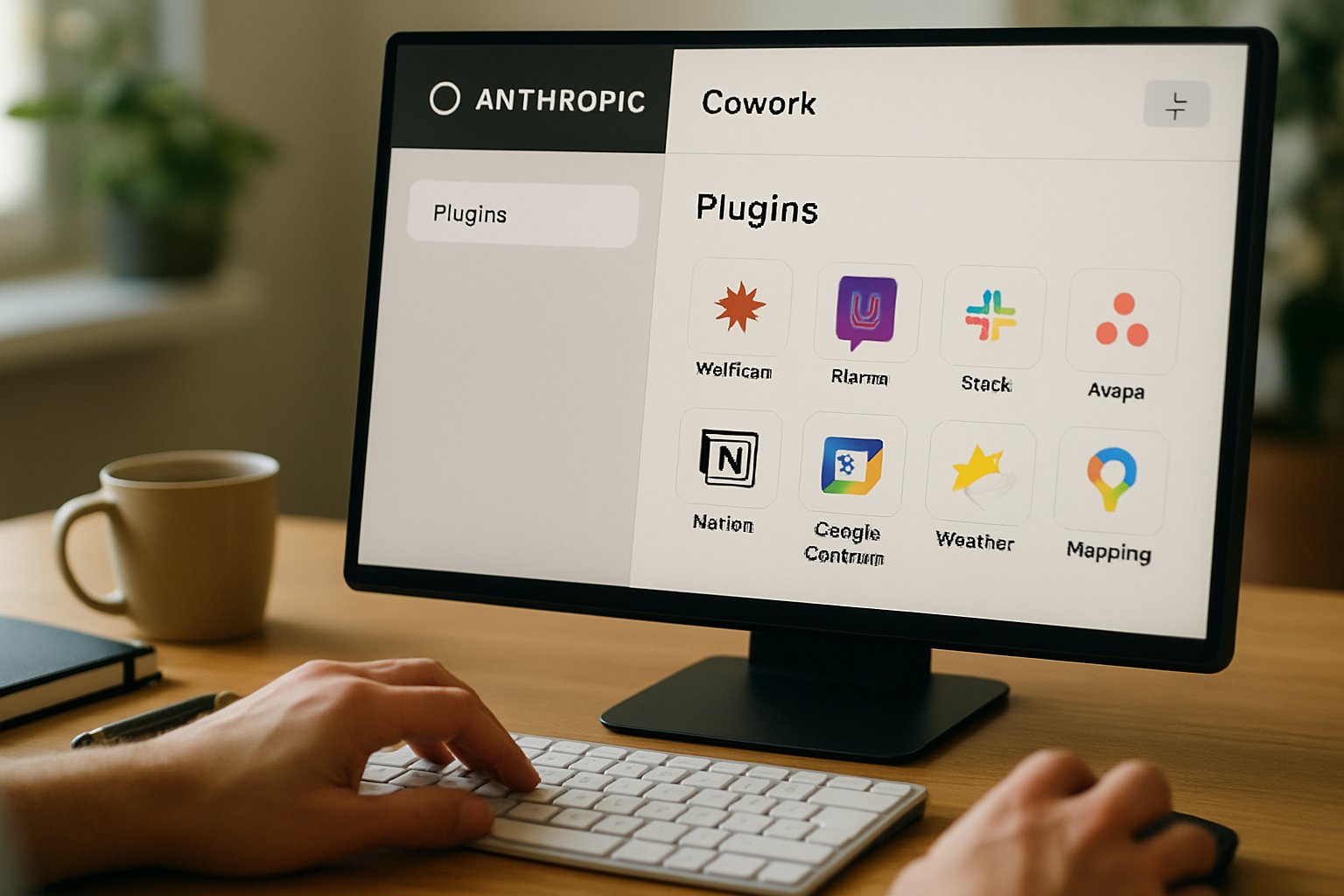
Anthropic embeds Claude inside a virtual machine that limits external damage yet allows controlled tool access. Moreover, users approve every high-risk action, maintaining oversight without manual execution. These mechanisms deliver reliable autonomy while satisfying cautious compliance teams.
Agentic workflows therefore promise consistent outputs, faster cycles, and documented decision paths. Yet architecture matters, so the next section dissects the new plugin format.
Open templates illustrate how domain expertise converts into repeatable agent logic within minutes. Moreover, community contributions could accelerate best-practice sharing across verticals.
Cowork Plugin Architecture Basics
The Cowork Platform delivers plugins as simple folders containing JSON manifests and skill scripts. Additionally, each plugin bundles MCP connectors that expose CRMs, ticketing systems, or internal databases. Slash commands provide human-friendly shortcuts that trigger entire multi-step sequences.
Core files live locally during the research preview, enabling quick edits with any text editor. However, Anthropic plans centralized management so administrators can enforce version control and audit policies. Meanwhile, the company published eleven open templates covering finance, marketing, and even biology research.
To simplify creation, a Plugin Create meta-plugin walks non-coders through manifest generation and testing. Consequently, line-of-business teams can encode best practices without waiting for engineering resources.
MCP’s open specification records each connector permission in plain text, simplifying security reviews and future migrations. Therefore, IT teams can diff two plugin versions to trace scope changes during audits.
These design choices lower the barrier to specialized automation. The following component breakdown offers deeper insight.
Core Plugin Components Overview
- Manifest file: declares plugin name, version, permissions, and required environment variables.
- Skills directory: stores role instructions, tone guidelines, and workflow rules.
- Connectors folder: bundles MCP adapters for SaaS tools, proprietary APIs, or on-prem data sources.
- Sub-agents: define background tasks like report consolidation or data enrichment.
Together, these elements deliver composable intelligence tailored to each department.
No Code Customization Wins
No command line emerges during typical setup because Cowork Platform exposes visual forms for every parameter. Moreover, live previews display Claude’s expected behavior before deployment, reducing trial-and-error cycles.
These advantages let small teams pilot automation in a single afternoon. Hence, value realization accelerates compared with traditional RPA initiatives.
With mechanics clarified, the article now shifts to strategic business benefits.
Enterprise Value Proposition Unveiled
For many executives, return on investment remains the central evaluation metric. Consequently, our analysis quantifies the most immediate gains.
- 20-30% productivity uplift: internal pilot teams reported shorter deal cycles and faster legal reviews.
- Consistent brand tone: marketing plugin enforces approved language across tweets, emails, and blog drafts.
- Reduced shadow IT: the workspace consolidates bespoke scripts under a governed plugin repository.
- Lower support costs: customer care plugin resolves repetitive tickets, escalating only edge cases.
- Faster onboarding: new hires load department plugins and follow built-in slash commands from day one.
Moreover, Anthropic disclosed that Claude Code surpassed a one-billion-dollar run rate within months. Leadership expects similar traction once plugins move beyond research preview.
The financial upside looks compelling, yet success depends on risk management. Accordingly, the next section examines security and governance challenges.
IDC analysts project agentic automation spending will exceed forty-five billion dollars by 2028. Consequently, early adopters might capture disproportionate efficiency dividends.
Security And Governance Hurdles
Early testers praised speed but also flagged prompt-injection and destructive file operations as looming threats. However, Anthropic built multiple guardrails, including sandbox isolation, explicit approvals, and activity logs.
During the preview, plugin files reside solely on the user’s device, complicating centralized compliance audits. Anthropic documentation advises users to write precise instructions to avoid unintended deletions. Nevertheless, roadmap notes promise org-wide management with RBAC and immutable logs.
Governance frameworks like SOC2 will still require documented review of every connector permission. Professionals can enhance compliance readiness with the AI Legal™ certification.
Security constraints therefore influence deployment timelines. Yet market competition accelerates, pressing leaders to evaluate options quickly.
Internal red-team exercises have already surfaced risky deletion loops that developers promptly patched. Nevertheless, ongoing penetration testing will prove essential before production rollouts in regulated sectors.
Competitive Enterprise AI Landscape
Microsoft, Google, and OpenAI all market copilots that embed agents within office suites. In contrast, Anthropic emphasizes file-based plugins and the open Model Context Protocol.
Furthermore, Cowork Platform operates locally, which appeals to privacy-sensitive industries. Conversely, cloud-first copilots may trigger additional data residency reviews.
Independent integrators also build MCP connectors, expanding the ecosystem beyond Anthropic employees. Subsequently, enterprises could negotiate multi-vendor toolchains while maintaining consistent agent behavior.
Meanwhile, open source projects like CrewAI experiment with similar plugin metaphors, though adoption remains modest. Regulated industries may prefer vendor neutrality, yet still demand provable audit trails.
Competitive dynamics will sharpen as governance features mature. Next, we summarize crucial points and outline practical steps.
Key Takeaways And Next
Anthropic’s plugin launch signals rapid evolution from chat assistant to enterprise coworker. Cowork Platform lowers technical barriers and speeds custom automation through no-code tooling. Consequently, operational champions should document measurable outcomes during every prototype sprint.
Benefits include productivity gains, standardized outputs, and reduced shadow IT. However, unresolved governance gaps demand careful pilot scoping and layered controls.
Therefore, stakeholders should monitor Anthropic’s roadmap for centralized management and expanded auditing. Meanwhile, teams may prototype low-risk workflows to build internal expertise.
Consequently, professionals seeking deeper governance knowledge should pursue the AI Legal™ certification. Start experimenting today and prepare your organization for the next wave of agentic automation. Continual learning and cross-functional dialogue will anchor sustainable adoption.
Disclaimer: Some content may be AI-generated or assisted and is provided ‘as is’ for informational purposes only, without warranties of accuracy or completeness, and does not imply endorsement or affiliation.


