

AI CERTs
2 months ago
Cisco Launches AI Security Suite to Shield Autonomous Systems
Autonomous agents promise faster business outcomes, yet they introduce unprecedented attack surfaces.
Boards therefore demand concrete safeguards before scaling agentic workloads across production networks.
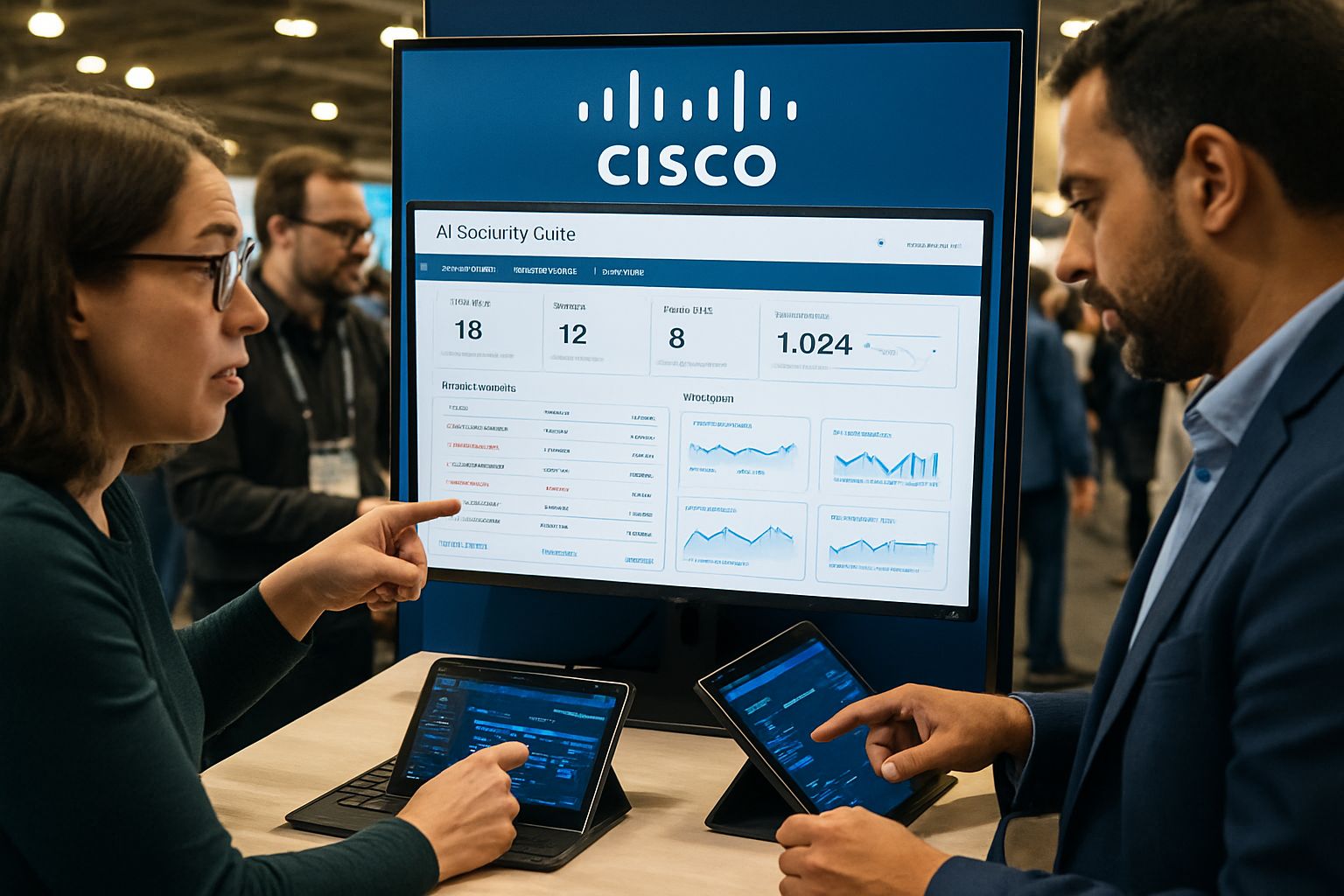
Against this backdrop, Cisco unveiled an ambitious security suite during the first half of 2025.
The portfolio targets discovery, validation, and containment of rogue models running in multi-cloud environments.
Moreover, it embeds controls directly inside switching, firewall, and observability layers.
Industry observers call the move timely because agentic breaches appear increasingly likely.
This report dissects the announcements, market context, expert opinions, and practical adoption steps.
Readers will also see balanced critique and guidance for next-generation Cyber Defense programs.
Finally, relevant certifications are highlighted for leaders seeking focused upskilling.
Consequently, the article equips security architects with actionable intelligence for 2025 planning.
Prepare to explore strategy, technology, and governance through a concise yet comprehensive lens.
Meanwhile, survey data shows only twenty-nine percent of organizations feel ready to stop model tampering.
Therefore, pressure mounts on vendors to deliver measurable protection without stalling innovation.
Cisco positions its new stack as the missing bridge between creativity and control.
Evolving AI Risk Landscape
Agentic AI chains execute sequences, call APIs, and pull data without constant supervision.
Consequently, attackers gain multiple pivot points, from malicious prompts to stolen service tokens.
OWASP guidance warns that prompt injection, tool poisoning, and unauthorized actions top the threat list.
In contrast, traditional monitoring seldom tracks machine identities or autonomous decision trees.
Survey results amplify alarm.
Cisco AI Readiness Index shows only twenty-nine percent detect or prevent model tampering today.
Furthermore, ninety-seven percent plan network upgrades to support AI and IoT programs.
Analyst firms predict the AI cybersecurity market may top sixty billion dollars by 2028.
These signals underline urgent gaps.
However, they also reveal commercial momentum for differentiated Cyber Defense offerings.
Security teams need visibility, validation, and enforcement delivered at network speed.
The next section examines how Cisco proposes exactly that.
Autonomous risks multiply faster than traditional controls can react.
Consequently, network-embedded solutions rise in priority, setting the stage for Cisco's strategy.
Cisco's Network First Strategy
Historically, firewalls guarded perimeter edges while applications carried their own access logic.
However, agentic architectures dissolve perimeters and inject logic across clouds, devices, and branches.
Cisco argues the only constant is the network fabric sitting between every workload.
Therefore, embedding inspection, segmentation, and policy orchestration within that fabric delivers deterministic control.
Hybrid Mesh Firewall embodies this principle by distributing firewalls close to east-west traffic paths.
Moreover, a centralized mesh engine synchronizes rules across data centers, edges, and public clouds.
Universal ZTNA extends least-privilege access to human and machine identities, including autonomous agents.
Subsequently, policy violations trigger automated containment through integrated Talos threat intelligence.
Finally, Splunk enrichment brings incident context into a single investigation console.
Analyst John Grady believes this union shortens detection cycles and bridges networking and SOC teams.
Nevertheless, he cautions that visibility alone will not guarantee policy efficacy.
Metrics and independent testing remain essential, a topic revisited later.
Network-centric design promises consistent control across heterogeneous platforms.
Next, we inspect specific products delivering these controls.
Key New Portfolio Highlights
This timeline below summarizes flagship launches and planned availability.
- AI Defense: discovers AI use, validates models, and enforces guardrails.
- Release slated March 2025.
- Hybrid Mesh Firewall: distributed inspection, segmentation, and centralized policy engine for multi-cloud fleets.
- Universal ZTNA: identity driven access for users, devices, and autonomous agents across networks.
- Model Context Protocol support: secures tool integration paths, providing authentication and audit trails.
Additionally, AgenticOps integrates with Splunk and ServiceNow to automate incident workflows.
Jeetu Patel describes the suite as "safety built into the network, not bolted on".
Moreover, MCP backing demonstrates alignment with open standards, easing vendor interoperability.
Analysts link these moves to the recent twenty-eight billion-dollar Splunk acquisition.
Therefore, observability data now fuels both detection logic and policy recommendations.
Cisco expects the integration to sharpen response accuracy while reducing manual triage.
Together, these pillars compose an end-to-end prevention, detection, and response workflow.
Industry viewpoints on strengths and gaps follow next.
Industry Perspectives And Concerns
Independent researchers welcome stronger guardrails yet raise caution about emerging blind spots.
OWASP notes that even with network enforcement, prompt injection remains difficult to catch.
Snyk engineer Rudy Lai warns that shadow agents may call external tools beyond firewall reach.
In contrast, Cisco claims model validation blocks most malicious content before execution.
Gartner predicts an agentic-powered breach will hit a major enterprise by 2026.
Therefore, boards demand metrics, not marketing, when evaluating Cyber Defense investments.
Grady suggests third-party penetration tests and red-team exercises as due diligence.
Meanwhile, vendor lock-in remains a recurring concern for multi-cloud adopters.
Stakeholders appreciate progress yet request proof through transparent benchmarks.
Consequently, competitive comparisons become crucial, examined in the next section.
Comparative AI Market Positioning
Palo Alto Networks touts Prisma AI-Assure, focusing on cloud workload posture.
Microsoft embeds protections within Azure OpenAI, leveraging tenant isolation and content filters.
CrowdStrike emphasizes runtime model monitoring combined with its Falcon platform telemetry.
In contrast, Cisco integrates enforcement directly inside switches, routers, and firewalls.
Market momentum favors approaches offering unified networking and security operations.
Moreover, Splunk synergy gives Cisco telemetry advantages competitors must replicate or partner for.
However, analysts warn that customers lacking substantial Cisco hardware may experience integration overhead.
Architectural alignment with existing infrastructure will influence vendor choice.
Subsequently, enterprises should map requirements before committing budgets.
Practical Enterprise Adoption Roadmap
Security leaders often struggle to move from pilot trials to full production.
Therefore, starting with discovery scans helps quantify current AI exposure.
Subsequently, policy teams can draft governance baselines leveraging Universal ZTNA identity attributes.
Next, enforce segmentation through Hybrid Mesh Firewall templates, enabling gradual rollout.
Meanwhile, integrate Splunk detection feeds to validate policy impact with real alerts.
Periodic red-team exercises confirm model validation effectiveness and surface tuning opportunities.
Professionals can deepen expertise through the AI Project Manager™ certification.
Moreover, structured training streamlines stakeholder alignment during cross-functional Cyber Defense projects.
An incremental roadmap mitigates disruption while building confidence.
Consequently, organizations progress steadily toward secure, autonomous operations.
Outlook And Next Steps
Demand for trustworthy agentic systems will accelerate through 2026 and beyond.
Analysts expect budgets to follow, rewarding vendors that prove effectiveness.
Cisco plans continuous updates, including additional MCP controls and hardware acceleration features.
Nevertheless, independent validation will define ultimate credibility.
Therefore, early adopters should demand transparent metrics and maintain layered Cyber Defense strategies.
The coming quarters will reveal whether network-embedded AI protection becomes the dominant paradigm.
Meanwhile, standards bodies intensify collaboration to mature threat models and mitigation patterns.
Organizations that participate will shape requirements and influence vendor roadmaps.
Consequently, proactive engagement delivers strategic insight alongside improved security outcomes.
Explore product demos, pursue targeted training, and evaluate architecture fit without delay.
Your next move could determine the resilience of tomorrow's autonomous enterprise.


