

AI CERTs
2 months ago
New AI Benchmarks Reveal Expert-Level Gaps
Professional investors and attorneys pursue precision. However, recent AI Benchmarks suggest current models still fall short. The new Professional Reasoning Bench, or PRBench, tests high-stakes finance and law tasks. Researchers published the open-source dataset on arXiv on 14 November 2025. Consequently, the release sparked intense discussion across evaluation forums. Top large language models scored below 40 percent on the hardest task subsets. These subsets represent realistic, open-ended prompts authored by 182 seasoned professionals. Moreover, tasks span 114 countries and 47 United States jurisdictions. The headline numbers worried many enterprise leaders evaluating generative tools. Meanwhile, some vendors argued rubric scoring captures new dimensions of capability. This article unpacks the study, highlights Model Performance trends, and explores next steps. Readers will gain practical insights for procurement, governance, and skills development.
Why PRBench Benchmark Matters
Traditional AI Benchmarks often rely on multiple-choice questions. Consequently, they measure factual recall instead of professional reasoning workflows. PRBench challenges that paradigm through granular rubrics. Each task includes numerous criteria assessing judgment, disclosure, and process transparency. Furthermore, practitioners designed prompts reflecting billable client scenarios. Rubric scoring therefore awards partial credit for sound approaches even when conclusions differ. In contrast, many earlier tests ignore procedural completeness. Such oversight hides weaknesses that appear during complex legal drafting or valuation. By focusing on open-ended tasks, PRBench aligns evaluation with real economic risk. Enterprises seeking dependable automation should understand this shift in assessment philosophy.
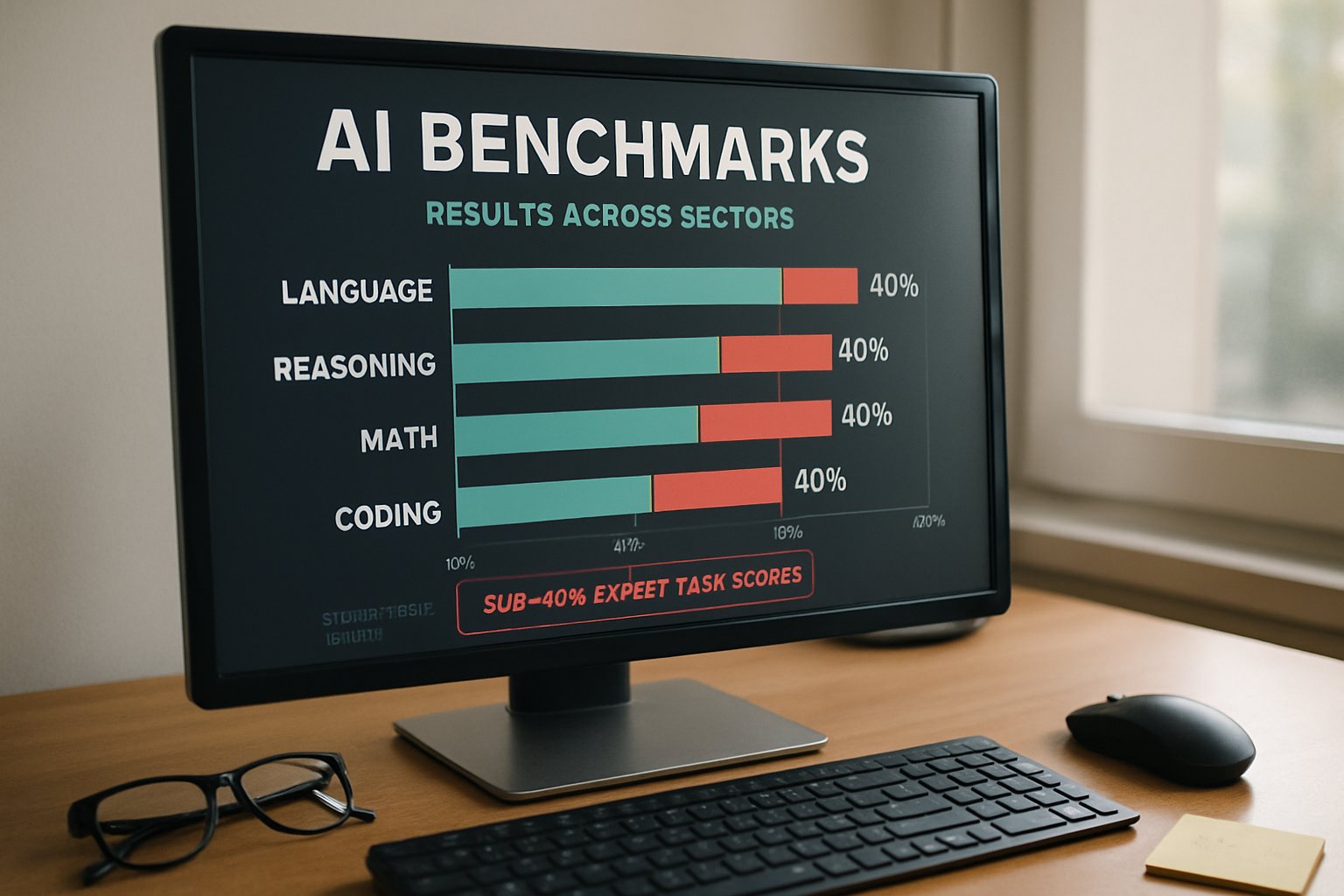
PRBench reframes success around professional process, not trivia. Consequently, rubric versus choice design deserves closer comparison next.
Rubric Versus Choice Tests
Multiple-choice datasets like MMLU remain popular because scoring is simple. Nevertheless, they fail to test multistep reasoning under uncertainty. PRBench uses 19,356 rubric checkpoints to track intermediate thinking. Moreover, evaluators can assign partial credit for justified assumptions. This mirrors how senior associates review junior drafts. Choice tests provide binary correctness, masking flawed rationales that accidentally reach right answers. Meanwhile, rubric feedback exposes missing citations or procedural missteps. Researchers argue this richness reveals true Model Performance variability. Top models gained points for structure yet lost for jurisdiction compliance. These contrasts illustrate why enterprises should consult diverse AI Benchmarks before deployment.
Both formats offer insight, but rubric depth surfaces operational risks. The next section quantifies those risks using headline figures.
Key Findings And Numbers
The PRBench paper evaluates 20 leading language models across finance and legal domains. Notably, Hard subset scores peaked at 0.39 in finance and 0.37 in law. Consequently, even frontier systems achieved below 40 percent aggregate rubric success. The research team shared additional dataset scale metrics, summarized below.
- 1,100 practitioner-authored tasks covering contracts, valuations, and compliance.
- 19,356 rubric criteria capturing process, disclosure, and risk analysis.
- 182 experts holding JDs, CFAs, or six-plus years domain experience.
- Coverage of 114 countries and 47 U.S. jurisdictions.
- Evaluation of 20 state-of-the-art models against AI Benchmarks hard subsets.
These numbers underscore rigorous scope and geographic diversity. However, the modest scores across these AI Benchmarks raise pressing questions about real-world readiness. We now examine where models stumbled most severely.
Revealed Professional Failure Modes
Researchers annotated common error categories across thousands of responses. Inaccurate quantitative judgment appeared frequently within valuation prompts. Additionally, models skipped crucial procedural disclaimers required by professional standards. Jurisdiction-specific law citations were often outdated or missing. Meanwhile, chain-of-thought reasoning sometimes contradicted final recommendations. These gaps lowered Model Performance despite fluent language generation. Furthermore, divergent strengths emerged among systems with similar overall scores. One model excelled at structure yet failed risk disclosure checkpoints. Another satisfied disclosure rubrics but omitted numerical cross-checks. Therefore, aggregate percentages mask heterogeneous capability profiles across AI Benchmarks.
Failure modes cluster around transparency, jurisdiction knowledge, and numeric rigor. The enterprise impact of such lapses merits deeper exploration next.
Implications For Enterprise Adoption
Finance and legal teams face regulatory accountability. Consequently, deploying unreliable automation risks fines, litigation, and reputational damage. Decision makers should require evaluation across multiple AI Benchmarks before production rollouts. Moreover, internal pilots must track system accuracy along domain-specific rubrics. Procurement leaders may demand transparency into training data provenance and tool usage. Governance frameworks should define human oversight thresholds based on task criticality. Meanwhile, professional development remains essential. Professionals can bolster expertise via the AI Healthcare Specialist™ certification program. Such credentials help staff audit automated outputs effectively. Consequently, enterprises can bridge talent and technology responsibly.
Robust governance, layered testing, and skilled oversight reduce operational risk. Yet improving core capabilities remains the ultimate solution.
Improving Future Benchmark Scores
Researchers outlined strategies to lift future scores. First, tool augmentation can supply retrieval, calculators, and citation checkers. Consequently, numeric mistakes and outdated references decline. Second, domain-specific fine-tuning on practitioner workflows enhances contextual understanding. Moreover, chain-of-thought distillation may encourage explicit process exposition. Open-source communities already build evaluation harnesses around diverse AI Benchmarks. Collaboration between vendors and regulators will standardize trustworthy reporting of Model Performance. Researchers also warn about overfitting static datasets. Therefore, rotating task pools and blind peer review remain vital. Finally, broader multilingual coverage will mirror growing global demand.
Technical, procedural, and oversight improvements must progress together. The concluding section synthesizes lessons from these AI Benchmarks and outlines next actions.
Conclusion And Forward Outlook
PRBench delivers a sobering snapshot of present capabilities. Despite rapid progress, frontier models scored under 40 percent on hardest tasks. Consequently, high-stakes domains still require expert supervision and rigorous governance. Multiple complementary AI Benchmarks should guide procurement and policy. Moreover, organizations must track Model Performance against transparent rubrics. Continued research, tool integration, and targeted fine-tuning promise measurable gains. Professionals should upskill through certifications and remain critical reviewers of automated advice. Take action today: evaluate your workflows, explore PRBench, and invest in responsible AI readiness.


