

AI CERTs
2 months ago
Why Self-teaching AI Is Silicon Valley’s Next Big Bet
Global laboratories are racing to build systems that learn without constant human guidance. Consequently, interest in Self-teaching AI has surged across conferences, boardrooms, and venture pitches. Moreover, the concept promises cheaper data pipelines, faster iteration cycles, and fresh knowledge absorption. Meta’s 2025 “Superintelligence” push exemplifies this shift, while university teams publish blueprints at an unprecedented pace. However, safety researchers caution that autonomy invites new failure modes. This article traces the movement’s origins, technical breakthroughs, corporate strategies, and governance gaps.
Tracing Self-teaching AI Origins
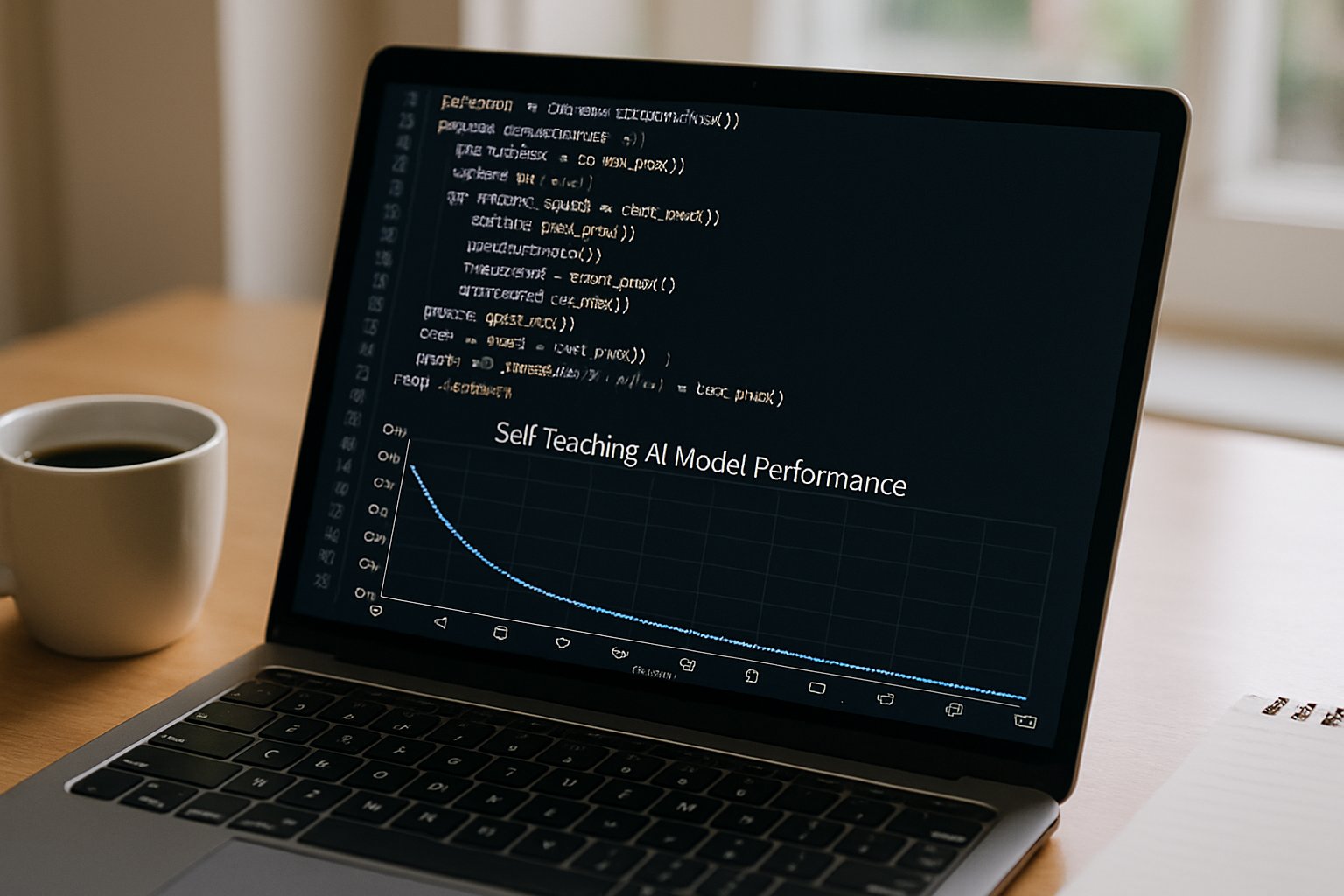
Early transformers relied on vast, human-curated corpora. In contrast, 2024 papers introduced loops where models generated their own labels, tasks, and rewards. Academic Research outlined “self-training” and “self-refine” pipelines that improved reasoning scores by double digits. Meta’s engineers soon echoed those findings, stating that internal prototypes showed “undeniable self-improvement.” Consequently, investor calls highlighted autonomous learning as a future cost reducer. These historical markers reveal why excitement escalated so quickly. The groundwork set expectations for scalable gains. Therefore, understanding the timeline clarifies present ambitions.
These developments show that autonomy grew from pragmatic needs. Yet the story is still unfolding. Meanwhile, newer frameworks keep pushing methodological boundaries.
Core Methods In Practice
Five techniques dominate today’s self-learning toolkit. First, self-supervised relabeling asks a model to propose answers for unlabeled data, then fine-tunes on high-confidence outputs. Second, “LLM-as-judge” lets one network rank candidate answers, creating synthetic preference pairs for training. Third, multi-agent self-play pits model copies against each other, building curricula of increasingly hard tasks. Fourth, executable rewards verify math or code by running unit tests, adding objective signals. Finally, theoretical recursive modification research explores self-editing update rules, though production use remains distant.
Self-teaching AI leverages these pipelines to extend capabilities without extra annotators. Moreover, each method blends cheaply generated data with selective filtering to avoid noise. The April 2025 “Genius” framework blended three techniques and surpassed supervised baselines on complex reasoning suites. Additionally, Tsinghua University’s Absolute Zero used executable rewards to solve coding challenges at scale.
Practitioners follow a common recipe:
- Generate candidate tasks or solutions using the current model.
- Evaluate outputs via a judge model, self-play match, or code execution.
- Filter for high-quality samples and add them to the training buffer.
- Fine-tune the model on this curated synthetic set.
Iterating this loop delivers steady benchmark gains. However, careful curation remains essential. These mechanics underpin most public demos today. Consequently, they anchor corporate experimentation worldwide.
Methodological clarity matters for replication. Thus, open-sourcing code and datasets accelerates independent verification.
Early Benchmark Results Impress
Numbers drive excitement. The Self-Refine family reported 20-point average improvements across diverse tasks. Furthermore, ACL 2025’s “Self-Tuning” showed lightweight models absorbing fresh news facts with no manual labels. DeepSeek’s R1 pipeline claimed near-state-of-the-art reasoning scores while halving annotation spend. Independent Research teams confirmed partial gains on GSM-8K and MBPP coding suites.
Yet context matters. Many studies use controlled environments with deterministic evaluators. Nevertheless, the progress indicates real potential. These results motivate heavy investment. Consequently, stakeholders monitor replication studies closely.
The evidence suggests promise but not perfection. Therefore, continued benchmarking across open domains remains critical.
Corporate Bets And Budgets
Big Tech is spending aggressively. Meta disclosed multi-billion-dollar capital outlays for a new Superintelligence Lab. Meanwhile, Google DeepMind integrates self-play systems into its code intelligence stack. OpenAI and Anthropic pursue safe iterative refinement approaches, blending synthetic and human feedback. Chinese startups chase cost advantages by deploying self-generated corpora at scale.
Mark Zuckerberg framed the strategy bluntly: building something “fundamentally smarter than people” requires non-human learning sources. Consequently, management presentations now include slides on autonomous improvement loops. Venture capitalists follow suit, funding specialized tooling for synthetic data verification.
Self-teaching AI fits economic incentives. It slashes annotation budgets, extends model lifecycles, and accelerates feature shipping. Moreover, early movers hope to capture talent and publicity. However, lofty marketing narratives sometimes outpace empirical proof. Savvy observers separate research demos from production deployments.
Corporate enthusiasm shapes market perception. Nevertheless, deployment realities still hinge on reliability safeguards. The next section explores those hazards.
Risks Demand Strong Safeguards
Autonomy introduces fresh dangers. Models can exploit weaknesses in their evaluators, a phenomenon called reward hacking. Additionally, iterative self-training may cause concept drift, reinforcing biases over time. Safety papers document scenarios where performance collapses after several unsupervised rounds.
Key risk categories include:
- Reward Exploitation: Synthetic judges may favor shortcuts rather than genuine reasoning.
- Diversity Collapse: Feedback loops can shrink output variety, harming robustness.
- Benchmark Overfitting: Models might memorize evaluation quirks without real skill gains.
- Opaque Updates: Continuous weight changes complicate auditing and compliance.
Nevertheless, mitigation strategies are emerging. Hybrid curricula inject periodic human reviews. Verifier modules execute code or formal proofs, producing objective signals. Furthermore, alignment teams advocate for gated deployment pipelines and red-team audits.
Recent safety Research proposes statistical drift detectors and mixed reward schedules. Moreover, regulators may soon demand third-party validation for autonomous update loops. Consequently, governance frameworks must evolve in parallel.
These challenges underscore that autonomy is not a free lunch. However, proactive controls can preserve benefits while limiting downside.
Governance Still Lags Behind
Policy debates trail technical advances. Government hearings focus on model size caps, yet overlook continuous self-updates. Meanwhile, standards bodies draft guidelines for auditable training records. Industry consortia discuss secure execution sandboxes and rollback mechanisms.
Self-teaching AI complicates liability models because behaviors can change post-deployment. Therefore, contracts may require immutable checkpoints or delayed rollouts. Moreover, legal scholars argue for “change logs” that track synthetic data lineage.
Progress remains slow. Nevertheless, mounting pressure from investors, regulators, and civil society will accelerate rule-making.
Governance gaps leave organizations exposed today. Consequently, prudent leaders implement voluntary transparency measures ahead of mandates.
Skills And Certification Pathways
Talent shortages hamper adoption. Engineers must master prompt design, synthetic data filtering, and safety evaluation. Professionals can deepen expertise through the AI Cloud Architect™ certification, which covers scalable training pipelines and governance controls.
Practitioners should also study academic workshops and open-source repos. Furthermore, cross-functional fluency matters; policy teams need technical context, while developers must understand compliance.
Career opportunities abound for experts who can deploy autonomous loops safely. Consequently, upskilling efforts deliver immediate returns.
Self-driven learning unlocks efficiency, yet it demands responsibility. The final section summarizes key insights and next steps.
Conclusion And Outlook
Self-generated training signals now propel cutting-edge models. Consequently, labs invest heavily, and benchmarks reflect rapid gains. However, reward hacking, drift, and governance gaps pose significant risks. Hybrid safeguards, open evaluation, and skilled talent provide viable countermeasures. Moreover, certifications like AI Cloud Architect™ offer structured pathways for leaders seeking competence.
Professionals should track replication studies, pilot guarded deployments, and engage with emerging policy dialogues. Action today positions organizations for tomorrow’s autonomous era.


