

AI CERTs
2 months ago
AI Retinal Screening Reshapes Healthcare
A quick photo of the retina may soon rival a blood test for diabetes detection. An Indian proof-of-concept study released on 23 January 2026 reports 95% sensitivity using AI. Consequently, global Healthcare leaders are examining whether eye-based screening could close the 43% undiagnosed gap. Moreover, similar systems like Qatar's DiaNet v2 already show high accuracy across larger cohorts. This article unpacks the evidence, benefits, and hurdles facing retinal AI in routine Healthcare practice. Additionally, it outlines next steps for clinicians, policymakers, and AI vendors. Meanwhile, experts caution that small datasets, image quality, and regulatory pathways could temper early enthusiasm. Nevertheless, the technology’s non-invasive nature may transform mass Diagnostics across low-resource settings. Subsequently, readers will discover performance metrics, expert quotes, and implementation insights. Consequently, decision makers can assess whether the promise outweighs the practical barriers.
AI Detects Diabetes Early
Retinal imaging captures blood vessels, optic disc, and macula without needles or dilation. Therefore, engineers label it a high-value biosensor hiding in plain sight. The DART study leveraged 226 vein tortuosity features extracted from 273 fundus images. Consequently, its linear discriminant model achieved 95% sensitivity and 72% specificity for diabetes.
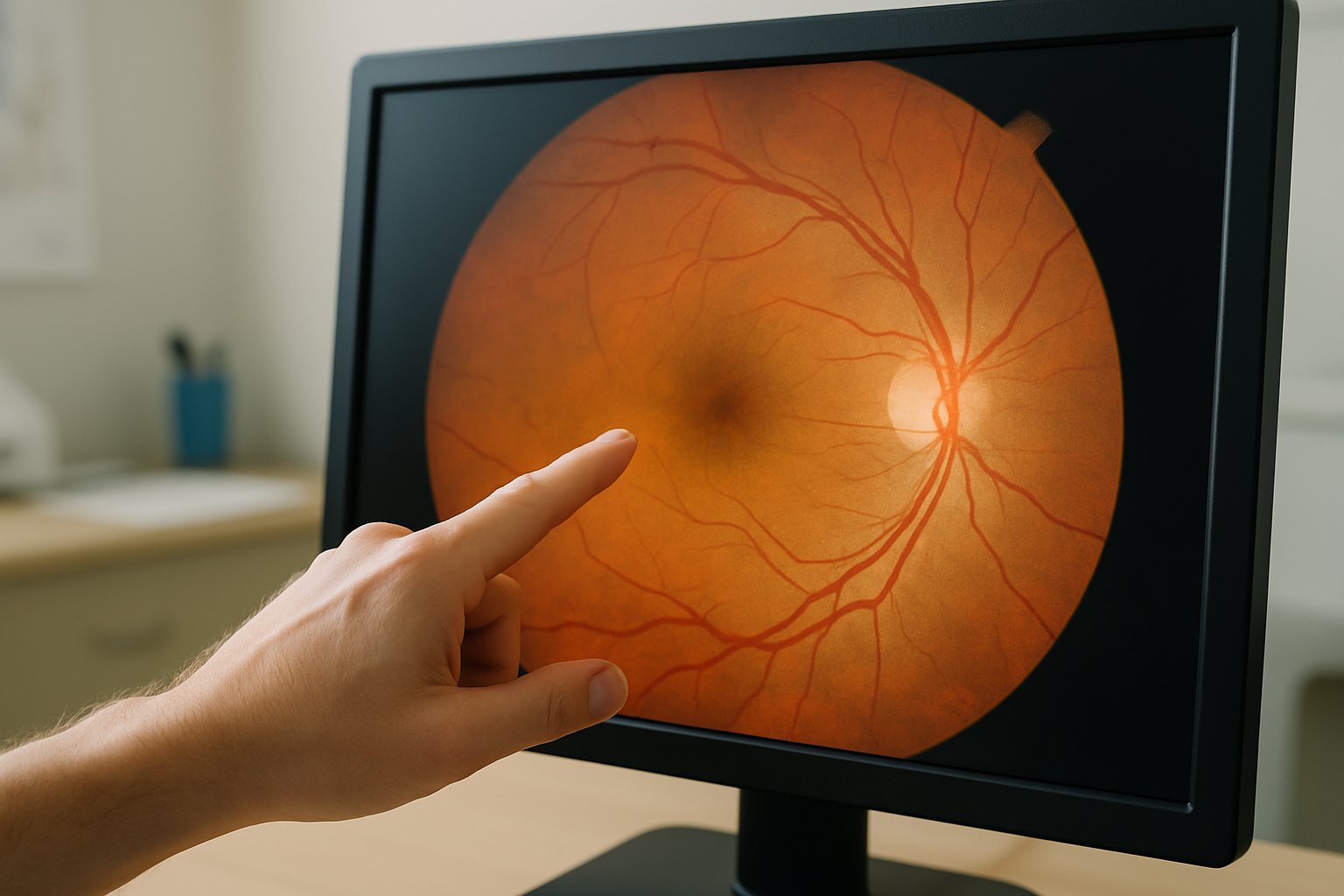
In contrast, Qatar’s DiaNet v2 trained on 5,545 participants delivered about 92% overall accuracy. Moreover, that deep network reported 93% sensitivity and 91% specificity within its single-country cohort. Both studies support a growing oculomics movement that links eyes and systemic disease. However, each relies on retrospective images and lacks prospective multisite validation.
These early results suggest retinal AI can flag diabetes with high recall. However, stronger evidence remains essential before Healthcare systems adopt the approach widely. Next, we examine the performance evidence in more detail.
Evidence From Recent Studies
Systematic reviews across 38 papers reveal broad performance ranges from AUC 0.68 to 0.97. Additionally, many authors highlight sparse external validation and inconsistent metric reporting. Meanwhile, the DART team reported an AUPRC of 0.96, which suits imbalanced datasets. DiaNet v2 published an AUROC near 0.98 and shared confusion matrices for transparency. Furthermore, nation-wide Healthcare datasets remain scarce, limiting algorithm robustness.
- DART: 95% sensitivity, 72% specificity, 273 images.
- DiaNet v2: 93% sensitivity, 91% specificity, 5,545 participants.
- Review range: AUC 0.68–0.97 across 38 studies.
- Global burden: 589 million adults live with diabetes, 43% undiagnosed.
Consequently, numerical superiority depends heavily on dataset composition and evaluation design. Expert reviewers warn that overfitting can inflate apparent accuracy when samples are small. Therefore, holding out independent sites remains the gold standard for medical AI evaluation.
Key Performance Metrics Explained
Sensitivity denotes the proportion of diabetics correctly flagged by the algorithm. Specificity measures how many healthy individuals avoid false alarms. Moreover, AUPRC captures precision under class imbalance, making it useful for screening tasks. In contrast, AUROC compares ranking ability across the entire threshold range.
Understanding these metrics equips Healthcare executives to interpret vendor claims accurately. Next, we explore expert perspectives on validation and scalability.
Expert Voices On Validation
Lead author Soujanya Kaup calls the eye a window into metabolic health. However, she stresses the need for larger, prospective trials across diverse populations. External commentator Daniel Ting notes ungradable image rates often exceed 15% in primary care. Consequently, real-world yields can fall below laboratory estimates.
Similarly, U.S. experience with FDA-cleared diabetic retinopathy AI shows reimbursement and workflow hurdles. Nevertheless, Ting believes alignment with existing tele-ophthalmology programs could accelerate adoption. Moreover, he views eye-based Diagnostics as a logical extension of preventive Healthcare.
Experts converge on the importance of multicenter validation and health-economic modeling. We now consider potential benefits should those gaps close.
Benefits For Global Screening
Retinal cameras are portable, battery powered, and already deployed for diabetic retinopathy programs. Moreover, one image can support multiple AI models, creating bundling opportunities. Therefore, a single capture may screen for retinopathy, cardiovascular risk, and diabetes simultaneously.
Low-resource clinics could offer rapid triage without laboratory infrastructure or cold-chain logistics. Additionally, patients avoid fasting and needles, improving participation. For overstretched Healthcare systems, earlier detection reduces costly complications downstream.
- No blood draw or fasting required.
- Image acquisition under one minute.
- Potential integration with existing eye screening workflows.
- Reusable devices lower per-screen cost.
These advantages could ease care inequities across urban and rural settings. However, several barriers still threaten scale-up.
Barriers And Open Questions
Image quality remains inconsistent outside eye clinics, raising unusable rates above 20% in some reports. Consequently, screening yield declines unless staff receive camera training and feedback loops. Moreover, population shift can erode model performance due to ethnic retinal differences.
Regulators will require evidence that AI improves outcomes, not just predictions. Therefore, sponsors must run prospective impact studies and cost-effectiveness analyses. Meanwhile, payers hesitate without reimbursement codes or clear follow-up protocols. Furthermore, Healthcare administrators need detailed Diagnostics pathways to manage positive results.
Regulatory And Adoption Hurdles
Existing FDA clearances cover diabetic retinopathy, not systemic diabetes detection. Consequently, new submissions must justify the novel intended use and safety profile. In contrast, European pathways rely on the CE mark but still demand post-market surveillance. Additionally, integration with electronic health records and confirmatory testing workflows needs planning.
Professionals can enhance readiness through the AI Researcher™ certification. Such training deepens understanding of algorithm validation, bias mitigation, and regulatory compliance.
Barriers are significant but addressable with deliberate design and stakeholder engagement. Therefore, ongoing pilots will reveal whether Healthcare gains outweigh operational complexity.
These challenges highlight critical gaps. However, emerging solutions are transforming the market landscape.
Conclusion And Next Steps
Retinal AI offers a non-invasive route to detect diabetes quickly and conveniently. Moreover, early studies show impressive sensitivity yet limited external validation. Consequently, Healthcare organizations must demand rigorous trials before integrating such tools. Additionally, clear Diagnostics pathways and reimbursement plans will determine adoption speed. Professionals should therefore pursue evidence-based training, such as the linked certification, to guide responsible deployment. Ultimately, collaborative research and thoughtful regulation can translate ocular insights into global health gains. Explore emerging certifications and stay ahead of the AI curve today.


