

AI CERTS
2 months ago
US–Taiwan Pact Reshapes Geopolitical Chip Security
This article unpacks the initiative’s origins, participants, data, and future milestones. Additionally, it balances supportive and critical perspectives to guide industry strategy. Semiconductor demand surged during the AI boom, exposing dangerous single points of failure. TSMC captured nearly 70 percent of global foundry revenue in Q2 2025, underscoring Taiwan’s centrality.
Consequently, governments now prioritize resilience, transparency, and geopolitical alignment. The Pax Silica framework positions itself as the diplomatic answer. However, its non-binding nature leaves execution questions unanswered. Global demand for AI Chips amplifies every disruption shock. Coordinated policies will determine Geopolitical Chip Security outcomes over the next decade.
Pax Silica Framework Basics
The Pax Silica Declaration launched in Washington on 11–12 December 2025. It sets voluntary principles for building trusted silicon and AI supply chains end-to-end. Therefore, coverage spans critical minerals, wafer fabrication, advanced packaging, compute, and data transmission. The US Department of State calls the pact a positive-sum partnership rather than an exclusionary bloc.
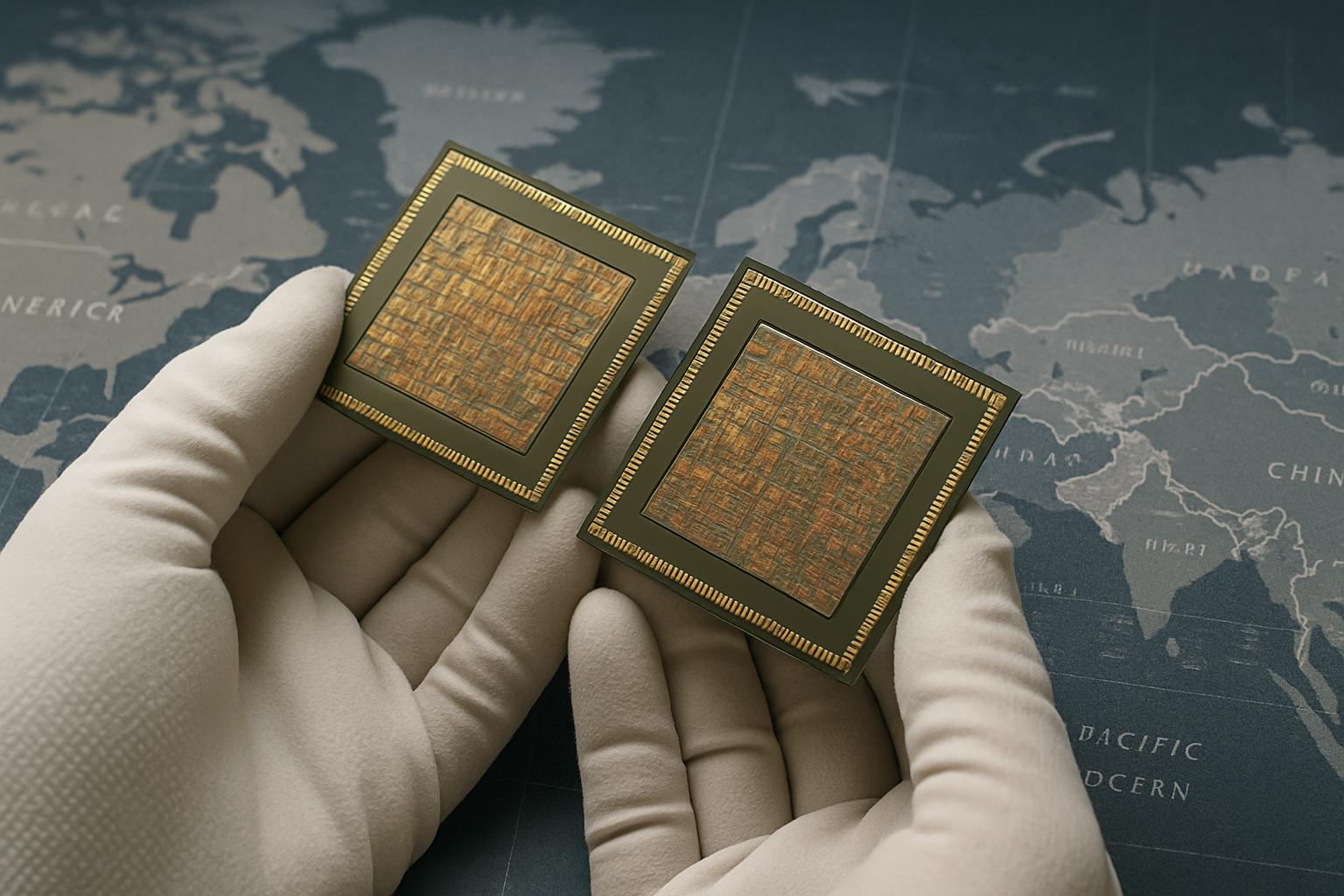
Initial participants included Japan, South Korea, Singapore, and the Netherlands. The United Kingdom, Israel, the United Arab Emirates, and Australia also joined. Furthermore, the EU, Canada, OECD, and Taiwan attended as guest contributors. Subsequently, Qatar and the UAE formalised accession in mid-January 2026.
Under Secretary Jacob Helberg framed the effort as defensive but open. He stated partners seek competitiveness without isolating others. Nevertheless, China interprets the plan as strategic containment. Such perceptions shape debate on Geopolitical Chip Security.
The declaration therefore provides a flexible umbrella for allied technology policy. However, practical governance depends on clear stakeholder commitments, explored next.
Key Stakeholder Governance Map
Pax Silica relies on a multi-layer governance structure. Core governments convene under rotating working groups on minerals, fabrication, and digital infrastructure. Corporate champions such as TSMC, Samsung, and ASML supply technical expertise. Meanwhile, investment funds coordinate capital mobilization with export-credit agencies.
US leadership remains pivotal. The US State Department hosts a dedicated Pax Silica secretariat staffed by economic security specialists. Taiwan ministries of Economic Affairs and Foreign Affairs manage bilateral workstreams with Washington. Additionally, the American Institute in Taiwan facilitates private engagement.
Non-government institutions bring standards and research heft. OECD offers data harmonization, while academia tracks supply chain metrics. Consequently, policy convergence becomes feasible across diverse regulatory cultures. Such alignment reinforces Geopolitical Chip Security objectives.
In sum, layered governance blends diplomacy, finance, and industry expertise. The following data illustrate why that blend matters.
Critical Market Data Snapshot
Numbers reveal concentration risks driving policy urgency. TrendForce recorded global foundry revenue of $41.7 billion in Q2 2025. TSMC alone captured nearly 70 percent of that total. Therefore, any Taiwan production interruption could shock worldwide device markets.
Counterpoint data showed foundry revenue reaching $84.8 billion by Q3 2025. AI accelerators and high-bandwidth memory orders fueled the leap. Meanwhile, China controls about 60–70 percent of critical mineral processing capacity. Such dominance challenges diverse supply routes necessary for Chips resilience.
- TSMC: ~70% pure-play foundry share, Q2 2025.
- Global foundry revenue: $41.7 billion, Q2 2025.
- Critical mineral processing: China ~65% average share.
- New Pax Silica members: Qatar, UAE joined January 2026.
Importantly, price elasticity studies show 5 percent wafer price increases ripple through $1 trillion electronic markets. Thus, marginal supply shocks threaten growth forecasts across automotive and cloud service segments. These figures highlight why partners prioritise Geopolitical Chip Security. The next section weighs advantages and critiques.
Pax Silica Benefits Concerns
Supporters argue Pax Silica mitigates single-source vulnerabilities. Moreover, coordinated investment could diversify advanced packaging and compute capacity. Aligned export controls aim to curb coercive technology leverage. Consequently, allied firms may capture new market share. Joint procurement mechanisms could also accelerate fab equipment delivery times. Moreover, harmonised talent visas may reduce engineering bottlenecks.
Critics warn of supply chain bifurcation and higher costs. In contrast, European hesitation signals difficulty achieving universal buy-in. Implementation gaps exist because the declaration remains non-binding. Therefore, projects require sustained funding beyond political cycles.
Analysts also watch Beijing’s counter-moves. Retaliatory export restrictions on minerals could test Security planning. Nevertheless, diversified capacity may limit damage from future shocks. Balanced strategies are essential for Geopolitical Chip Security success.
Both opportunities and risks demand careful governance and metrics. These tensions foreground the recent US Taiwan statement.
US Taiwan Joint Statement
Washington and Taipei endorsed Pax Silica principles on 27 January 2026. The joint statement mapped seven cooperation areas, including AI supply chains and drone ecosystems. It also pledged workstreams on critical minerals, talent, and third-country projects. However, Taiwan remains a guest contributor rather than a formal declaration signatory.
The arrangement balances diplomatic sensitivities while deepening practical collaboration. Furthermore, it signals US commitment to Taiwan’s economic security without overt treaty language. Industry leaders welcomed clarity on export-control alignment and investment screening. Such clarity advances Geopolitical Chip Security goals for both partners.
Professionals can boost policy fluency with the AI Policy Maker™ certification. Such training equips executives for forthcoming regulatory negotiations.
The bilateral roadmap adds substance to prior diplomatic statements. Next, attention turns to measurable progress indicators.
Forward Looking Indicators Ahead
Helberg indicated additional Pax Silica members could appear in early 2026. Possible entrants include India and further European states. Moreover, financing announcements will reveal political seriousness. Watch for joint ventures on mineral refining and advanced packaging plants. Observers expect an inaugural project list before the next G7 summit.
Data center placements near renewable energy sources will test cost assumptions. Meanwhile, partner parliaments must approve budget lines supporting initiatives. Subsequently, standard-setting groups will publish supplier vetting protocols. These outputs influence Geopolitical Chip Security trajectories. Robust benchmarks will anchor Geopolitical Chip Security accountability.
- Formal signatory roster updates.
- Cross-border project financing vehicles.
- Supply chain transparency dashboards.
- Responses from Chinese regulators.
Timely delivery of these items will legitimize the Pax Silica experiment. Failure would invite renewed fragility across Chips production networks. Therefore, industry leaders must stay engaged and prepared.
Key Takeaways
Pax Silica marks a decisive pivot in technology diplomacy. It offers a flexible yet ambitious path toward resilient supply chains. Nevertheless, success hinges on financing, standards, and transparent metrics. The US, Taiwan, and partners must convert principles into factories and dashboards. Corporate strategists should monitor membership updates, mineral deals, and packaging capacity announcements. Additionally, teams must adapt compliance programs to evolving export-control rules. Professionals who master Geopolitical Chip Security frameworks will shape the competitive landscape. Enroll in the linked certification today and lead that conversation.


