

AI CERTS
2 months ago
Linguistic Model Research Drives Arabic AI Benchmarks
Meanwhile, Arabic.AI announced a collaboration that helped build the leaderboard and earned its LLM-X the top aggregated score. However, experts caution that dialect gaps remain. This article unpacks the technical story, its strategic impact, and next steps for researchers and businesses.
Evolving Arabic Benchmarking Landscape
Historically, Arabic evaluation leaned on translated English tasks. Moreover, fragmented efforts caused incompatible metrics. HELM Arabic centralizes progress by combining AlGhafa, ArabicMMLU, Arabic EXAMS, MadinahQA, AraTrust, ALRAGE, and ArbMMLU-HT.
Therefore, stakeholders gain a single reference point covering knowledge, safety, retrieval, and reasoning. Stanford documents every request and response, ensuring end-to-end transparency. Linguistic Model Research benefits from this clarity, enabling precise replication.
These consolidated datasets move assessment beyond classroom questions. Nevertheless, dialectal and multimodal challenges persist. These gaps underscore the need for sustained dataset innovation. Hence, the landscape continues evolving quickly.
Inside HELM Arabic Suite
HELM uses a zero-shot protocol with 1,000 sampled examples per task. Additionally, it disables think-step modes to equalize conditions. Closed-weight giants like GPT-5.1, Gemini 2.5, and Mistral Large compete beside open-weight models such as Qwen3 235B A22B and Llama 4.
The leaderboard also lists Arabic-specialist systems including JAIS, AceGPT-v2, and SILMA. Consequently, practitioners can compare API options with self-hosted alternatives. This breadth aligns with Linguistic Model Research goals of holistic visibility.
Stanford hosts raw logs on GitHub, allowing independent audits. Moreover, reproducible scripts simplify reruns when models update. Such openness addresses common reproducibility criticisms that plagued earlier Benchmarks.
Arabic Model Rankings Explained
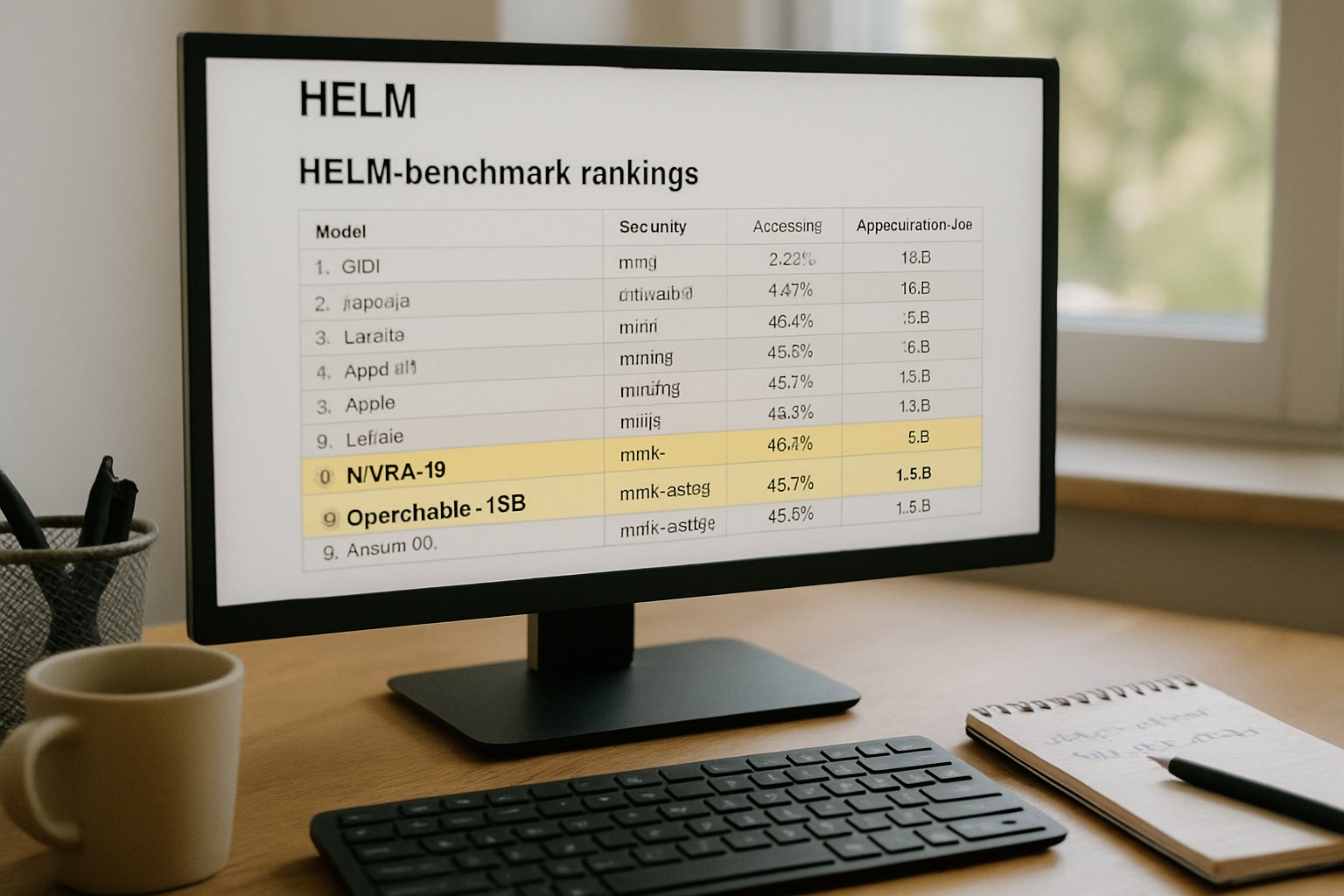
Arabic.AI LLM-X leads the aggregated score, topping six of seven sub-benchmarks. In contrast, Qwen3 235B A22B Instruct ranks first among open-weight entrants, scoring roughly 0.786 mean accuracy.
HELM discloses per-task breakdowns showing notable variance. For example, ArbMMLU-HT remains challenging for every system, while ALRAGE reveals retrieval weaknesses in closed models. Consequently, leaderboard positions shift when weighting changes.
Such nuances remind observers that a single number masks complexity. Therefore, analysts conducting Linguistic Model Research should examine task-level logs before drawing deployment decisions.
- Top closed-weight mean: Arabic.AI LLM-X
- Top open-weight mean: Qwen3 235B A22B ≈ 0.786
- Benchmarks aggregated: seven distinct tasks
- Publication date: 18 December 2025
These metrics highlight current leaders. However, rapid model releases will quickly change standings. Continuous monitoring remains critical.
Methodology And Known Limitations
Zero-shot prompting reduces engineering overhead. Nevertheless, alternative prompt designs could reverse ranks. Furthermore, the 1,000-sample cap omits variability present in full datasets.
Dialect coverage skews toward Modern Standard Arabic. Consequently, colloquial performance remains uncertain. Multimodal evaluation also lags, as shown by CAMEL-Bench where GPT-4o reached only 62 percent.
Moreover, several evaluated Arabic models date back to 2024. Their older training corpora may hinder fairness against 2026 releases. Therefore, researchers pursuing Linguistic Model Research should treat this snapshot as provisional, not definitive.
These caveats signal opportunities for community contributions. However, they also warn decision-makers to validate models on domain data before production rollout.
Comparative Benchmarking Ecosystem Context
HELM Arabic joins Hugging Face’s Open Arabic LLM Leaderboard v2 and academic suites like ORCA, ARB, and Swan. Additionally, CAMEL-Bench offers a 29,036-question multimodal challenge.
Collectively, these Benchmarks create complementary coverage. In contrast, duplication still occurs, wasting researcher cycles. Consequently, interoperable metrics and shared logs remain priorities.
Industry analysts note strong regional momentum. Moreover, community leaderboards recorded roughly 700 model submissions and 46,000 visitors during initial months. Such engagement underscores market appetite.
- Open Arabic Leaderboard v2: launched Feb 2025
- ARB multimodal reasoning: May 2025
- CAMEL-Bench NAACL paper: July 2025
This broader context helps businesses gauge maturity. Subsequently, they can align internal evaluations with public standards.
Business Impact And Opportunities
Accurate Arabic evaluation supports risk mitigation in finance, government, and healthcare. Moreover, transparent scoring eases vendor selection. Organizations comparing closed and open models can reference HELM Arabic to inform procurement.
Professionals can deepen their expertise through the AI Researcher™ certification. Consequently, teams gain structured skills for dataset curation, prompt design, and Linguistic Model Research validation.
Vendors pursuing regional contracts gain marketing leverage by ranking on respected leaderboards. However, they must also address dialectal gaps to maintain credibility. Therefore, continuous fine-tuning and re-evaluation remain operational imperatives.
These commercial benefits illustrate benchmarking’s strategic value. Meanwhile, regulatory frameworks may soon reference such public scores.
Future Research Directions Ahead
Stanford plans iterative updates, potentially adding dialectal datasets. Additionally, safety tracking could expand beyond AraTrust into cultural sensitivity checks. Researchers contemplate integrating speech and vision tasks, aligning with ARB’s multimodal direction.
Moreover, automated eval agents might lower re-ranking latency, reflecting weekly model releases. Community collaboration will accelerate these enhancements. Linguistic Model Research therefore sits at the center of upcoming advances.
Nevertheless, sustainable funding and compute remain challenges. Open-weight contributors need hosted inference to participate promptly. Consequently, shared infrastructure will prove decisive.
These prospective steps promise richer insights. However, they demand coordinated governance across academia, industry, and open communities.
In summary, HELM Arabic represents a milestone. It unites rigorous methods, transparent data, and cross-model comparison. Linguistic Model Research thrives when such pillars align.
Key Takeaways Forward
• HELM Arabic aggregates seven diverse tests.
• Arabic.AI LLM-X leads current standings.
• Dialect and multimodal gaps persist.
• Continuous evaluation will drive progress.
Therefore, practitioners should monitor updates and engage with community efforts.
These insights guide strategic decision-making. Meanwhile, further research will refine Arabic AI excellence.
Conclusion
The Arabic evaluation landscape now enjoys a transparent, unified benchmark. HELM Arabic, built by Stanford and Arabic.AI, offers reproducible scores across closed and open models. Nonetheless, dialectal and multimodal shortcomings require continued attention. Moreover, rapid model iterations necessitate frequent leaderboard refreshes. Consequently, organizations should integrate public findings with internal tests before deployment.
Professionals eager to lead future evaluations should pursue formal upskilling. Explore the linked AI Researcher™ certification and deepen your Linguistic Model Research expertise today.


