

AI CERTS
5 months ago
WeRide Unveils Autonomous Simulation Engine GENESIS for Testing
The company claims the system merges generative AI, physics fidelity, and closed-loop analytics into one stack. Moreover, executives say GENESIS can build city-scale worlds in minutes and replay rare traffic events effortlessly. Industry peers, regulators, and investors immediately asked what this launch means for global AV timelines. This article dissects the announcement, market context, technical claims, and unanswered questions. By the end, readers will grasp GENESIS’s strategic impact and practical next steps.
Market Momentum Signals Growth
Market demand for high-fidelity Simulation platforms keeps rising. ResearchAndMarkets valued the AV Simulation niche at about USD 1.4 billion in 2025. Furthermore, analysts forecast nearly 20 percent CAGR through 2034, driven by regulation and compute costs. Meanwhile, cloud-based GPU pricing keeps falling, lowering entry barriers for smaller teams. Consequently, simulator innovation has become a boardroom priority for OEMs and startups. Waymo, NVIDIA, and Applied Intuition already tout billion-mile virtual datasets.
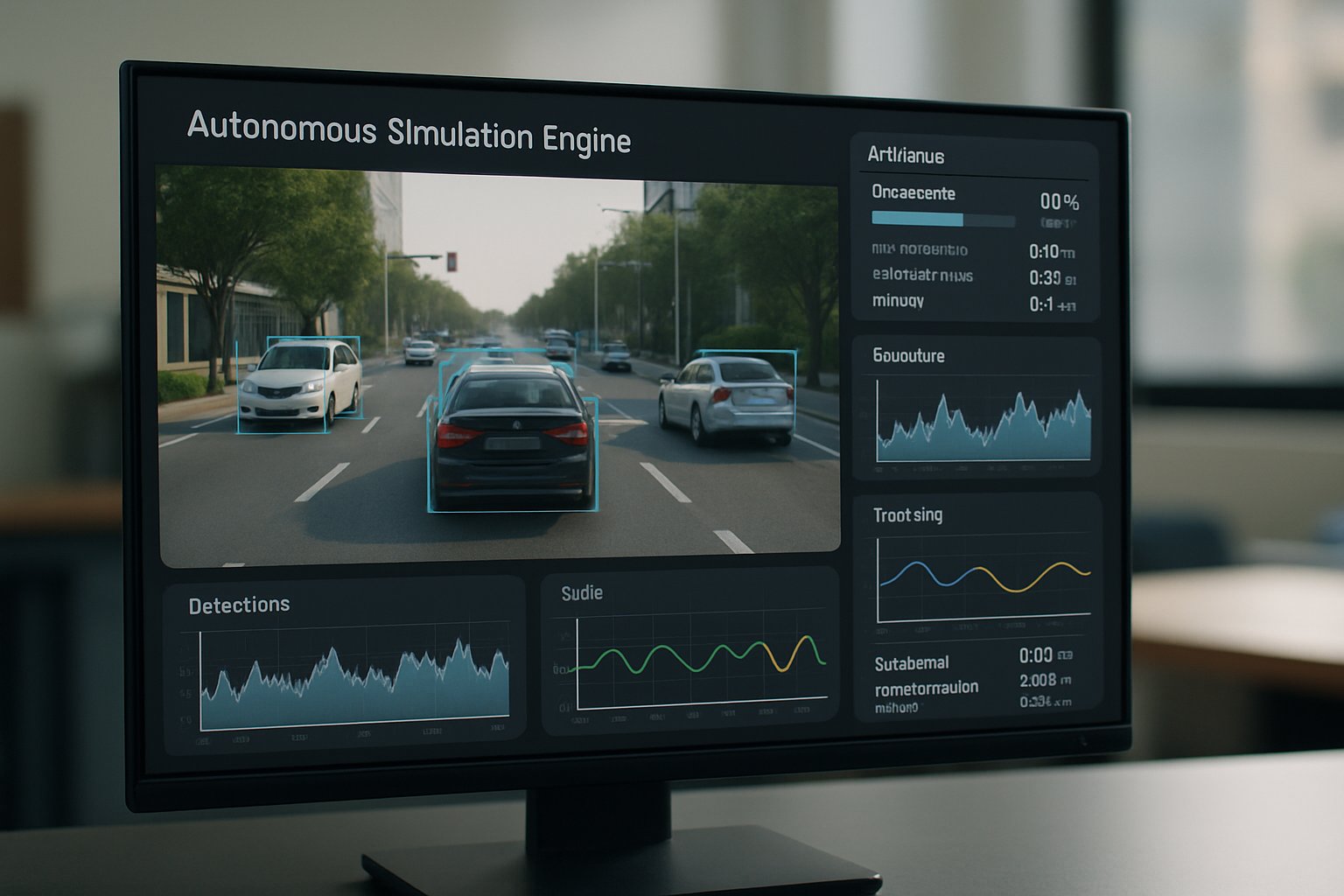
In contrast, WeRide argues its new stack closes key capability gaps rather than simply scaling mileage. Moreover, the company leverages 55 million kilometers of real logs to seed scenarios.
- 2025 market size: USD 1.4 billion
- Projected 2034 size: USD 7-plus billion
- Estimated CAGR: ~20 percent
These figures confirm a lucrative backdrop for any credible Autonomous Simulation Engine entrant. Therefore, GENESIS debuts at an opportune moment. Next, we examine its internal design.
Inside GENESIS Architecture Details
GENESIS integrates four AI-centric modules working in concert. Firstly, AI Scenarios auto-generates long-tail events and common traffic flows. Secondly, AI Agents emulate human drivers, riders, and pedestrians with data-driven behavior models. Thirdly, AI Metrics compute quantitative safety, comfort, and rule-compliance indicators after every virtual run. Finally, AI Diagnosis pinpoints root causes and suggests code fixes automatically. Moreover, the stack connects to WeRide’s continuous integration pipeline, producing nightly regression reports. Additionally, the modules communicate through standardized gRPC interfaces to simplify maintenance. Consequently, engineers iterate features without waiting for scarce physical test slots.
The architecture also supports multiple sensor configurations across radars, LiDARs, and cameras. Therefore, one Autonomous Simulation Engine build covers passenger cars, vans, and robo-buses. These design choices hint at aggressive cost optimization. However, generative worldbuilding truly differentiates the release. The next section explores that capability.
Generative AI Worldbuilding Power
Creating digital cities manually often requires months of artist time. The platform replaces that effort with text-to-world generation powered by large diffusion models. Furthermore, executives claim entire metropolitan meshes appear in minutes, complete with dynamic weather variations. Road signs, lane markings, and curb geometry follow local regulations automatically. Consequently, an Autonomous Simulation Engine scenario for Paris can morph into Lagos with minor prompts.
The technology also reproduces edge cases rarely captured in sensor logs. Moreover, long-tailed events like tire blowouts or jaywalking groups surface repeatedly until software behaves safely. Data-driven randomness keeps distributions statistically representative. Such repeatability shortens statistical validation timelines. Nevertheless, worldbuilding speed is meaningless without feedback loops. We next analyze that loop.
Closed-Loop Validation Cycle Explained
After each run, the platform logs agent trajectories, sensor frames, and metric breaches. Subsequently, AI Diagnosis clusters failure patterns and ranks root causes. Engineers receive actionable suggestions inside their integrated development environment. Therefore, a bug fix can re-enter the Autonomous Simulation Engine pipeline the same evening. New code then faces thousands of regenerated situations overnight.
Meanwhile, validated updates propagate to physical fleets for on-road confirmation. WeRide asserts that the loop compresses millions of driving kilometres into days of compute time. Such performance could accelerate geographic AV expansion plans. Consequently, hardware-in-the-loop benches can replay the same traces for sensor verification. However, rivals make similar claims, necessitating competitive context. The following section compares major players.
Competitive Landscape Overview Today
Waymo, Nvidia, Applied Intuition, and Cognata dominate commercial Autonomous Simulation Engine discourse. Each vendor markets photoreal rendering, agent libraries, and scenario catalogs. In contrast, WeRide now promotes a vertically integrated stack tightly coupled to its fleet data. Furthermore, the company has not announced licensing plans. Therefore, GENESIS may mirror Waymo's internal CarCraft rather than Nvidia's platform business. Each company positions its Autonomous Simulation Engine as the safest and most scalable option.
- Ownership: Proprietary, in-house tool
- Worldbuilding: Generative AI focus
- Target users: WeRide engineers today
- Commercial path: Undisclosed
These contrasts underscore market segmentation between platform vendors and fleet operators. Nevertheless, third-party validation could still influence procurement conversations. Market analysts still expect multiple winners as demand diversifies. Risk analysis illuminates that requirement.
Risks And Open Questions
Simulation realism sits at the heart of regulatory acceptance. Academic papers warn that agent behavior and long-horizon stability remain difficult problems. Moreover, proprietary benchmarks impede cross-company comparison. WeRide has published no independent GENESIS metrics yet. Consequently, skepticism will persist until standardized evaluations emerge. Peer reviewed benchmarks could provide that confidence.
Commercial strategy also remains unclear. If GENESIS stays private, most competitors continue relying on existing vendors. In contrast, public licensing could disrupt the Autonomous Simulation Engine supplier hierarchy. Meanwhile, regulators may insist on external audits before approving robotaxi expansions. Therefore, transparency will likely shape GENESIS’s long-term influence. The final section distills practical insights.
Conclusion And Next Steps
WeRide’s launch underscores the strategic importance of simulation in autonomous mobility. GENESIS combines generative worldbuilding, agent modeling, and feedback analytics inside one Autonomous Simulation Engine. Consequently, development cycles could shrink, and city rollouts may accelerate. However, competitive advantage will depend on validated realism, regulatory trust, and potential commercialization paths. Additionally, professionals can deepen expertise via the AI+ Robotics™ certification. Therefore, staying informed and certified positions teams to evaluate and deploy next-generation tools effectively. Explore the links, review emerging data, and prepare for a faster autonomous future.
Disclaimer: Some content may be AI-generated or assisted and is provided ‘as is’ for informational purposes only, without warranties of accuracy or completeness, and does not imply endorsement or affiliation.


