

AI CERTs
5 months ago
How Steel Giant Fuels AI Infrastructure Expansion
Hyperscale computing feels intangible, yet its backbone is steel. Every new server hall depends on metal frames, racks, and cable trays. Consequently, traditional mills now sit at the heart of digital expansion. One firm, Nucor Corporation, has positioned itself as the silent enabler of modern AI infrastructure. This article examines how the largest U.S. electric-arc steelmaker powers tomorrow’s data flows. Moreover, it explores market drivers, sustainability claims, and looming obstacles that could slow momentum. Readers will gain concrete numbers, strategic insights, and guidance for procurement teams. Finally, professionals will find certification links to deepen expertise in design for hyper-scale builds. In contrast to chip headlines, steel manufacturing rarely grabs attention. However, without resilient supply chains, GPUs remain boxed in warehouses.
Steelmaker Targets Data Centers
Nucor spent $115 million acquiring Southwest Data Products in April 2024. Subsequently, the company launched Nucor Data Systems to serve cabinet and enclosure needs. Management now claims to supply over 95 percent of a typical data center’s steel content. Furthermore, executives describe demand as “white hot” and a coming “tsunami of earnings power.” The remarks align with Grand View Research, which projects the overall market hitting $652 billion by 2030. Therefore, sustained construction will likely benefit suppliers that control vertical integration. Nucor’s approach links raw metals, fabrication, and on-site installation under one umbrella.
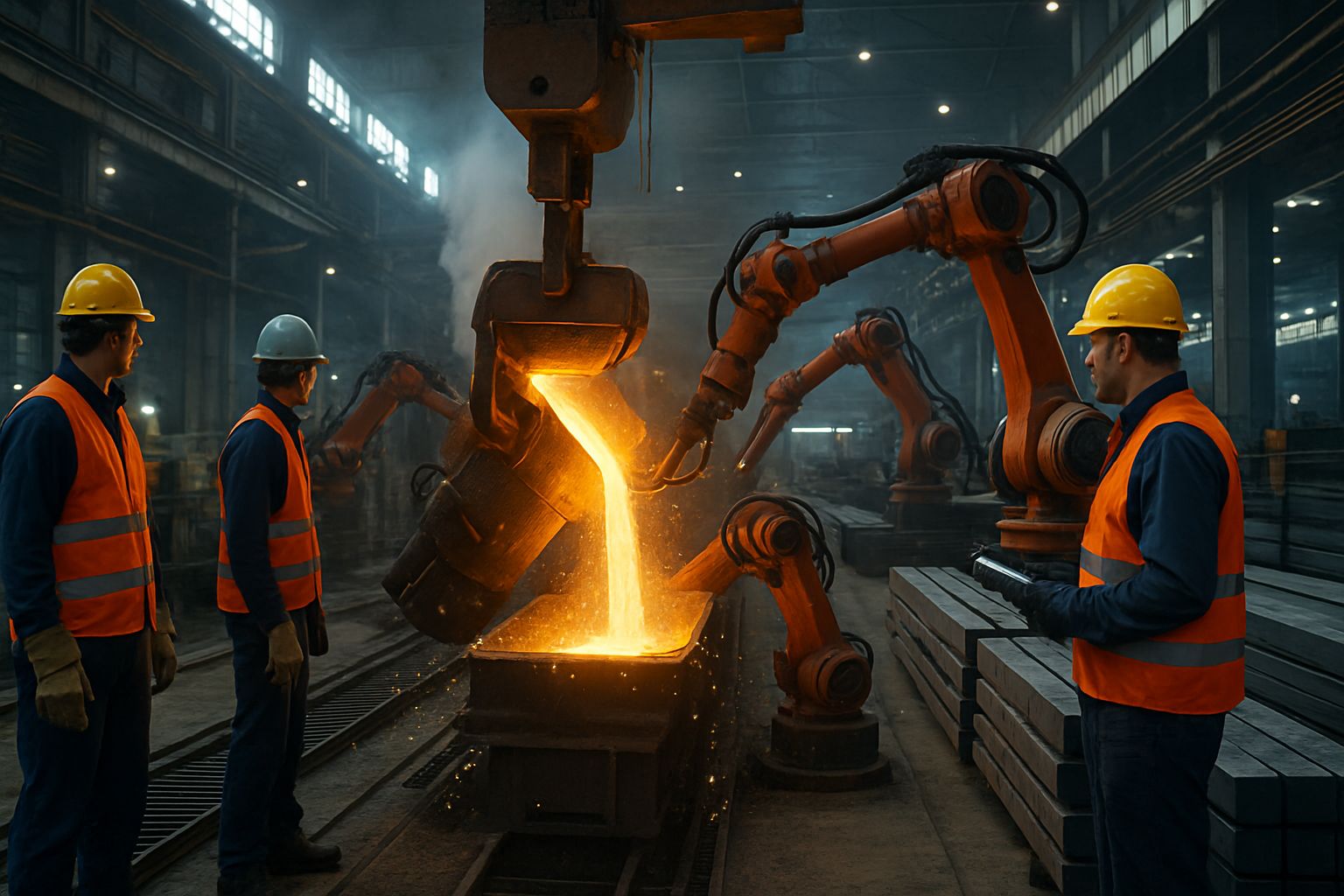
These moves put the producer directly inside AI infrastructure discussions. Nevertheless, competitors like Steel Dynamics and Cleveland-Cliffs are watching closely. This rivalry could tighten lead times, pricing, and innovation cycles.
The aggressive push underscores a broader shift. Steel manufacturing once ended at coil shipment; today, value migrates toward turnkey assemblies. Consequently, investors increasingly weigh downstream fabrication capability when evaluating mill strategies. These signals clarify why Nucor prioritized data-center acquisitions.
The milestone acquisition illustrates commitment. However, market growth also rests upon power availability, examined next.
Market Forces Driving Growth
Several tailwinds amplify steel demand. First, global AI infrastructure expansion drives fresh building shells and interior fit-outs. Second, hyperscalers face mounting sustainability mandates, favoring recycled-content material. Third, reshoring policies incentivize domestic sourcing for strategic supply chains.
Key statistics reveal momentum:
- Grand View Research valued the sector at $347.6 billion in 2024.
- Projected compound growth remains in double digits through 2030.
- U.S. electric-arc furnaces now represent roughly 70 percent of capacity.
- Dominion Energy saw connection requests balloon to tens of gigawatts, signaling soaring data center power needs.
Moreover, trade press highlights corporate shift toward low-carbon procurement frameworks. Meanwhile, government projects embed embodied-carbon thresholds into bid documents. Consequently, mills with greener footprints command pricing premiums. Steel manufacturing therefore intersects directly with climate reporting metrics.
These growth drivers appear durable. Yet, power constraints could delay some timelines, as the following section details.
Inside Nucor Data Systems
Nucor Data Systems extends the enterprise from coils to completed racks. Additionally, Southwest Data Products brought decades of airflow containment expertise. That knowledge matters because thermal limits define rack density and ultimately data center power budgets. Engineers require enclosures that channel cold air efficiently while supporting heavy AI accelerators.
The business unit now offers:
- Server cabinets and hot-aisle containment modules
- Perimeter caging for co-location compliance
- Pre-engineered metal building panels
- Installation and integration services nationwide
Consequently, procurement officers can secure framing, racks, and specialty containment from one domestically located partner. Furthermore, Nucor cites its ability to shorten lead times by coordinating freight across its own mill network. That logistical control proves critical when AI infrastructure projects move under compressed schedules.
Professionals can enhance their expertise with the AI+ UX Designer™ certification. Coursework covers design thinking for high-density compute layouts, complementing supplier knowledge.
Integrated offerings undoubtedly attract hyperscalers. Nevertheless, sustainability advantages may seal contracts, as explored next.
EAF Sustainability Advantage Explained
Electric-arc furnaces melt scrap using electricity instead of coke. Therefore, lifecycle emissions drop compared with blast-furnace routes. Moreover, many U.S. EAF plants run on renewable electricity contracts, lowering embodied carbon further. Hyperscalers pursuing net-zero goals increasingly request verifiable carbon disclosures. In contrast, imported slab often carries higher footprint values and longer transit times.
Nucor highlights its recycled content ratio in marketing decks. Additionally, management argues that greener steel manufacturing strengthens bids for federal and state facilities. The pitch resonates because embodied emissions now influence permitting decisions alongside energy efficiency metrics.
Lower-carbon material supports AI infrastructure without compromising structural performance. Consequently, developers can meet disclosure requirements while maintaining schedule certainty.
Sustainability provides a key edge. However, data center power availability remains a formidable bottleneck.
Power Constraints Shape Timelines
Grid interconnection queues lengthen as hyperscalers request multi-gigawatt capacity. Meanwhile, utilities struggle with transmission upgrades and local permitting. S&P Global identifies electricity access as the top near-term obstacle for new builds. Consequently, some steel deliveries wait in yards while substations catch up.
Nevertheless, modular construction trends may mitigate delays. Prefabricated racks and wall panels can ship once sites receive partial energization. Furthermore, Nucor’s geographic footprint allows rail delivery close to most major clusters, reducing inventory idling.
Developers therefore juggle steel schedules against transformer arrivals. In contrast, earlier eras prioritized concrete curing timelines. The changed sequence underscores how AI infrastructure reshapes construction logistics.
These constraints spotlight operational risk, examined in the next section.
Risks And Execution Challenges
Vertical integration offers benefits yet introduces complexity. Nucor must assimilate Southwest Data Products culture while maintaining mill reliability. Additionally, any fabrication bottleneck could cascade across multiple hyperscale campuses. Trade policy shifts add further unpredictability; tariffs may alter scrap flows or raise input costs.
Moreover, concentration risk emerges if buyers rely on one firm for 95 percent of steel content. Nevertheless, diversified product lines and regional plants provide some redundancy.
Industry observers suggest continuous investment in automation and workforce training. Consequently, steel manufacturing resilience becomes as crucial as manganese content or tensile strength. Therefore, corporate governance teams monitor on-time delivery metrics alongside earnings per share.
Execution competence ultimately determines whether AI infrastructure ambitions translate into revenue. The final section distills practical insights for decision makers.
Strategic Takeaways For Leaders
Technology executives should view steel procurement as strategic, not tactical. Furthermore, early engagement with integrated suppliers can compress schedules by weeks. Developers must also coordinate material drops with data center power milestones, avoiding stranded inventory. Sustainability officers should verify EPD documentation to capture embodied-carbon credits.
Key actions include:
- Align rack specifications with future liquid-cooling retrofits.
- Lock recycled-content commitments into master service agreements.
- Audit logistics paths to minimize double handling.
- Encourage cross-training via the AI+ UX Designer™ certification.
Moreover, continuous monitoring of trade policies protects cost forecasts. Consequently, cross-functional collaboration emerges as the decisive success factor.
These steps equip leaders for volatile markets. However, disciplined follow-through remains essential.
The discussion above clarifies market momentum, sustainability levers, and operational risks. Therefore, executives can refine playbooks for the next wave of AI infrastructure buildouts.
Conclusion
Nucor’s expansion illustrates how foundational industries now drive digital capability. Moreover, recycled-steel leadership aligns with stringent carbon targets. Data center power constraints and trade dynamics still pose hurdles; nevertheless, integrated supply chains lessen exposure. Consequently, procurement teams should engage early with proven partners while reinforcing internal skills. Professionals seeking deeper design insight can explore the linked AI+ certification. Act now to secure resilient, sustainable, and competitive AI infrastructure.
Disclaimer: Some content may be AI-generated or assisted and is provided ‘as is’ for informational purposes only, without warranties of accuracy or completeness, and does not imply endorsement or affiliation.


