

AI CERTs
5 months ago
Fake AI photos on Facebook Distort Holocaust History
An endless stream of synthetic portraits now clutters Facebook timelines.
However, many viewers believe these sepia-toned faces belong to real Holocaust victims.
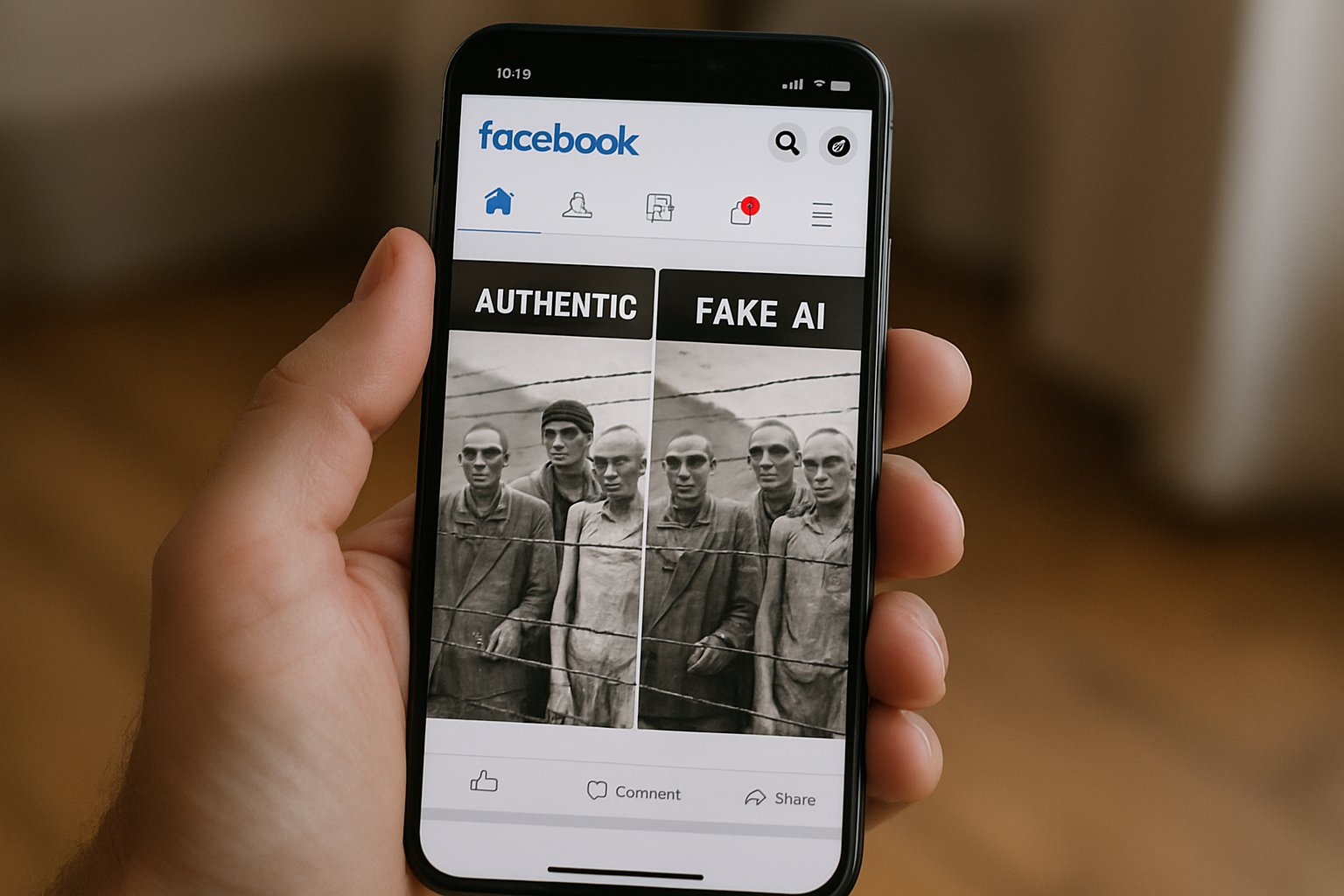
The images are, in fact, Fake AI photos created by content farms seeking clicks.
Historians warn the trend distorts Holocaust history and exploits collective grief.
Furthermore, investigative reports link the surge to monetisation incentives baked into the platform.
This article unpacks the phenomenon, examines platform responses, and outlines professional actions to curb the damage.
Consequently, educators and memorial institutions are demanding stricter guardrails around generative imagery.
Meanwhile, regulators cite the EU Digital Services Act as legal leverage for faster enforcement.
Readers will discover new data, expert quotes, and available certifications that strengthen responsible AI practice.
Such misinformation complicates public understanding of verified archives.
Historical Memory Under Threat
Generative tools can fabricate convincing vintage portraits within seconds.
Moreover, Fake AI photos paired with invented biographies present fiction as fact.
Auschwitz Memorial calls the tactic a dangerous distortion of Holocaust history and risks trivialisation.
Consequently, survivors' families confront content that hijacks their relatives' stories for engagement.
The practice undermines authentic testimony and erodes trust in archival photography.
However, scale, not intent, makes the threat uniquely urgent, leading us to the next surge analysis.
AI Surge Alarms Historians
Monitoring groups noticed a spike between April and June 2025, then another around Remembrance Day 2026.
Furthermore, Facebook pages like "90’s History" posted up to 50 items daily during peak weeks.
Analysts tied many uploads to networks recycling names of real victims from Holocaust history.
In contrast, Meta disclosed no public statistics quantifying removals or prevalence.
The opacity frustrates researchers who cannot gauge enforcement progress.
Consequently, pressure shifts toward understanding the monetization engine driving Fake AI photos.
Monetization Drives Viral Content
Investigations by EDMO and Provereno reveal clear economic motives behind the posts.
Moreover, Facebook's algorithm rewards emotionally charged stories with broader reach and revenue sharing.
Content farms churn thousands of Fake AI photos because each extra view can trigger creator payments.
Therefore, synthetic tragedy becomes a scalable business model, not an isolated prank.
- Pages studied: 10–50 posts per day during 2025 surge.
- Estimated victims referenced: over 1.1 million names manipulated.
- Watchdogs identified dozens of coordinated operator accounts.
- Platform enforcement appeared inconsistent across regions.
Meanwhile, researchers noted that engagement spikes around commemorative dates, magnifying revenue potential during emotionally charged periods.
The numbers confirm a supply chain fueled by clicks, not commemoration.
Nevertheless, technical detection remains the next barrier to halting the spread.
Detection Tools Still Struggle
Generative AI detectors remain unreliable when images resemble genuine period photography.
Additionally, many uploads are compressed, erasing subtle artefacts that watermark systems seek.
UNESCO urges provenance solutions, yet open standards are nascent.
Consequently, Fake AI photos frequently bypass automated filters and stay online for months.
Researchers test multimodal models that cross-check captions with known archives.
However, large archival gaps limit precision, especially for lesser-documented victims.
Subsequently, memorial technologists pilot open-source hashes to tag authentic images at upload.
Detection remains an arms race between creators and moderators.
Therefore, policy intervention and ethical design become essential, as the next section explores.
Platform Response Still Lags
Meta states it removes Holocaust denial and hate, yet policy for synthetic history is vague.
Furthermore, memorial staff report many flagged posts remain live or reappear via new pages.
Oversight Board rulings highlight inconsistent application, compounding user confusion about misinformation rules.
In contrast, some accounts were disabled for spam rather than historical distortion, sidestepping the real issue.
Despite public criticism, Facebook offered no dataset detailing action taken against Fake AI photos.
Moreover, EU regulators hint that the Digital Services Act could force greater transparency in 2026.
Therefore, civil society coalitions are urging real-time transparency dashboards similar to election integrity centers.
Policy lag leaves memorials carrying the monitoring burden.
Subsequently, stakeholders look to stronger governance frameworks and professional upskilling.
Policy And Ethical Path
Lawmakers debate mandatory provenance labels for AI imagery across social networks.
Meanwhile, memorial coalitions ask Meta to classify synthetic Holocaust history as harmful misinformation.
Experts also recommend educational programs for creators about responsible generative practice.
Professionals can enhance expertise via the AI Learning Development™ certification.
Moreover, newsroom training on AI verification tools strengthens editorial defenses against Fake AI photos.
Consequently, a combined legal, technical, and educational approach offers the best protection.
Holistic strategies address incentive structures, user literacy, and platform accountability.
Nevertheless, professionals still need actionable steps, outlined in the final section.
In contrast, creative scholars defend limited, clearly labeled reconstruction projects as legitimate educational tools.
Action Steps For Professionals
First, audit content pipelines for synthetic imagery using multiple detection plugins.
Second, embed clear disclosure policies for any AI-assisted visuals referencing Holocaust history.
Third, flag Fake AI photos promptly through platform reporting channels and external watchdog portals.
Fourth, collaborate with museums to verify archival materials before publication.
Additionally, share verified resources to counter misinformation and reduce algorithmic amplification.
Professionals seeking deeper skill sets should consider structured courses and relevant certifications.
Therefore, continuous education builds resilience against future manipulation waves.
Fifth, integrate routine staff briefings that analyse emerging AI threats across sectors.
These practical measures empower teams to safeguard digital memory.
In contrast, inaction invites further distortion, as concluding reflections emphasize.
Conclusion And Call-To-Action
The Holocaust remains one of humanity’s starkest lessons.
However, Fake AI photos threaten to blur that lesson for millions scrolling social feeds.
Monetization incentives, weak detection, and slow policy each fuel the ongoing surge.
Furthermore, Facebook’s limited transparency hampers collective defense against sophisticated misinformation campaigns.
Yet, coordinated action across regulation, technology, and education can reverse the tide.
Consequently, professionals must adopt the steps outlined above and pursue recognised credentials for responsible AI practice.
Begin today by exploring the linked certification and sharing verified knowledge within your organisation.
Authentic remembrance depends on exposing Fake AI photos before they rewrite history.
Disclaimer: Some content may be AI-generated or assisted and is provided ‘as is’ for informational purposes only, without warranties of accuracy or completeness, and does not imply endorsement or affiliation.


