

AI CERTs
4 months ago
Gemini 3 Chrome Ushers Agentic Browsing Era
Few product updates reshape daily workflows as quickly as a browser overhaul. Nevertheless, Google’s latest move aims for exactly that reach. The company has begun rolling out Gemini 3 Chrome to U.S. desktop users. Consequently, millions now test-drive a multimodal AI that lives natively inside the omnipresent browser. Meanwhile, Google promises that agentic browsing capabilities will follow within months. These features could fill forms, compare products, and even book appointments on behalf of users. Moreover, the launch lands just weeks after Google debuted its Gemini 3 model family. Analysts already cite improved reasoning, long context windows, and stronger tool use as headline upgrades. Therefore, the Chrome integration serves as both a showcase and a distribution rocket for the technology. This article examines market impact, technical advances, security concerns, and strategic opportunities for professionals.
Inside Gemini 3 Chrome
At launch, users see an unobtrusive icon in the Chrome toolbar. Additionally, clicking the icon invites conversational queries without leaving the active tab. In contrast, earlier extensions required context switching or window juggling.
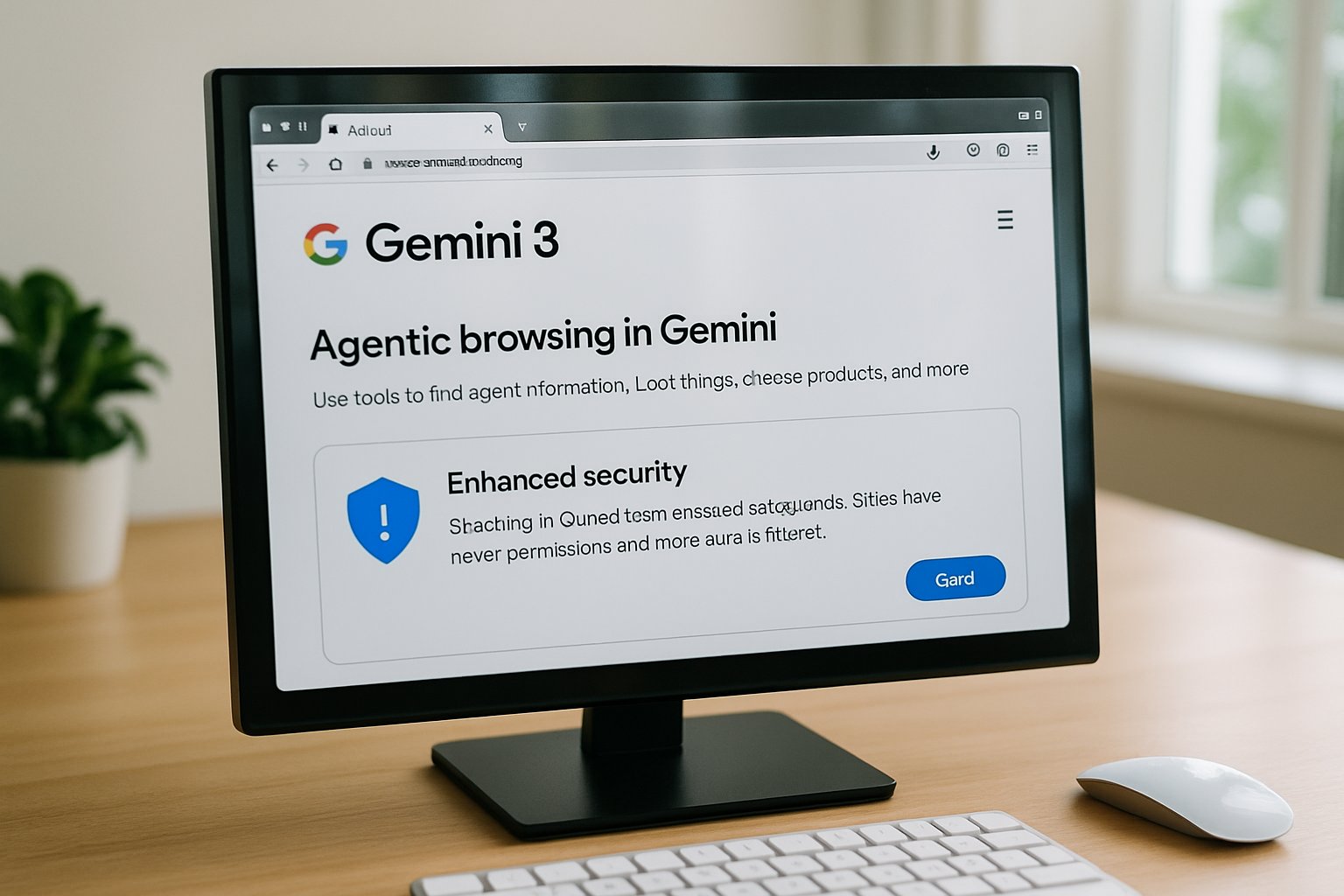
Gemini 3 Chrome currently offers three headline tools. First, multi-tab summarization condenses research across open pages into bullet points. Second, on-page clarifications let readers highlight confusing passages for instant explanation. Third, an AI Mode inside the omnibox surfaces Search Overviews and suggested follow-ups.
Google assistant branding appears sparingly, yet the conversational flow feels familiar to mobile users. However, the company stresses that the browser incarnation draws power from the new Gemini 3 model. Consequently, responses now incorporate images, code samples, and citations when relevant.
These tools demonstrate immediate convenience gains. However, broader autonomy looms in the next release wave. Gemini 3 Chrome will enable these flows without extensions.
To gauge scale, consider Chrome’s unparalleled market footprint.
Chrome Reach Magnifies Impact
Chrome held roughly 71 percent global browser share in December 2025, per StatCounter. Furthermore, U.S. desktop share registered near 64 percent during the same period. Therefore, shipping new AI features through Chrome instantly seeds a billion-plus potential testers.
Several data points underscore the commercial opportunity.
- Grand View Research values the 2024 conversational AI market at USD 11.6 billion.
- The firm projects USD 41.4 billion by 2030, reflecting compound momentum.
- MarketsandMarkets offers similar growth, hitting almost USD 50 billion by 2031.
Consequently, embedding Gemini 3 Chrome positions Google to capture expanding enterprise budgets. Publishers, advertisers, and developers will inevitably adjust to shifting user behavior.
Market size and installed base create undeniable leverage. Next, we explore what true autonomy might entail.
Agentic Tasks Explained Clearly
Google defines agentic browsing as AI executing multi-step web tasks autonomously. Examples include adding shoes to a cart, booking a haircut, or uploading expense receipts. Subsequently, the user can monitor actions through an on-screen timeline and pause if needed.
Under the hood, Gemini orchestrates planning, navigation, and form completion using specialized tool calls. Nevertheless, Google claims every irreversible step requires explicit user confirmation. The design echoes emerging safety patterns in autonomous agents.
Analysts caution that agentic browsing magnifies risk alongside convenience. A December 2025 incident reportedly wiped a developer drive during an agentic coding workflow. Consequently, Chrome will ship sandboxing, privilege separation, and an action log for transparency. Google assistant style prompts will alert users before sensitive actions execute.
Agentic power promises time savings yet demands vigilant safeguards. With risks outlined, governance becomes paramount. Enterprise leaders must analyse control frameworks next.
Enterprise Controls And Risks
Gartner research highlights growing demand for explainable generative platforms. Moreover, the firm urges lifecycle governance, audit trails, and role-based permissions. Therefore, Google presents Gemini 3 Chrome with adjustable data sharing settings for Workspace domains.
Security teams still raise questions about prompt injection, phishing surfaces, and data residency. In contrast, Google cites “comprehensive safety evaluations” and external red-teaming. Nevertheless, independent audits remain scarce until public agentic rollout completes.
For developers, Antigravity offers command review before system execution. Additionally, terminal access defaults to read-only unless elevated with human approval. Such guardrails intend to prevent another destructive episode.
Strong governance will determine enterprise adoption pace. Meanwhile, competition pushes the innovation cycle forward. Understanding rivals helps forecast market dynamics.
Competitive Landscape Heats Up
Microsoft positions Edge Copilot as the principal challenger. Furthermore, OpenAI prototypes its own Operator browser agent. Brave integrates Leo while smaller vendors test partnerships with model providers.
Consequently, capabilities once unique become table stakes. Edge already summarizes pages and drafts emails within Outlook. However, Gemini 3 Chrome benefits from Google’s ecosystem depth in Search, Maps, and YouTube.
Advertisers worry conversational answers may reduce click-through to external sites. Publishers echo similar concern over traffic volatility. In contrast, Google argues AI Overviews link prominently to sources.
Competitive pressure accelerates feature shipping cycles. Therefore, developer tooling becomes a strategic hinge. Antigravity illustrates that pivot.
Developer Tools And Antigravity
Antigravity enters public preview alongside Gemini 3’s broader release. The environment lets multiple agents coordinate code, terminal commands, and browser actions. Additionally, artifact storage and replay logs facilitate compliance audits.
Developers can call Gemini 3 Chrome APIs for cross-tab summarization or task automation. Subsequently, Vertex AI and AI Studio provide scaling paths. Google assistant stubs simplify rapid prototyping for Workspace integrations.
Nevertheless, engineers must design fallback strategies when agent plans fail. Timeouts, manual overrides, and granular scopes remain essential defensive patterns.
Robust tooling empowers experimentation within controlled boundaries. Next, professionals should map career implications. Certification offers a practical first step.
Certification And Next Steps
Demand for AI fluency now extends beyond data scientists. Product managers, marketers, and security leads all need baseline competence with autonomous systems.
Professionals can boost expertise through the AI Researcher™ certification. Courses cover prompt engineering, agent evaluation, and governance frameworks aligned with industry guidance. Consequently, graduates can better translate Gemini 3 Chrome capabilities into secure business value.
Additionally, teams should pilot low-risk workflows before scaling to mission-critical processes. Metrics such as time saved, error rate, and user trust should guide rollouts.
Structured learning and phased pilots reduce uncertainty. Therefore, organizations capture upside while containing exposure.
Gemini 3 Chrome signals a decisive shift toward ambient, autonomous web experiences. However, the technology’s success will hinge on transparent governance and practical safety rails. Market data shows ballooning demand for conversational AI, yet competition remains fierce. Consequently, Google must iterate quickly while sustaining trust. Enterprise leaders should weigh productivity gains against compliance obligations. Meanwhile, developers can experiment safely within Antigravity’s auditorable environment. Professionals who upskill early will differentiate themselves as agentic browsing becomes the norm. Start preparing now, and let structured certification guide the journey toward effective, responsible AI adoption.
Disclaimer: Some content may be AI-generated or assisted and is provided ‘as is’ for informational purposes only, without warranties of accuracy or completeness, and does not imply endorsement or affiliation.


