

AI CERTs
5 months ago
OpenAI workspace Prism shakes up research
The race to streamline scientific writing intensified yesterday. OpenAI unveiled Prism, a cloud-based platform that merges LaTeX editing with GPT-5.2 reasoning for scientists. The OpenAI workspace promises unlimited projects, collaborators, and compile speed—at zero cost. Consequently, researchers worldwide are reassessing existing workflows. This article dissects the launch, features, benefits, and unresolved concerns in 1200 words. Furthermore, it positions Prism within the broader market for free AI research tools. Expect concise analysis tailored for technical professionals. Finally, you will learn actionable next steps and certification resources.
Launch Signals New Era
Prism debuted on January 27, 2026, via an OpenAI blog post and product page. Accordingly, the announcement highlighted free, unlimited access for anyone holding a ChatGPT personal account. Meanwhile, organizational tiers—Business, Enterprise, Education—will roll out soon. OpenAI cited 8.4 million weekly ChatGPT science queries as the catalyst for development. Kevin Weil, OpenAI VP for Science, offered an eye-catching comparison. He said, “I think 2026 will be for AI and science what 2025 was for AI and software engineering.” The quote underscored strategic intent to embed the OpenAI workspace into daily scholarly routines. Moreover, Prism repackages technology from the acquired LaTeX editor Crixet, accelerating time-to-market. These facts illustrate a timely push toward integrated, free AI research tools. Nevertheless, the bold promises require close scrutiny before laboratories migrate entirely. Prism’s rapid arrival signals aggressive expansion by OpenAI into academic territory. However, product substance matters more than marketing; the next section inspects key capabilities.
Key Features At Glance
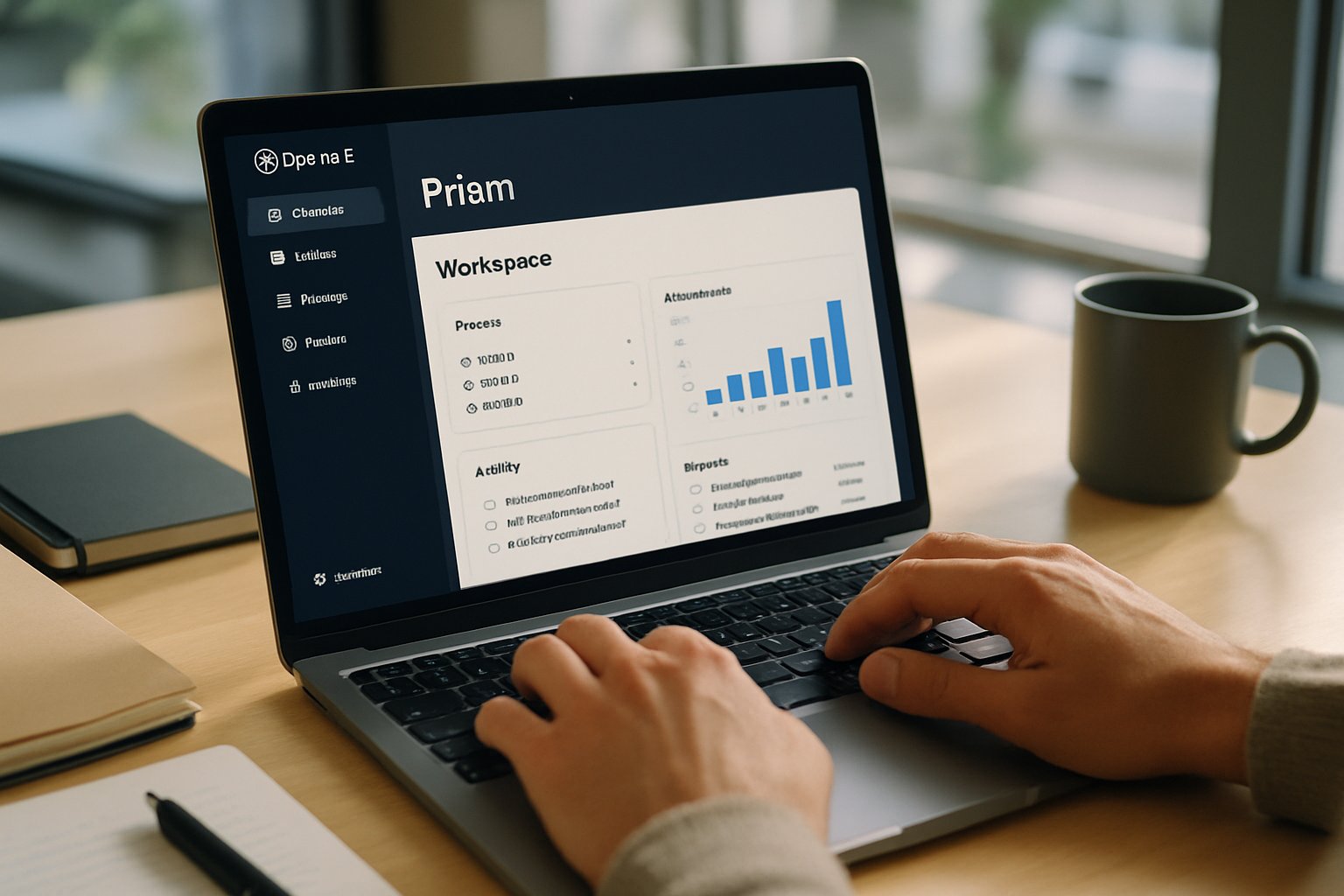
Prism centers on a LaTeX-native cloud editor with live rendering and version control. Additionally, GPT-5.2 Thinking sits beside every paragraph, equation, and figure. Because the model sees full context, it can refactor formulas, suggest citations, or rewrite cumbersome prose. Moreover, users can convert whiteboard images into TikZ diagrams or voice notes into code blocks. Zotero integration simplifies literature management, although group libraries lack support today. Unlimited compile speed removes traditional latency during PDF generation. Core capabilities include:
- Project-aware GPT editing with contextual reasoning.
- Real-time collaboration for unlimited coauthors.
- Seamless Zotero citation syncing.
- Image, handwriting, and voice to LaTeX conversion.
- Instant export to PDF, LaTeX, or Git repositories.
Consequently, the OpenAI workspace aspires to replace piecemeal tooling stacks with one browser tab. These features set the stage for measurable productivity gains, examined next.
GPT5.2 Contextual Reasoning Power
GPT-5.2 claims important advances in long-context tasks. For example, OpenAI benchmarked accurate multi-document co-reference across thousands of tokens. Therefore, Prism can allegedly analyze entire manuscripts without losing variable definitions or symbol references. Independent validation remains pending, yet early testers report coherent equation explanations. In contrast, earlier models often drifted after several pages. The OpenAI workspace could thus elevate confidence in AI-generated technical edits. Nevertheless, citation hallucinations remain a documented risk. Feature breadth is impressive, combining editing, reasoning, and reference management. Next, we evaluate how these capabilities translate into real productivity for scientists.
Productivity Gains For Scientists
Researchers and scientists juggle drafting, formatting, and collaboration across disparate tools. Consequently, context switches erode focus and introduce version conflicts. Prism consolidates tasks inside one OpenAI workspace, potentially recapturing hours each week. A preliminary internal test by OpenAI showed 35 percent faster manuscript completion. Additionally, unlimited collaborators remove paywall friction for graduate students and visiting scholars. Because GPT-5.2 comment threads live beside source code, feedback cycles compress significantly. Moreover, the free AI research tools suite democratizes access for institutions with limited budgets. Key reported gains include:
- Reduced formatting effort during LaTeX compilation.
- Automatic equation checking with immediate correction suggestions.
- Rapid citation lookups pulled from arXiv and PubMed.
- Smoother author attribution tracking through document history.
Professionals can enhance their expertise with the AI+ Cloud Architect™ certification. Therefore, workflow speedups intersect with formal skill development opportunities. These advantages appear compelling; yet, scientists must weigh material risks, detailed next.
Risks And Open Questions
Every OpenAI workspace carries trade-offs. Prism’s literature assistant might fabricate titles or DOIs, mirroring broader LLM citation issues. Furthermore, provenance of model-generated text complicates authorship attribution for journals. Data privacy remains opaque because OpenAI has not clarified training retention policies for personal accounts. Meanwhile, enterprise customers will demand strict contractual guarantees. Vendor lock-in also looms; exporting complex figures back to Overleaf may break TikZ paths. Subsequently, researchers could become dependent on proprietary infrastructure. Independent benchmarks are still scarce, leaving performance assertions unverified. Real concerns span accuracy, ethics, and platform dependence. However, competitive dynamics could accelerate transparency, explored in the next section.
Competitive Landscape And Outlook
Overleaf currently dominates collaborative LaTeX editing across academia. Google’s Gemini models integrate with Docs but lack full LaTeX support. Anthropic positions Claude as a document assistant yet lacks a native editor. Consequently, the OpenAI workspace enjoys first-mover advantage in an integrated, model-aware environment. Nevertheless, incumbents may respond quickly by embedding multi-modal reasoning into existing portals. Market adoption will hinge on model accuracy, privacy guarantees, and export flexibility. Moreover, OpenAI hinted that premium tiers will add advanced functions, signaling a future freemium split. Analysts expect institutions to pilot free AI research tools during 2026 grant cycles. Competition will likely drive rapid iteration and clearer governance. With that context, practitioners need concrete adoption strategies.
Practical Adoption Next Steps
Teams considering Prism should begin with a low-stakes pilot manuscript. First, enable Zotero sync and test citation accuracy on known references. Secondly, upload a complex equation set and evaluate GPT-5.2 refactoring. Thirdly, export the project to PDF and raw LaTeX, verifying fidelity. During pilots, observe how the OpenAI workspace handles proprietary information. Additionally, document any privacy notices displayed during onboarding. Subsequently, hold a retrospective to compare time savings against baseline metrics. If benefits outweigh risks, negotiate enterprise terms before handling sensitive data. Professionals can reinforce cloud governance skills through the AI+ Cloud Architect™ certification. Structured evaluations mitigate hype and surface gaps early. Consequently, stakeholders can decide on full adoption with confidence.
Prism arrives amid rising demand for integrated, intelligent writing platforms. The OpenAI workspace couples LaTeX fluency with GPT-5.2 reasoning, offering unmatched convenience. Furthermore, scientists gain free AI research tools that reduce administrative overhead. Nevertheless, citation fidelity, data governance, and lock-in warrant vigilant assessment. Competition from Overleaf and Google will likely improve options and transparency. Therefore, early pilots with clear metrics remain the wisest course. By combining practical tests with continuing education, teams can harness AI without compromising rigor. Explore Prism, scrutinize its outputs, and pursue certifications to stay ahead in 2026’s AI-driven research economy.
Disclaimer: Some content may be AI-generated or assisted and is provided ‘as is’ for informational purposes only, without warranties of accuracy or completeness, and does not imply endorsement or affiliation.


