

AI CERTs
6 months ago
ASML bookings soar amid AI chip rush
Investors anticipated strong numbers from ASML. Nevertheless, the Dutch lithography champion still surprised the market. On 28 January 2026, the company disclosed fourth-quarter orders worth €13.2 billion. Consequently, ASML bookings more than doubled versus the prior quarter. The surge links directly to runaway AI server capacity expansions and unprecedented chip demand. Furthermore, greater logic and memory investments lifted demand for extreme ultraviolet tools. Analysts immediately raised price targets and highlighted a €38.8 billion backlog. Meanwhile, sceptics pointed to geopolitical limits and customer concentration risks. This article unpacks the numbers, drivers, and implications for semiconductor supply chains. It also examines how future strategies could influence capital spending patterns.
Record Bookings Signal Momentum
First, the headline data deserve careful attention. Fourth-quarter ASML bookings reached €13.2 billion, versus €5.4 billion in Q3. Moreover, €7.4 billion of these orders involved EUV systems, underscoring the technology’s central role. ASML shipped 94 lithography systems during the quarter and 300 during 2025 as a whole. Consequently, the backlog swelled to €38.8 billion, offering multi-year revenue visibility. Net bookings represent future revenue, not immediate sales, yet investors treat the metric as an early signal. Therefore, doubling quarter-on-quarter orders indicates vigorous customer roadmaps rather than simple inventory fills. CEO Christophe Fouquet attributed the momentum to accelerating AI workloads across hyperscale data centers.
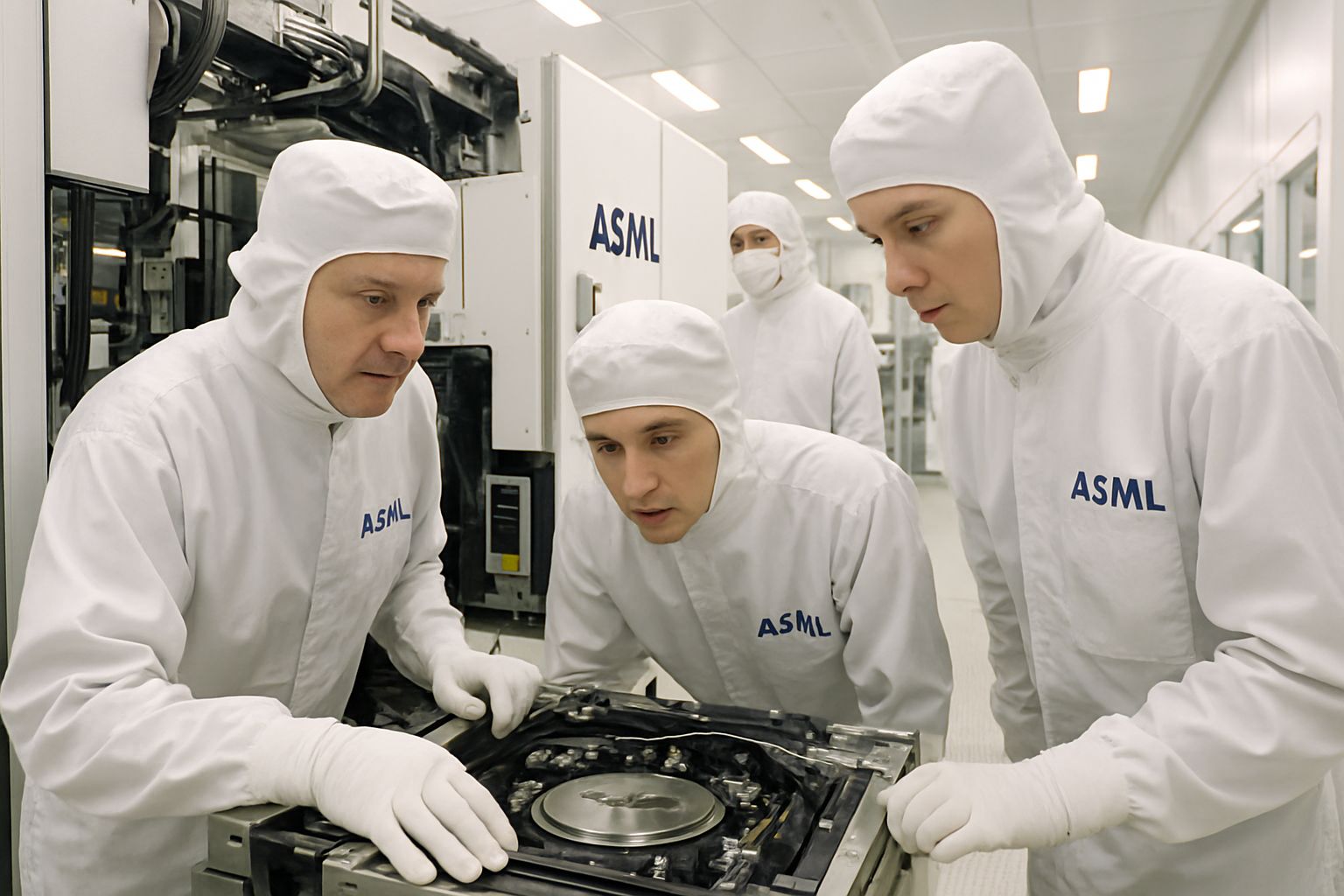
The numbers confirm unprecedented manufacturing intent among leading foundries. However, interpreting the quality of these orders requires understanding the capex context. We turn next to the AI investment wave powering that context.
AI Capex Demand Surge
Artificial intelligence workloads continue scaling almost exponentially. Consequently, chipmakers must expand advanced nodes for training and inference accelerators. Cloud providers including Microsoft, Google, and Amazon demand ever larger clusters. Moreover, lower inference costs widen AI adoption beyond research labs. Growing chip demand from every cloud region amplifies the capital cycle. Fouquet told CNBC that cheaper AI means more applications and, therefore, more chips. That logic cascades back to foundries such as TSMC, Samsung, and Intel. These firms placed significant Q4 orders, driving the spike in ASML bookings. Analysts at Evercore estimated AI servers now consume over half of new 3-nanometer wafers. Additionally, memory makers Micron and SK Hynix advanced DRAM roadmaps that also need EUV.
- Q4 net bookings: €13.2 billion
- EUV share: €7.4 billion
- Backlog: €38.8 billion
- Projected 2026 sales: €34-39 billion
The AI capex flywheel shows few signs of stalling. Nevertheless, demand momentum brings supply-chain pressures, examined in the next section.
EUV Demand Outpaces Supply
EUV tools sit at the heart of modern lithography equipment. However, each machine costs over €200 million and involves complex optical subsystems. ASML depends on exclusive partners for lasers, mirrors, and vacuum modules. Moreover, scaling production requires multi-year capacity investments at suppliers. Supply tightness therefore persists even as ASML ramps manufacturing. High backlog stretches lead times, forcing customers to place early orders. Consequently, many foundries ordered ahead, inflating ASML bookings but reflecting real necessity. In contrast, slower memory pricing cycles could create temporary shipment delays. Yet management expects 2026 gross margins between 51 % and 53 % despite ramp costs. These figures suggest continued pricing power amid constrained lithography equipment supply.
Persistent tool scarcity underpins ASML’s strong margins. However, geopolitical factors may still reshape regional sales patterns, as discussed next.
Geopolitical Risks Loom Large
Export controls remain the prime external hazard for ASML. Dutch and US rules now restrict high-end lithography equipment shipments into China. Consequently, Chinese fabs cannot access EUV, limiting one potential revenue stream. Moreover, Washington could tighten restrictions further if tensions escalate. Analysts note that China once accounted for nearly 15 % of global chip demand and ASML revenue. In contrast, stronger US and Taiwanese demand currently offsets the gap. Nevertheless, heavy reliance on a few customers increases forecast volatility. Bernstein warned that any node delay at a top foundry would dent ASML bookings. Therefore, investors should monitor regulatory headlines and customer roadmap signals closely.
Geopolitics inject uncertainty into an otherwise bullish story. Subsequently, technology transitions will determine whether upside potential materializes. High-NA EUV embodies the crucial upcoming transition.
High-NA Adoption Questions
High-NA EUV improves resolution by raising numerical aperture from 0.33 to 0.55. However, the upgrade halves field size, raising stitching complexity and cost. Intel expects first production in 2027, while TSMC remains cautious. Consequently, some analysts fear a slower revenue curve than standard EUV. ASML claims early demand is firm, citing prototype shipments already delivered. Moreover, the firm builds capacity for 20 High-NA systems annually by 2028. Yet customers will adopt only if throughput economics prove favorable. Slippage could weigh on future ASML bookings beyond 2027.
Technology risk therefore persists despite current euphoria. Next, financial guidance provides clues about management confidence.
Financial Outlook And Guidance
Management guided 2026 revenue between €34 billion and €39 billion. Gross margin should remain above 51 %, assuming component availability stabilises. Furthermore, a €12 billion buyback program extends through 2028. Consequently, shareholder returns stay attractive even amid volatile markets. Quarter-one 2026 sales are forecast at €8.2-8.9 billion, implying modest sequential decline. However, ASML bookings strength suggests revenue acceleration in later quarters. Debt levels remain low, preserving flexibility for additional lithography equipment capacity investments. Professionals may deepen skills via the AI Ethics Strategist™ certification. Such credentials strengthen governance discussions during advanced node negotiations.
Financial signals appear consistent with sustained growth. Yet workforce changes could influence execution, as outlined next.
Strategic Workforce Streamlining Impact
ASML plans to streamline leadership layers, reducing about 1,700 net roles. Management argues the move will speed decisions and support faster volume ramps. However, workforce shifts carry cultural and operational risks. Moreover, tight engineering labour markets complicate re-hiring if demand surprises upside. Consequently, project management discipline becomes crucial during high-NA scaling. ASML bookings momentum could stall if execution falters. Nevertheless, prior productivity programs delivered margin gains without major disruptions.
The reorganisation seeks agility ahead of the next technology cycle. Finally, the broader industry should watch whether delivery times improve.
Conclusion And Next Steps
ASML’s latest quarter underscores how AI reshapes semiconductor capital flows and chip demand. Moreover, record ASML bookings demonstrate urgent demand for cutting-edge capacity. EUV scarcity, geopolitical uncertainty, and High-NA questions remain unresolved for lithography equipment suppliers. Nevertheless, management guidance and share buybacks signal confidence in sustained growth. Investors should track customer roadmaps, policy shifts, and quarterly ASML bookings to gauge momentum. Consequently, proactive professionals who master ethics and governance can influence responsible AI scaling. Explore the linked certification and stay informed on lithography trends shaping tomorrow’s digital infrastructure.
Disclaimer: Some content may be AI-generated or assisted and is provided ‘as is’ for informational purposes only, without warranties of accuracy or completeness, and does not imply endorsement or affiliation.


