

AI CERTS
2 months ago
Synthetic Clients Boost Therapist Training Outcomes
Consequently, universities, hospitals, and startups are racing to adopt the technology. However, lawsuits involving consumer chatbots have intensified scrutiny from regulators and professional boards. The stakes are high because mental-health shortages persist despite surging demand. Moreover, early evidence suggests simulated practice only works when paired with structured feedback. This article examines the market, research, benefits, and risks behind Synthetic Clients for therapist education. Readers will gain actionable questions for vendors and links to skill-building credentials.
Why Training Needs Change
Demand for therapy outpaces available supervisors across the United States. In contrast, accredited programs confront budget constraints that limit standardized patient sessions. Synthetic Clients promise scalable rehearsal without scheduling hassles. Furthermore, remote learning trends accelerated after pandemic disruptions, increasing appetite for virtual solutions.
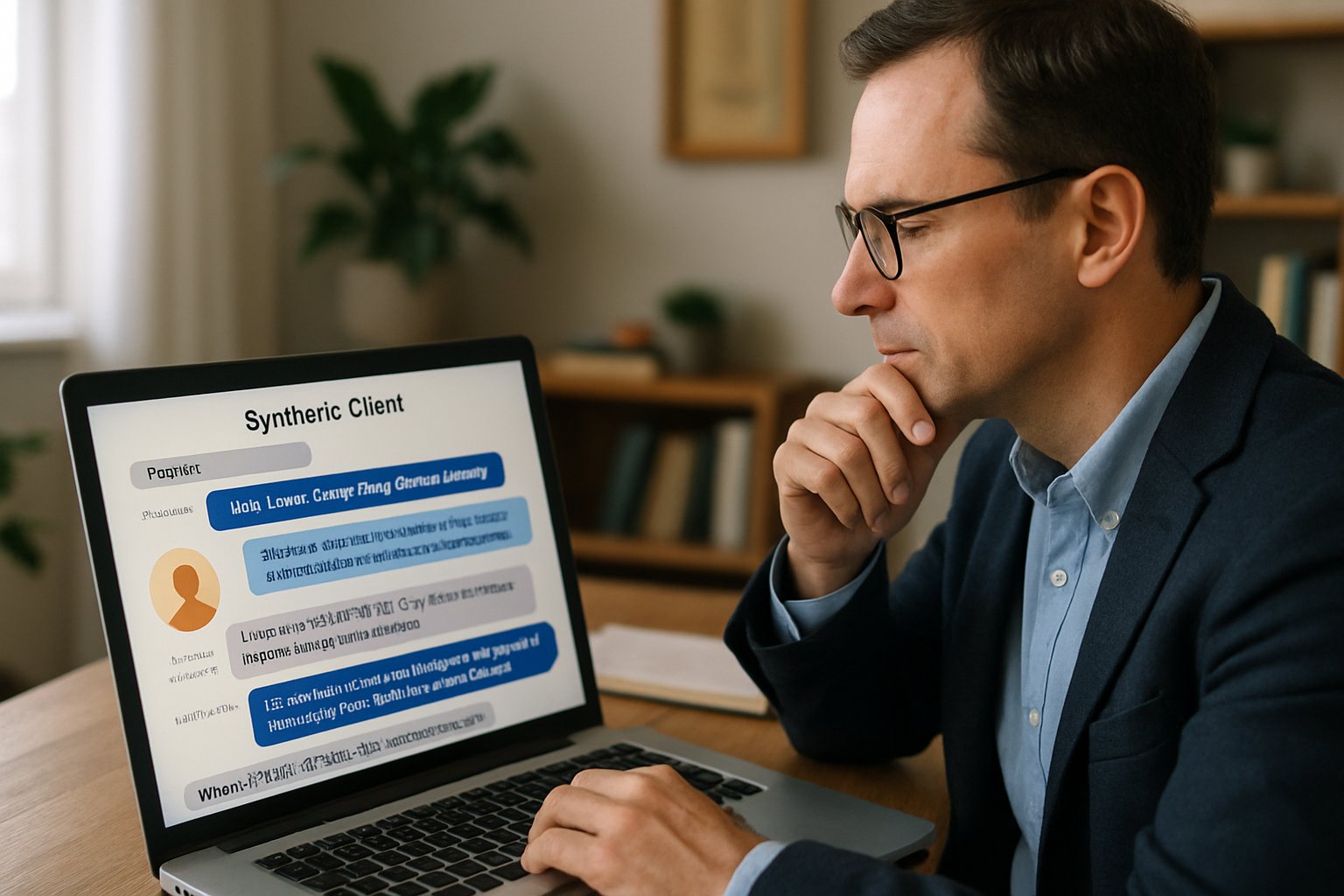
Psychology faculty report larger cohorts and diverse geographical enrollment in online masters programs. Therefore, program directors adopt digital simulations to maintain individualized coaching loads. Meanwhile, insurers push providers to demonstrate measurable quality, rewarding documented therapeutic skills adherence. These pressures collectively drive investment toward AI role-play platforms.
Budgets, enrollment, and accountability needs are converging. Consequently, Synthetic Clients look irresistible to educators.
How Simulations Actually Work
Most platforms couple dialogue engines with scenario libraries built by clinical experts. Many systems rely on finely tuned LLM personas configured with demographic, diagnostic, and linguistic profiles. Consequently, trainees can interview a depressed adolescent one minute and a veteran experiencing PTSD the next. Voice or avatar layers render facial expressions, adding multimodal realism.
After each exchange, analytic modules automatically code reflections, questions, and empathy statements. Moreover, dashboards benchmark learner performance against evidence-based motivational interviewing rubrics. The CARE randomized trial showed that practice combined with feedback improved key counseling behaviors by about 35%. However, practice without feedback occasionally reduced empathy scores.
LLM personas provide lifelike dialogue, yet feedback engines supply the learning gains. Therefore, Synthetic Clients must always integrate objective coaching.
Evidence From Recent Studies
Peer-review databases list more than twenty evaluations published since mid-2024. PATIENT-Ψ compared custom CBT personas with generic GPT-4 across 13 trainees. Those LLM personas demonstrated consistent symptom expression across repeated sessions. Trainees reported higher confidence and observers rated the specialized agent more realistic. In contrast, CARE recruited 94 novice counselors and produced statistically significant behavior improvements only when feedback was present.
Meanwhile, avatar platforms like Kognito show preparedness gains across hundreds of university gatekeepers. However, long-term patient outcomes remain understudied. Researchers call for multi-site trials that follow graduates into clinical practice. Psychology journals are beginning to prioritize such designs.
Key Study Metrics Detail
- CARE trial: effect sizes d≈0.32–0.39 on reflections and questions.
- PATIENT-Ψ study: experts rated realism 15% higher than GPT-4 dialogue.
- Kognito meta-analysis: preparedness scores improved by 12-18% across cohorts.
Collectively, early results validate simulated training but expose evidence gaps. Consequently, Synthetic Clients research is accelerating worldwide.
Benefits Clinicians Frequently Cite
Educators highlight four recurring advantages over conventional role-play.
- Unlimited practice hours without risking patient safety.
- Immediate, objective feedback on therapeutic skills adherence.
- Customizable difficulty, including crisis or cultural scenarios.
- Lower marginal cost than hiring standardized patients.
Moreover, Synthetic Clients support asynchronous learning, letting shift workers practice during off-hours. LLM personas also capture complete transcripts for supervisor review, strengthening reflective practice. Consequently, trainees refine therapeutic skills faster and document competence for insurers. Psychology departments report improved student engagement when gamified scoring dashboards are introduced.
Scalability, data, and flexibility explain the enthusiasm. However, every benefit carries parallel risks addressed next.
Risks Regulators Now Flag
The 2025 Raine v. OpenAI lawsuit alleged chatbot negligence in a teen suicide. Subsequently, several states proposed limits on autonomous digital therapy. Although training tools differ, public perception often conflates them. Consequently, health systems demand strict guardrails before deploying Synthetic Clients.
Experts warn that LLM personas may hallucinate or drift from scripted clinical boundaries. Moreover, simulated crisis language requires real-time detection and escalation protocols. Privacy is another concern because session transcripts contain identifiable information. Therefore, vendors must follow HIPAA and encryption best practices.
Safety, fidelity, and governance dominate regulatory discussions. Nevertheless, transparent design can mitigate most objections.
Implementation Questions To Ask
Procurement teams should interrogate vendors before signing contracts. Firstly, request peer-reviewed evidence linking the product to measurable therapeutic skills gains. Secondly, confirm how crisis scenarios are handled and escalated. Thirdly, examine data retention, encryption, and de-identification policies.
- Evidence quality and sample sizes
- Safety audits and human oversight
- Compliance with HIPAA and FERPA
- Cost of feedback customization
Professionals can enhance their expertise with the AI Educator™ certification. Additionally, certification coursework clarifies critical evaluation checkpoints for Synthetic Clients deployments.
Thorough vetting ensures patient safety and educational value. Consequently, well-informed buyers avoid painful surprises.
Future Research And Policy
Researchers anticipate larger randomized trials that follow trainees into community clinics. Moreover, interdisciplinary Psychology and computer science teams are standardizing crisis benchmarks. International bodies may craft accreditation pathways for Synthetic Clients platforms. Meanwhile, vendors race to publish transparent safety audits to reassure regulators.
LLM personas will grow multimodal, integrating eye-contact detection and emotion classification. Consequently, future simulations could personalize feedback more precisely to emerging therapeutic skills. Nevertheless, balanced policy must guard patient welfare while fostering innovation.
Standards, audits, and multimodal advances define the forthcoming decade. Simulated patients will likely remain central to therapist development.
Synthetic Clients have progressed from novelty to essential teaching infrastructure. Controlled studies indicate meaningful, though modest, skill gains when feedback accompanies practice. However, safety scandals remind the sector that design decisions carry real consequences. Regulators, researchers, and educators must therefore collaborate on robust standards. Meanwhile, professionals can future-proof careers by mastering emerging methodologies and compliance principles. Explore the linked certification to deepen insight and lead responsible innovation.


