

AI CERTs
2 months ago
Unpacking Stock market AI impact on sentiment and valuation
Investors have talked about artificial intelligence for decades. However, the conversation turned material after ChatGPT's debut in 2022. Since then, the Stock market AI impact narrative has moved prices, careers, and policy agendas. Moreover, record earnings-call mentions signal that executives believe capital markets reward AI commitment. Yet academics note that sentiment effects fade fast when businesses lack real revenue. Consequently, investors now parse each disclosure line for clues about sustainable cash flows. This article dissects mention counts, price behavior, regulation, and strategy so professionals can separate signal from spin.
Stock Market AI Impact
FactSet logged 306 S&P 500 earnings calls that cited AI between 15 September and 4 December 2025. Consequently, the Stock market AI impact was visible in intraday charts as traders chased symbols with fresh AI soundbites. Industry event-studies found average three-day abnormal returns near 4.6% when companies highlighted AI strategy during 2022-2023 windows. Meanwhile, social-media excitement created intraday volatility that algorithmic funds tried to arbitrage. These figures confirm that language can still move markets. Nevertheless, euphoria fades when fundamentals disappoint. Next, we examine why hype sometimes outruns valuation.
AI Hype Meets Valuation
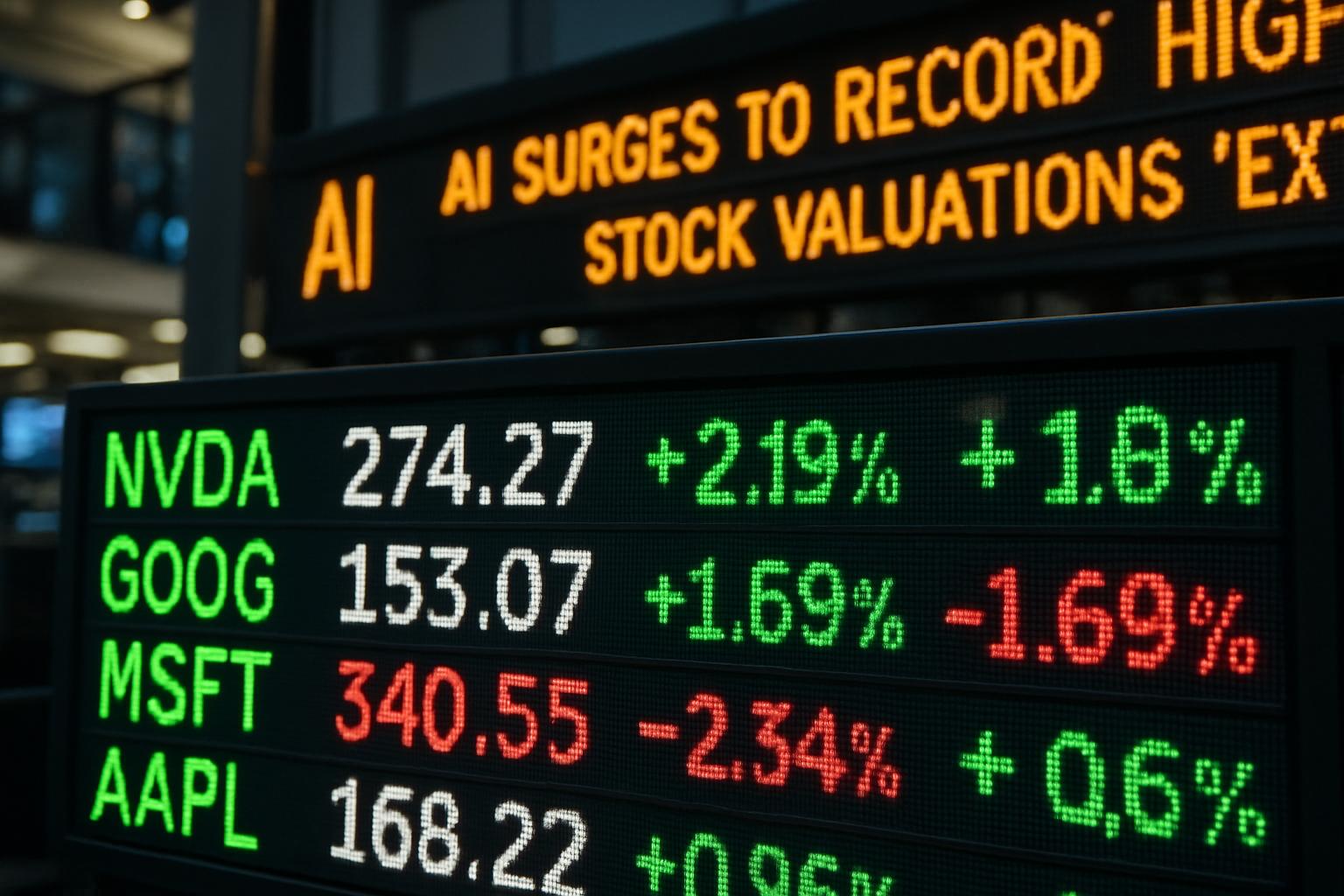
Investors once rewarded any company that uttered AI, yet 2025 brought a valuation reality check. In contrast, Deutsche Bank found many heavy-talking firms later underperformed peers because spending exceeded realized revenue. Meanwhile, concentrated enthusiasm pushed Nvidia above a $5 trillion market cap in October 2025. Such extremes magnified the Stock market AI impact on passive index performance, especially in megacap-weighted benchmarks. However, Dow Jones AI influence remained narrower because only a subset of constituents provides core AI infrastructure. Equity strategists at major banks advise moving from narrative screens to cash-flow screens before allocating capital. Valuation requires evidence, not buzzwords. Subsequently, market participants turned to data science to separate credible adopters from opportunistic name-droppers. The next section explores how modern NLP helps that filtering.
Sentiment Signal Extraction
Advanced LLMs now rank disclosure sentences by materiality rather than word frequency. Moreover, S&P Global claims its transformer model beats lexicon approaches in backtests across 2019-2025 data. Quant desks feed these scores into event-driven strategies for faster, cleaner entry signals. Therefore, traders capturing the Stock market AI impact through machine readers reported higher Sharpe ratios in pilot programs. Additionally, Dow Jones AI influence models link semiconductor orders to industrial suppliers inside the index. Nevertheless, model drift remains a threat when corporate language shifts or regulators mandate new disclosure styles. Backtests spanning bull and bear regimes still show signal decay after six months, underscoring the importance of retraining. Effective signal extraction demands constant monitoring and retraining. Consequently, investors must weigh tooling risk alongside potential alpha. Next, we discuss concentration hazards tied to a few dominant enablers.
Concentration Risk Warning Signs
Capital has flowed disproportionately to chipset leaders such as Nvidia, AMD, and TSMC. Meanwhile, passive funds replicate that tilt, raising systemic exposure if growth stalls or supply shocks hit. IMF officials warned in 2025 that overreliance on a single technology stack threatens financial stability. The Stock market AI impact becomes most visible when one hyperscale earnings miss drags the whole benchmark lower. Furthermore, Dow Jones AI influence could amplify volatility because price-weighted mechanics magnify big moves in high-priced shares. Portfolio stress tests suggest a 25% correction in one megacap could trim index earnings by 8%. Concentration builds quietly until stress reveals fragility. Therefore, regulators and risk managers track cross-holdings and prime brokerage leverage. The next section reviews the policy response.
Regulatory Scrutiny Intensifies Globally
SEC settlements in March 2024 targeted advisers that exaggerated algorithmic capabilities. Chair Gary Gensler warned that AI-washing will stay an enforcement priority. Moreover, European regulators study disclosure templates to harmonize AI risk reporting across exchanges. When enforcement actions hit, the Stock market AI impact can reverse quickly, erasing earlier hype gains. In contrast, transparent firms often enjoy a credibility premium, particularly within Dow Jones AI influence sectors. Asia-Pacific exchanges are drafting similar guidelines to maintain cross-border comparability. Policy momentum favors clarity over slogans. Subsequently, corporate boards seek defensible metrics before adding AI to investor decks. Next, we examine specific Dow movements reflecting these dynamics.
Dow Component Dynamics Shift
The Dow’s 30 names respond unevenly to AI narratives because weighting depends on absolute share price. Consequently, a large move in Nvidia or Microsoft can swing the index even if fundamentals elsewhere stay muted. During October 2025, analysts calculated that Nvidia alone contributed over 60 points to daily Dow gains. Such data underscore the Dow Jones AI influence on traditional blue-chip perception among global investors. Furthermore, the Stock market AI impact spills into industrial names supplying data centers, widening the thematic footprint. Index committees review composition annually, yet structural biases remain hardwired. Index structure shapes headline risk. Nevertheless, tactical investors can hedge exposure with sector swaps or options. The final section outlines a pragmatic playbook.
Tactical Playbook For Investors
Portfolio managers should begin with a materiality checklist before paying any premium for AI promises. First, verify revenue contribution, capex plans, and model lineage within public filings. Second, compare sentiment scores from at least two vendors to reduce single-source bias. Third, stress-test concentration scenarios using factor and scenario analysis tools. Professionals can enhance their expertise with the AI Writer™ certification, which teaches rigorous disclosure analysis.
- Does the company disclose AI revenue separately?
- Are cost savings verified by auditors?
- Is the data pipeline proprietary or licensed?
- What guardrails address model drift risk?
Moreover, overlaying options strategies can buffer sudden narrative shifts. The Stock market AI impact remains fluid, so plans must adapt as evidence accumulates. Fourth, engage governance teams to pressure issuers for audited AI metrics. Disciplined frameworks convert hype into measurable risk-adjusted returns. Consequently, informed investors lead during sentiment cycles rather than follow headlines.
AI continues to reshape capital markets, yet the story now demands proof. FactSet counts, NLP advances, and regulatory actions reveal both opportunity and fragility. Furthermore, concentration risk, Dow Jones AI influence mechanics, and enforcement momentum require vigilant monitoring. Therefore, the Stock market AI impact will favor firms showing tangible revenue, clear metrics, and responsible disclosure. Adopt the playbook, pursue continuous learning, and stay skeptical when hype outruns delivery. Explore the AI Writer™ credential and refine your market analytics edge today.


