

AI CERTS
6 months ago
AI Data Centers Trigger Record Peak Power Demands
The rapid shift raises strategic, technical, and political questions that the industry must answer fast. This analysis examines rising demand drivers, US grid impacts, hyperscalers' responses, and evolving policy debates. It also outlines mitigation technologies and highlights certification paths for energy-savvy architects.
Global electricity use by AI Data Centers hit 415 TWh in 2024, per the International Energy Agency. IEA projects a doubling to 945 TWh by 2030 if current GPU deployment trends persist. Meanwhile, Lawrence Berkeley National Laboratory warns that US grid share could reach 12 percent within three years. These numbers set the stage for an unprecedented energy conversation.
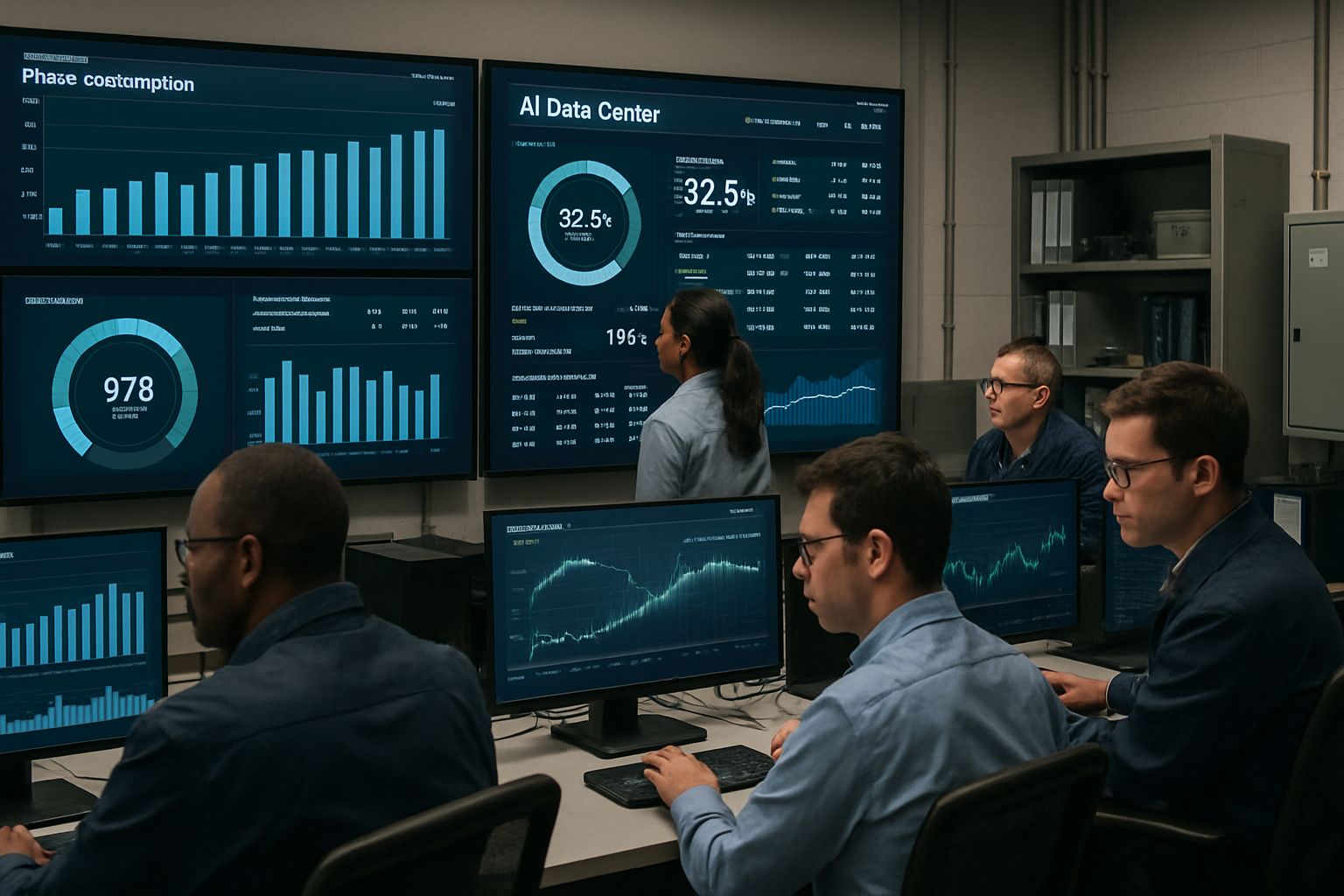
Global Demand Surges Upward
IEA researchers attribute most growth to compute-hungry generative AI workloads and escalating rack densities. Moreover, average GPU thermal design power has jumped from 400W to 700W within five years. Therefore, campus-level peak loads now push 1GW electricity in several proposed facilities. IEA notes the sector’s share remains small globally, yet local grids feel acute stress.
Key global indicators include:
- 2024 electricity use: 415 TWh, up 40% since 2020.
- Projected 2030 demand: 945 TWh under IEA base case.
- Annual growth rate: roughly 12 percent worldwide.
- Installed IT capacity: about 100 GW today.
Collectively, these figures reveal the steep climb facing planners. However, the strain intensifies once demand clusters inside the US grid.
Strain On US Grid
The United States hosts nearly 45 percent of global AI Data Centers. Consequently, the US grid absorbs disproportionate peak loads. LBNL estimates 176 TWh consumption in 2023, rising possibly to 580 TWh by 2028. That scenario equals 74–132 GW of continuous draw, equivalent to dozens of new nuclear reactors.
Utilities from PJM to ERCOT have revised peak forecasts upward multiple times during 2025. Meanwhile, several local moratoria halted data-center permits until transmission upgrades catch up. In contrast, Texas encourages flexible participation, allowing large campuses to curtail load during extreme weather. Such regional differences complicate planning. Therefore, hyperscalers increasingly step in to fund infrastructure. Their involvement is the focus of the next section.
Key Role Of Hyperscalers
Hyperscalers dominate procurement of cutting-edge GPUs and efficient cooling equipment. Additionally, they negotiate multibillion-dollar power purchase agreements to secure renewable supply. OpenAI's planned Stargate campus illustrates the trend, pledging to cover 1GW electricity needs privately. Google, Microsoft, and Amazon promise similar measures across Virginia, Ohio, and Iowa.
Moreover, hyperscalers design dedicated microgrids integrating batteries and gas turbines to bypass interconnection delays. Such projects relieve the US grid temporarily while long lines are built. Nevertheless, on-site combustion raises emissions concerns now addressed by new EPA guidance. These AI Data Centers now represent strategic assets for cloud growth. Financial muscle helps hyperscalers act quickly. However, technology choices decide sustainability outcomes. The following section explores those technologies.
Mitigation Technologies Rapidly Emerging
Cooling Efficiency Advances Continue
Liquid cooling is moving mainstream as rack densities surpass 50 kW. Consequently, operators report Power Usage Effectiveness values near 1.1 in new AI Data Centers. Direct-to-chip loops reduce water loss compared with legacy evaporative towers. Meanwhile, designers capture waste heat for district heating in colder regions.
Popular mitigation tools include:
- Battery energy storage for four-hour peak shaving.
- Gas or fuel-cell generators sized below 1GW electricity for resilience.
- AI-driven workload shifting to participate in demand response markets.
Professionals can enhance their expertise with the AI Architect™ certification. Graduates learn to size microgrids, optimize cooling, and integrate renewables for AI Data Centers. These technologies cut operating risk. Nevertheless, local politics still shape outcomes. Policy dynamics come next.
Policy And Community Tensions
EPA tightened permitting for portable turbines after air quality complaints near several campuses. Additionally, counties in Northern Virginia imposed zoning changes to slow unchecked expansion. Community advocates fear higher rates and water depletion despite economic benefits. In contrast, some Texas towns compete aggressively for new facilities by offering tax abatements.
Regulators face uncertain forecasts and must decide who funds transmission for peak periods. Therefore, several states created dedicated rate classes for AI Data Centers to avoid cross-subsidies. Utilities welcome clarity yet warn timelines remain tight. Policy friction will persist. Subsequently, stakeholders watch forecasts to guide investments. Those projections can diverge widely.
Forecasts And Uncertainties Ahead
BloombergNEF sees US grid demand from data centers exceeding 100 GW by 2035. Analysts expect thousands of additional AI Data Centers, though timelines remain fluid. Meanwhile, Grid Strategies models even higher peaks if all speculative projects proceed. LBNL presents low and high cases, differing by almost 60 GW in 2028. Consequently, planners debate whether efficiency gains will offset the Jevons rebound effect.
Moreover, future chip designs could reduce watts per operation or, conversely, enable bigger models that erase savings. Forecast divergence makes cost allocation, siting, and policy timing risky. Nevertheless, consensus exists that growth remains steep through at least 2030. Prepared organizations can still thrive, as the conclusion explains.
Peak demand from AI Data Centers is reshaping power planning faster than many experts expected. However, proactive action by hyperscalers, utilities, and regulators can limit negative impacts. Investments in liquid cooling, microgrids, and demand response already shave 1GW electricity spikes at new sites. Moreover, clearer rate structures ensure costs fall on beneficiaries rather than small consumers. Professionals who master power architecture will stay valuable as expansion continues. Consequently, now is the ideal moment to pursue the AI Architect™ certification and lead the next generation of sustainable AI Data Centers.
Disclaimer: Some content may be AI-generated or assisted and is provided ‘as is’ for informational purposes only, without warranties of accuracy or completeness, and does not imply endorsement or affiliation.


