

AI CERTs
2 months ago
AI literacy India push gains urgency after AI4India report
A January 2026 AI4India report has placed a stark spotlight on India’s preparedness for an AI-driven economy. Moreover, the study urges the government to declare AI literacy India a national baseline within the next 18 months. The call arrives as student adoption soars and institutions struggle to keep pace. Consequently, policy makers face a narrow window to align curriculum, teacher skills, and infrastructure. Released ahead of the India-AI Impact Summit at IIT Delhi, the report synthesises 85 expert interviews and multiple surveys. It warns that choices made now will shape employability for a generation. Meanwhile, parallel initiatives like the IndiaAI Mission promise foundational courses for ten million citizens. However, experts caution that scale without depth may widen existing inequities. This article unpacks the evidence, stakeholder reactions, and practical pathways proposed. Readers will gain a clear view of successes, gaps, and next steps. Finally, professionals will discover certification routes to build strategic competence.
Report Highlights Readiness Gap
The 83-page document opens with a blunt message about readiness. According to AI4India, 53.5% of higher-education students use generative AI daily. Additionally, 23.5% report weekly usage, while only 4.7% rarely engage. In contrast, institutional strategies remain fragmented. Approximately 65% of campuses still police or ban AI instead of teaching with it. Furthermore, the AI Readiness Index shows Tier-1 institutes scoring 2.7 times higher than Tier-3 peers. Authors Alok Agrawal and Shashi Shekhar Vempati label the disparity “unsustainable for inclusive growth.” Therefore, they recommend swift national coordination, financial incentives, and a shift toward AI-first pedagogy. Expanding AI literacy India is presented as the essential first lever.
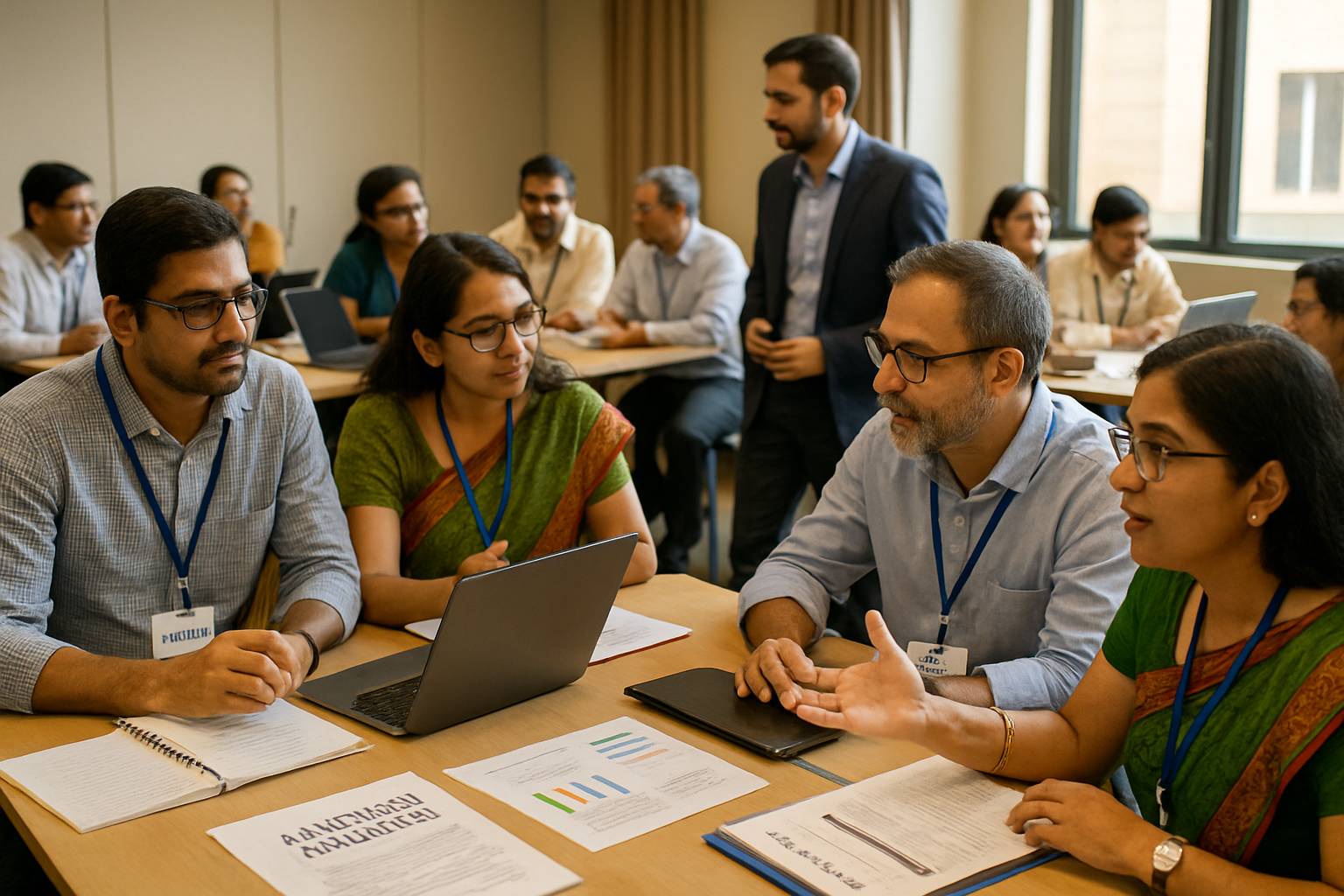
These metrics depict a nation enthusiastic yet underprepared. Nevertheless, coherent policy could still close the gap quickly. Consequently, the next section examines how students are already pushing boundaries.
Student Usage Trends Surge
Student behaviour offers the strongest argument for urgent reform. Moreover, nearly every campus survey echoes AI4India’s findings. Learners rely on chatbots for coding, summarisation, design, and language translation. Faculty interviewees reported libraries buzzing with whispered prompt exchanges instead of textbook debates.
- 53.5% daily users, according to AI4India
- 23.5% weekly users, expanding fast
- Only 4.7% rare or non-users today
- Usage highest in engineering and business programs
However, the report argues that many students exhibit ‘shallow capability’. They can generate answers yet cannot critique bias or hallucination effectively. Therefore, the authors redefine AI literacy as four intertwined competencies: data insight, critical evaluation, collaborative workflow, and ethical awareness. Importantly, this definition extends beyond coding to every discipline. Student enthusiasm highlights that AI literacy India must embed across every syllabus.
Students are ready and impatient. Yet, without depth, enthusiasm may degrade into dependency. Subsequently, we explore why faculty readiness is lagging.
Faculty Skills Still Lag
Faculty capacity remains the most cited bottleneck. Only 17% of lecturers rate their AI proficiency as advanced or expert. Moreover, just 6% feel satisfied with institutional support resources. Several interviewees admitted learning new tools from their own students. Meanwhile, professional development budgets stay static despite escalating demands. The report urges the National Council for Teacher Education to recognise AI pedagogy as a formal specialisation. Furthermore, it recommends a government-funded faculty certification programme aligned with micro-credential frameworks. Professionals can deepen strategy skills with the AI Executive™ certification. Such pathways would raise baseline AI literacy India across classrooms through recognised proof of competence.
Teacher confidence underpins sustainable reform. Consequently, investments in skills will determine program credibility. Therefore, the policy environment deserves closer attention next.
Policy Moves And Missions
Policy momentum is visible yet uneven. Furthermore, several national schemes already address components of the literacy puzzle. The IndiaAI Mission’s recent partnership with Simplilearn exemplifies scalable delivery. It pledges a foundational ‘YUVA AI for ALL’ course for ten million citizens. Additionally, the National Education Policy 2020 has injected AI modules into school syllabi. CBSE now offers elective AI from class six and trains thousands of teachers. Collectively, these measures inch toward AI literacy India at population scale. Experts agree that a unified national AI education framework needs strong metrics.
IndiaAI Ten Million Plan
Under the plan, learners access micro-courses through mobile platforms in multiple languages. However, device affordability and data costs remain obstacles in rural areas. Therefore, AI4India calls for subsidised compute labs and community hubs.
NEP School Initiatives Grow
Schools have begun pilot projects using chatbots for language practice and maths coaching. Nevertheless, researchers warn of widening digital divides without robust teacher training. Consequently, budget allocations for teacher fellowships and content localisation are critical.
Policy tools are gathering but lack coordination. Aligned governance could transform isolated projects into a coherent national AI education system. In contrast, failure to integrate policies could amplify risks discussed next.
Opportunities And Persistent Risks
AI4India outlines high economic upside if reforms succeed. Moreover, AI-augmented roles could boost productivity across sectors from healthcare to logistics. Industry leaders promise to revise job descriptions and embrace portfolio-based hiring. Yet, without structured AI literacy India, gains could cluster among urban elites. However, the report also flags three major risks.
- Inequality between Tier-1 and Tier-3 institutions could widen
- Untrained faculty might encourage superficial tool dependence
- Lack of Indic-language models may exclude vast populations
Furthermore, governance questions persist around measurement, funding, and model stewardship. Independent analysts interviewed by India Today echoed these concerns, stressing ethics and misinformation resilience. Therefore, robust guardrails must accompany expansion.
Opportunities remain significant and attainable. Nevertheless, ignoring the flagged risks could erode public trust quickly. Subsequently, we turn to the practical roadmap proposed.
Implementation Roadmap Steps Ahead
The report details a phased approach for stakeholders. Firstly, policymakers should publish an official baseline competency framework within six months. Simultaneously, finance ministries must allocate funds for shared compute clusters and device subsidies. Secondly, universities should redesign assessments to value AI-augmented reasoning over rote recall. Moreover, institutions must guarantee minimum connectivity and hardware for every student. Thirdly, industry can supply anonymised use cases, apprenticeships, and mentorship to align curricula with workplace reality. Hiring managers should also adopt portfolio evidence rather than GPA alone. Collectively, these steps advance AI literacy India from aspiration to measurable practice.
Such coordinated actions would solidify a sustainable national AI education pipeline. Consequently, graduate employability could improve while mitigating inequality.
The roadmap supplies actionable tasks for each actor. In contrast, delaying execution could entrench existing gaps. Finally, we summarise key insights and outline immediate next actions.
Conclusion And Next Actions
India stands at a decisive juncture. Moreover, the evidence shows students have already normalised AI on campus. Faculty, policy makers, and industry must now institutionalise AI literacy India through coordinated action. Subsequently, universal access, teacher certification, and ethical guidelines should anchor the emerging national AI education framework. The AI4India roadmap offers clear milestones and measurement suggestions. Professionals seeking leadership roles can validate expertise via the AI Executive™ credential. Consequently, organisations will gain talent ready to harness generative tools responsibly. Act today, embed AI literacy India within strategy, and secure competitive advantage for the decade ahead. Nevertheless, delaying AI literacy India adoption could entrench regional and socioeconomic divides.


