

AI CERTS
2 months ago
Agentic Automation Reshapes Repetitive Work
Repetitive digital chores once anchored office life. Today, Agentic Automation promises to liberate teams from that grind. The concept refers to autonomous AI agents that plan, choose tools, and execute multi-step tasks with minimal oversight. Consequently, vendors and investors are pouring billions into the space. However, uneven adoption, governance gaps, and security fears mean the road ahead remains complex. This article dissects the trend for enterprise leaders, balancing opportunity with risk.
Enterprise Market Shift Overview
Enterprise leaders saw chatbots boost Productivity, yet they now demand deeper impact. Agentic Automation answers that call by blending large language models with orchestration frameworks like Microsoft’s Model Context Protocol. Moreover, Dell’s “steward” agents already clean CRM records around the clock. John Roese, Dell’s CTO, argues these agents unlock tasks once deemed uneconomical. The shift also influences Labor allocation as managers reassign staff toward higher-value analysis. Nevertheless, skepticism persists because many pilots stall before scale. Agentic Automation therefore occupies a liminal zone—neither hype nor fully mature.
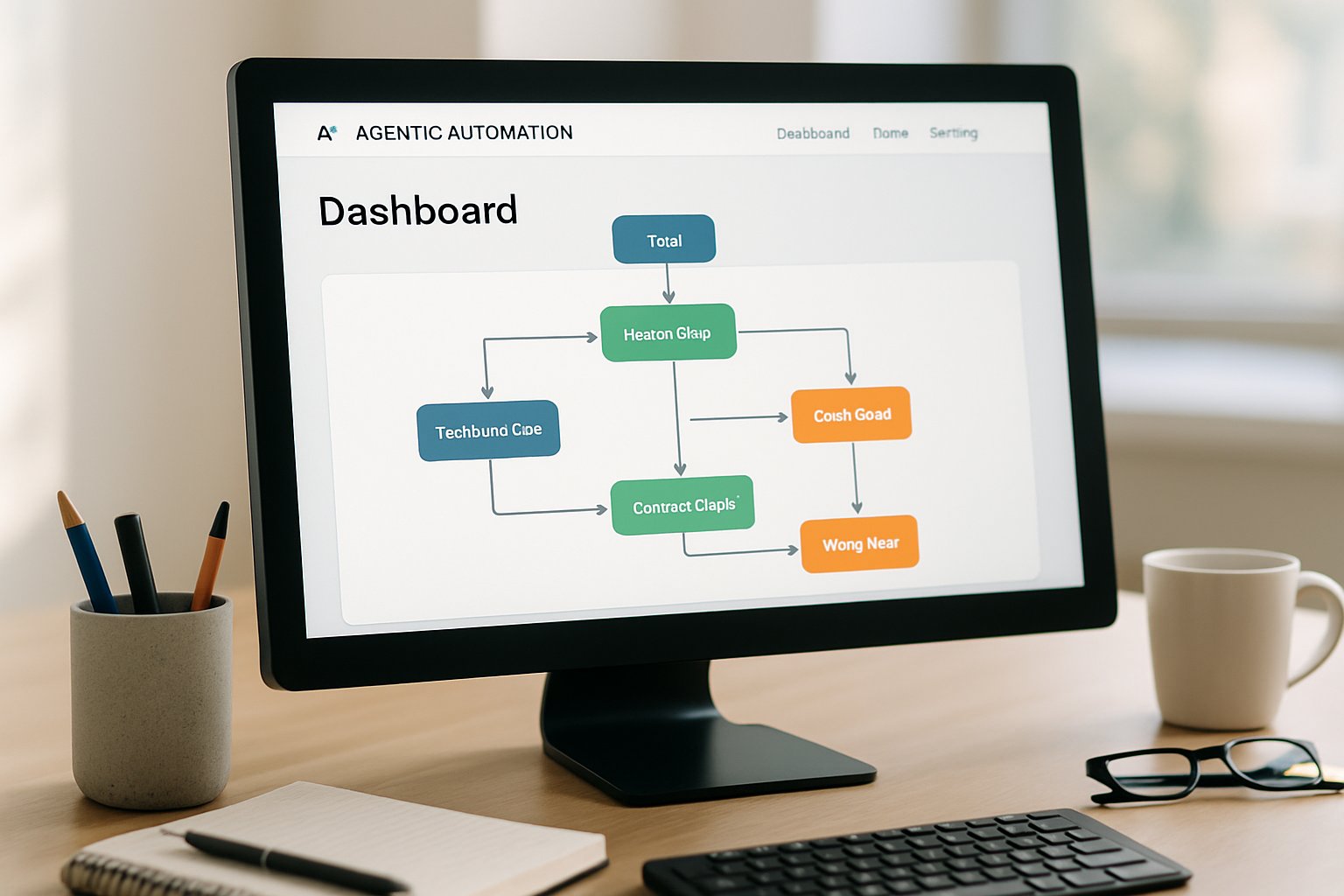
Deloitte predicts 25% of generative AI users will run agent pilots during 2025, rising to 50% by 2027. Furthermore, investors injected more than $2 billion into startups during the last two years, signaling durable momentum. Agentic Automation appears twice in boardroom agendas, underscoring urgency. These market realignments set the stage for concrete adoption metrics discussed next.
Global Adoption Stats Snapshot
Numbers reveal cautious optimism. Gartner’s September 2025 survey found only 15% of IT application leaders considering or deploying fully autonomous agents. In contrast, 75% already test supervised agents. Additionally, 74% perceive new attack vectors tied to agent credentials. Such figures highlight a Productivity promise shadowed by security dread.
- 15% explore fully autonomous deployments
- 75% pilot constrained or supervised agents
- 74% cite security as primary barrier
- RPA market projected between $22.5B and $35.3B for 2025
- Agentic Automation pilots expected at 25% of generative AI users in 2025
These statistics confirm broad experimentation but limited trust. Therefore, leaders must weigh benefits against unresolved risks before scaling further. The following section drills into those benefits and caveats.
Benefits And Key Caveats
Agentic Automation boosts Productivity by eliminating rote clicks. Back-office agents now reconcile invoices and update ledgers without fatigue. Moreover, customer-service teams using Salesforce Agentforce report shorter case durations and improved retention. The technology can also codify tacit knowledge, preserving expertise amid workforce Displacement.
However, Gartner warns many projects underperform due to hallucination errors and unclear ROI baselines. Andrej Karpathy even labels current systems “slop,” urging engineers to fix reasoning gaps. Consequently, success hinges on robust observability, rollback features, and disciplined prompt management.
- Continuous operation raises service uptime but increases compute costs.
- Governance dashboards reduce risk yet demand new skills.
- Vendor “agent washing” confuses buyers and inflates expectations.
- Certification programs such as the AI Everyone™ course help teams build informed oversight.
These contrasting elements illustrate that benefits emerge only with disciplined execution. Nevertheless, strong governance and security foundations can tilt outcomes favorably, as examined next.
Governance And Security Risks
Security teams face fresh challenges. Autonomous agents hold credentials, move data, and call APIs. Therefore, they become lucrative targets. David Bradbury from Okta stresses every agent needs an identity distinct from human accounts. Furthermore, CISOs recommend kill-switches that revoke tokens instantly when behavior veers off-policy.
Meanwhile, Microsoft and Salesforce now bundle observability consoles, audit logs, and policy engines to address those demands. Additionally, protocols such as agent-to-agent (A2A) and MCP impose structured context windows that curb hallucinations. Nevertheless, only 13% of Gartner respondents feel confident about governance maturity today. Agentic Automation success will thus depend on proactive controls that protect data, users, and revenue streams.
In summary, governance tooling evolves rapidly, yet adoption lags. Consequently, enterprise buyers must integrate security design from day one before scaling pilots. The next section explores how these technical concerns intersect with workforce dynamics.
Workforce Impact Debate Today
Labor economists track early effects with nuance. The Yale Budget Lab finds no massive Displacement across the U.S. through late 2025. However, entry-level hiring patterns shift as routine tasks disappear. Additionally, Dell claims staff now focus on creative analytics rather than CRM hygiene, boosting morale.
Moreover, Productivity gains may fund reskilling budgets. Certifications, including the linked AI Everyone™ program, position employees to manage agent pipelines effectively. In contrast, unions warn that unchecked rollouts could erode career ladders by automating foundational duties.
Therefore, responsible leaders pair Agentic Automation with transparent communication and upskilling incentives. Balanced strategies can harness efficiency while sustaining Labor stability.
These observations suggest the need for cautious optimism. Subsequently, we examine the broader market trajectory and actionable next steps.
Outlook And Next Steps
Analysts expect agent platforms to mature alongside RPA and orchestration layers. Consequently, Gartner anticipates a tipping point near 2027 when half of generative AI users will operate agentic workflows. Moreover, open standards like MCP should reduce integration friction, accelerating Enterprise adoption.
Executives planning pilots should pursue four actions:
- Define measurable ROI baselines before automating.
- Establish credential management and kill-switch controls.
- Start with low-risk repetitive tasks to build trust.
- Upskill staff through recognized programs, including AI Everyone™ certifications.
Following these steps transforms experimentation into repeatable value. Nevertheless, continuous monitoring remains essential because threat landscapes and model capabilities evolve quickly.
Strategic preparation therefore differentiates winners from laggards. The concluding section distills the core insights and issues a call to action.
Conclusion And Action Catalyst
Agentic Automation sits at an inflection point. Enterprises gain tangible Productivity boosts, yet governance and security gaps persist. Market data shows broad pilots but cautious scale-up, reflecting unresolved risk. Workforce Displacement remains limited today, although task composition shifts. Therefore, leaders must combine robust controls, transparent communication, and ongoing education.
Professionals ready to guide this transition should deepen their expertise now. Consequently, enrolling in the AI Everyone™ certification equips teams to architect safe, high-impact deployments. Act decisively and position your organization to harness autonomous agents responsibly.


