

AI CERTs
6 months ago
Zoho AI ERP Debut: India-Made Challenger to SAP and Oracle
Global ERP competition gained a new contender this week. On 23 January, Zoho unveiled its India-made suite named Zoho AI ERP. Consequently, industry observers are weighing its potential to unsettle SAP, Oracle, and other giants. Moreover, the launch spotlights rising confidence in Indian product engineering beyond metropolitan hubs.
Meanwhile, the Kumbakonam event highlighted Zoho’s plan to scale local talent from 200 to 2,000 employees. Therefore, Indian enterprises now have a homegrown alternative promising AI-native automation, compliance, and lower costs. Analysts note that ERP remains a $66-billion global market with cloud and AI driving fresh adoption cycles. However, successful disruption will depend on product depth, partner ecosystems, and migration simplicity. Consequently, this article dissects Zoho’s strategy, capabilities, and market implications for technology leaders.
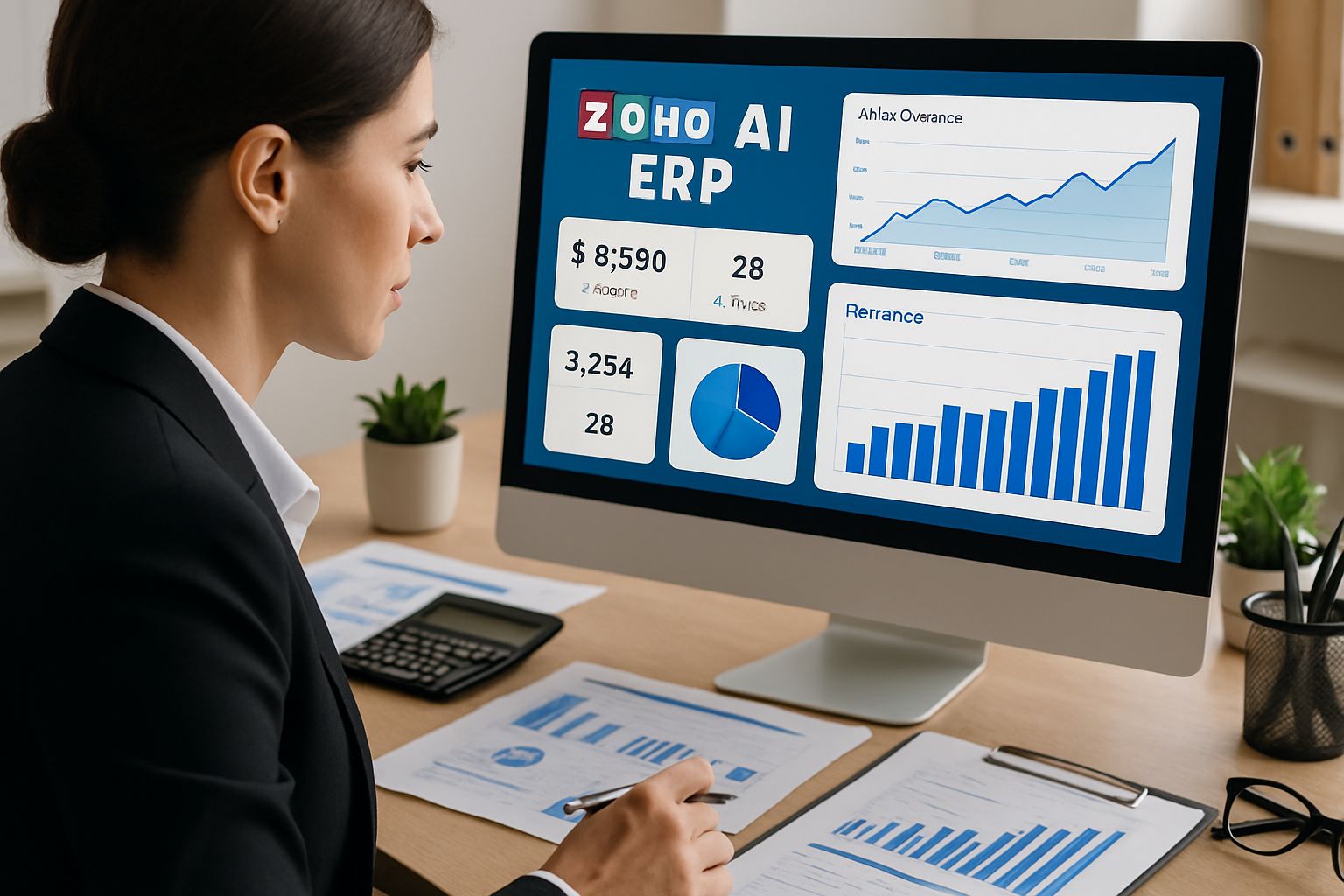
Zoho AI ERP Vision
Accordingly, the company frames Zoho AI ERP as an AI-native core for modern finance and operations. Sridhar Vembu described a global opportunity exceeding $300 billion during a Financial Express interview. Furthermore, CEO Shailesh Davey positioned the platform as a strong homegrown alternative to global incumbents.
Unlike piecemeal add-ons, the suite embeds machine learning, natural-language assistance, and predictive insights from day one. Consequently, Zoho promises faster value realisation and reduced dependence on external consultants. Additionally, the vendor stresses a unified data model across its 55-plus applications.
These statements convey an ambitious roadmap. Nevertheless, concrete adoption metrics will reveal whether the strategy resonates. The next section examines why Zoho believes incumbent gaps create room for disruption.
Why Zoho Targets Gaps
Indian organisations often juggle separate accounting, payroll, and inventory tools. Consequently, data remains siloed and compliance updates cause friction. In contrast, Zoho AI ERP claims to unify these processes inside one cloud platform. Moreover, integrated fintech hooks promise faster collections and automated vendor payouts.
Sivaramakrishnan Iswaran stresses the importance of linking banking, spending, and ledgers in real time. Therefore, Zoho highlights lower total cost of ownership and shorter deployment timelines. Gartner research supports the argument, because integration complexity inflates traditional ERP budgets.
Key pain points the new suite targets include:
- GST and e-invoice updates delivered automatically
- Payroll engines covering EPF, ESI, and TDS
- Low-code tools that adapt workflows quickly
- Fintech integrations enabling instant settlements
Collectively, these features address pressing operational gaps for mid-market firms. However, technical sophistication alone will not guarantee advantage. Consequently, AI differentiation becomes essential, as the next section details.
AI Capabilities Differentiator Edge
Zoho embeds machine learning across finance, procurement, and inventory flows. For example, anomaly detection flags outlier invoices before payment releases. Meanwhile, Ask Zia enables voice queries for dashboards and forecasts. Such capabilities seek to collapse decision latency and raise productivity.
Zoho AI ERP appears to apply reinforcement learning to refine predictions with every transaction. Moreover, low-code extensions let business analysts script additional AI triggers without heavy coding. Gartner analysts agree that embedded intelligence will shape next-generation Enterprise Software, but they warn about data quality.
Professionals can enhance their governance skills with the AI Ethics Professional™ certification. Consequently, enterprises secure ethical guardrails while deploying predictive functions. The focus on compliance merits deeper attention in the subsection below.
Compliance For Indian Businesses
Indian statutes evolve quickly, especially GST rule changes and state-level payroll levies. Therefore, Zoho AI ERP ships with pre-built engines for GST, e-invoicing, EPF, ESI, and TDS. Moreover, revenue recognition templates align with IFRS 15 and ASC 606, easing audit preparation.
Automatic updates arrive through Zoho’s cloud, eliminating manual patch cycles. Consequently, finance teams can focus on analysis rather than statutory tracking. These compliance strengths feed directly into competitive positioning, as the next market section explains.
Market Context And Competition
Gartner values the core ERP platform market at roughly $66 billion for 2024. Allied Market Research projects $40 billion in cloud-centric growth by 2033. Nevertheless, Zoho must confront entrenched leaders such as SAP, Oracle, Microsoft, and Workday.
Incumbents possess extensive partner networks and decades of vertical templates. In contrast, Zoho AI ERP relies on low-code tooling to reduce system-integrator dependence. Furthermore, aggressive pricing could pressure rivals to repackage offerings.
Analysts foresee competition intensifying across mid-market Enterprise Software segments where price sensitivity remains high. Consequently, buyers may welcome additional choice, provided migration risks stay manageable.
Current industry snapshots highlight the scale and stakes:
- ERP leaders control approximately 60% of global revenues
- Cloud migrations now account for 42% of new deployments
- AI investments form the top spending priority for 55% of CIOs
These statistics underscore fierce competition and significant upside. The following talent discussion illustrates Zoho’s unique rural playbook.
Talent Strategy Rural Hubs
Zoho has championed decentralised engineering centres in Tenkasi and Kumbakonam since 2011. Subsequently, the company expanded the Kumbakonam headcount target to 2,000 for the ERP program. Moreover, rural hiring lowers costs and nurtures loyalty, according to founder interviews.
This model also differentiates the firm among Indian Enterprise Software vendors still clustered in metros. Consequently, availability of domain experts near customers may accelerate support cycles. The benefit could strengthen Zoho AI ERP adoption in tier-two industrial belts.
Rural talent may prove decisive if adoption scales. Next, we explore expansion timelines outside India.
Global Expansion Roadmap Timelines
Zoho plans phased releases for Southeast Asia, the Middle East, and North America. Meanwhile, localisation teams are mapping tax and payroll requirements for each territory. Zoho AI ERP will likely reach early adopters abroad within eighteen months, according to internal briefings.
However, winning reference customers abroad will demand vertical depth and credible implementation partners. Therefore, the firm is courting boutique system integrators while refining migration toolkits.
International ambitions appear achievable yet contingent on partner orchestration. The concluding section distills key lessons for technology leaders.
Zoho AI ERP has entered a crowded arena with an audacious promise of AI-native, compliant, and cost-effective operations. Furthermore, its rural talent strategy and unified app ecosystem strengthen differentiation among Enterprise Software contenders. Nevertheless, the platform must validate scalability, partner reach, and migration simplicity before shifting market share. Technology leaders should monitor pilot deployments, pricing, and roadmap progress during 2026.
Meanwhile, professionals seeking ethical AI governance expertise can pursue the AI Ethics Professional™ certification. Consequently, they will be poised to guide successful ERP transformations in an increasingly automated landscape.
Disclaimer: Some content may be AI-generated or assisted and is provided ‘as is’ for informational purposes only, without warranties of accuracy or completeness, and does not imply endorsement or affiliation.


