

AI CERTs
2 months ago
China’s AI Drone Swarm Test Redefines Battlefield Autonomy
Chinese state television has unveiled striking footage. One soldier supervised a formation of more than 200 autonomous drones. The AI Drone Swarm demonstration, broadcast on 23 January 2026, originated from the PLA’s National University of Defence Technology. Analysts worldwide noted its scale, mission flexibility, and potential strategic weight.
However, experts caution against accepting every televised claim at face value. They suggest separating controlled tests from battlefield resilience. Meanwhile, rival programs in the United States and elsewhere have faced notable integration challenges. Consequently, understanding the technology, context, and limits matters for Military AI planners and industry leaders.
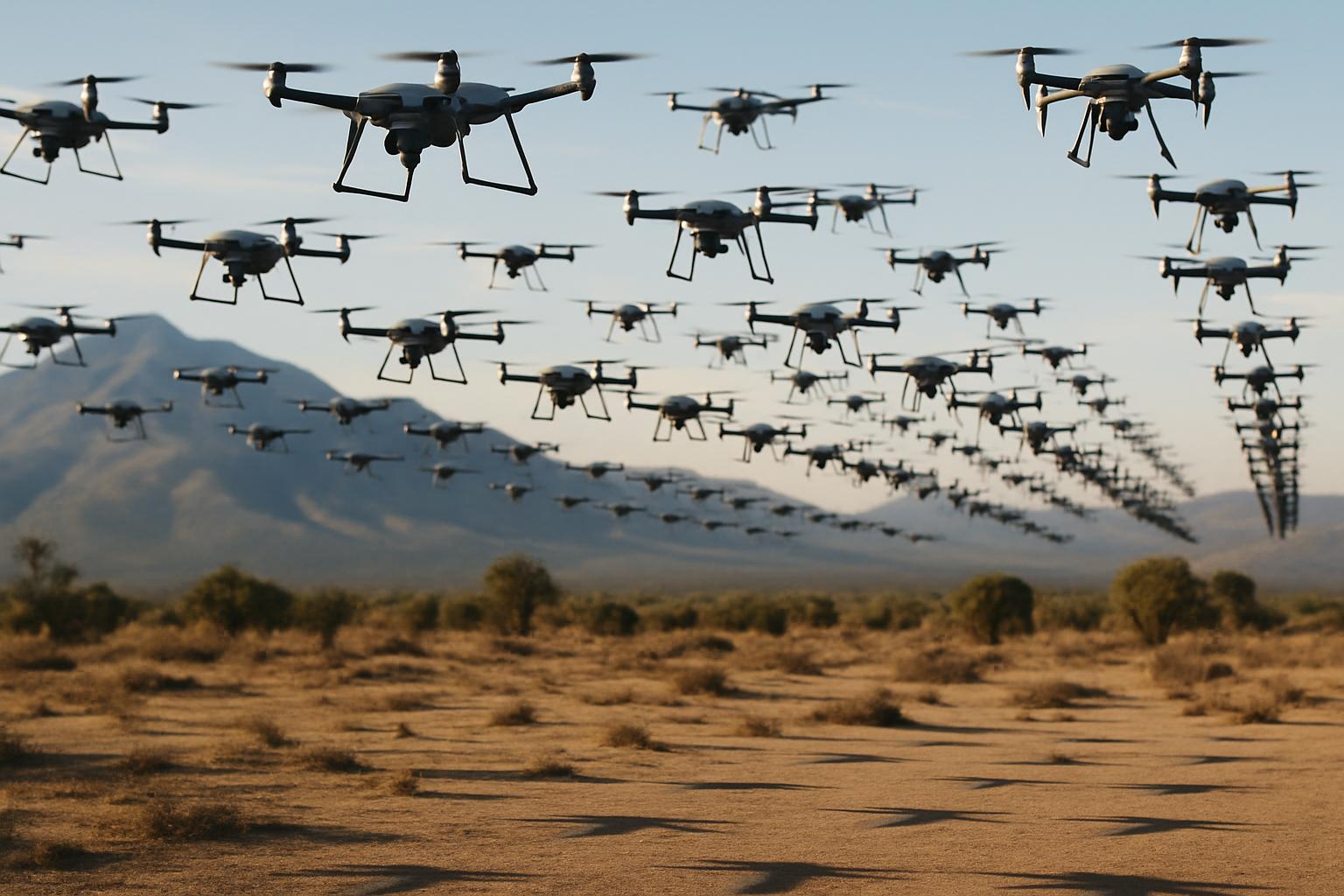
Therefore, this article dissects the footage, evaluates technical assertions, and compares rival developments. Readers will gain a concise yet thorough view of the emerging unmanned swarm race.
AI Drone Swarm Overview
The televised test showed multiple truck-mounted launchers firing fixed-wing drones in rapid succession. A tablet wielded by one operator appeared to issue mission-level commands. Xiang Xiaojia, a National University of Defence Technology researcher, offered commentary. He stated, “Each drone is equipped with an intelligent algorithm.”
Observers highlighted three assigned roles: reconnaissance, electronic decoy or jamming, and strike. Furthermore, the footage suggested onboard negotiation algorithms divided these tasks autonomously. The presentation underscored claimed scalability, noting more than 200 airframes under single-person supervision. Nevertheless, the AI Drone Swarm footage lacked detailed telemetry or failure data.
These visuals promote an image of seamless coordination. However, autonomous claims require deeper inspection, which the next section addresses.
Autonomy Claims And Limits
NUDT researchers framed the operator’s role as “human-on-the-loop.” Consequently, software handled routing, formation, and dynamic task allocation. Such design follows consensus-based swarm literature and reduces cognitive load.
In contrast, sceptics argue televised flights often use scripted waypoints. Moreover, communication channels remain vulnerable to saturation, spoofing, and weather interference. The AI Drone Swarm claims therefore warrant open-source imagery and telemetry verification.
Autonomy reduces manpower demands yet raises verification challenges. Subsequently, anti-jamming performance becomes the next critical question.
Anti-Jamming Algorithm Test Details
CCTV commentators said the swarm flew inside an electromagnetic interference corridor. Therefore, drones purportedly replanned routes when links degraded. Analysts acknowledge on-board vision and inertial systems can enable such resilience.
Nevertheless, jamming intensity metrics were absent. Meanwhile, the PLA has not released frequency spectra, signal-to-noise thresholds, or sustained loss statistics. Without those numbers, AI Drone Swarm robustness remains an open debate.
Available data suggest promising concepts yet limited proof. Consequently, comparison with foreign projects offers helpful perspective.
Comparative Global Programs Landscape
The Pentagon’s Replicator initiative champions quantity by leveraging commercial drones and modular software. However, official reports cite integration, sensor fusion, and budgetary hurdles. Israel and Australia also fund smaller experimental swarms.
- United States: Replicator aims for thousands of autonomous systems by 2027.
- Britain's MOSQUITO program explores low-cost teaming aircraft.
- China: The AI Drone Swarm demo signals mass production ambitions.
Moreover, Western analysts note that open architectures complicate cybersecurity certification. Military AI governance frameworks still lag technical advances. Therefore, procurement timelines often stretch beyond political cycles.
Collectively, these programs illustrate converging ambitions. However, capability maturity differs, as the subsequent security section explains.
Security And Doctrine Impacts
Massed swarms threaten traditional layered air defences by saturating sensors and interceptors. Consequently, navies studying China’s coast must revise missile allocation models. Analysts warn that a validated AI Drone Swarm would intensify pressure on carrier groups.
Meanwhile, Military AI ethics debates focus on human oversight. PLA statements stress supervisory control, yet campaign tempo may erode meaningful intervention windows. Therefore, allied planners advocate robust counter-swarm research, including directed-energy weapons.
Strategic models must adapt to cheap mass autonomy. Subsequently, attention turns to unresolved technical gaps.
Technical Gaps And Verification
First, observers lack raw flight logs confirming adaptive routing. Secondly, platform endurance remains unknown, especially under cold or humid conditions. Moreover, maintenance cycles for a 200-aircraft battery were not disclosed.
In addition, warfighters need assured identification, friend or foe, when hundreds share airspace. AI Drone Swarm deployments will challenge existing IFF transponder protocols. Consequently, verification teams request scenario-based trials with independent instrumentation.
These unknowns caution investors against overconfidence. Nevertheless, professionals can prepare by upskilling.
Upskilling For Defence Engineers
Engineers seeking relevance in swarm projects should master embedded autonomy, resilience testing, and secure communications. Furthermore, coding proficiency in ROS, PX4, and reinforcement learning frameworks is prized. Practical experience with flight-testing processes also matters.
Professionals can enhance their expertise with the AI Developer™ certification. The program covers neural network deployment, hardware optimization, and compliance auditing.
Moreover, workshops now integrate AI Drone Swarm simulation exercises. Military AI curricula increasingly emphasise collaborative autonomy and ethical guardrails.
Continuous learning sustains engineering credibility. Therefore, the final section distils key insights.
Conclusion And Outlook
China’s televised AI Drone Swarm trial marks a symbolic leap in scalable autonomy. However, test-range triumphs differ from contested skies. Verification data, especially on anti-jamming performance, remain scarce. Meanwhile, Military AI stakeholders worldwide monitor the demonstration’s diplomatic and procurement reverberations.
Nevertheless, the episode underscores rising demand for resilient, affordable unmanned formations. Consequently, engineers, policymakers, and investors should scrutinize claims while advancing counter-swarm defences. Readers eager to lead next-generation projects can begin today by exploring specialized certifications and staying informed on evolving standards.


