

AI CERTS
2 months ago
Three Stocks Riding AI Market Efficiency Wave
Capital is chasing smarter compute. Consequently, executives and analysts now focus on AI Market Efficiency gains when judging technology leaders. Moreover, lower cost per token has become a pivotal metric. Investors therefore watch firms whose hardware, software, or intellectual property shrink energy budgets. AI Market Efficiency has turned from an abstraction into a board-level requirement across hyperscale budgets.
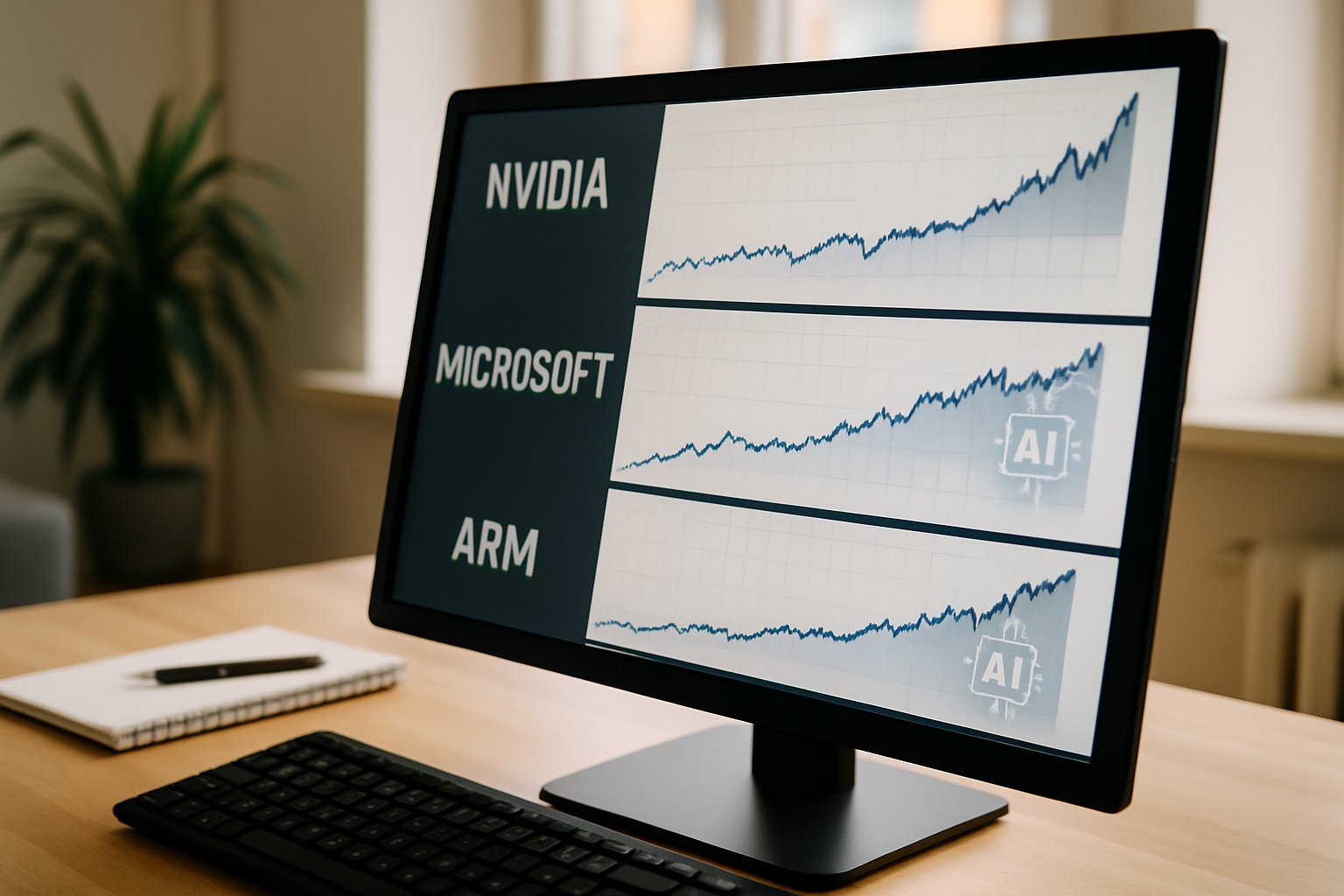
However, not every vendor monetizes this shift equally. Three public companies—NVIDIA, Microsoft, and Arm—stand apart. They combine silicon, cloud scale, and licensing leverage to transform rising demand into profits. This article details how each business advances AI Market Efficiency, summarizes fresh data, and evaluates associated stocks. Readers also learn practical signals for tracking future valuation trends. Another mention of AI Market Efficiency clarifies the theme.
Core Efficiency Theme Overview
Data-center power constraints dominate C-suite conversations. Meanwhile, inference traffic explodes as models graduate from labs to production. Therefore, reducing joules per token unlocks deployment scale. The simple equation is clear: greater throughput plus lower wattage equals larger profit pools. AI Market Efficiency succinctly captures that equation. For investors, the concept links technical progress to financial outcomes.
Three levers drive current improvements:
- Architectural leaps in accelerators and CPUs
- Fleet-level software optimizations and reservations
- Licensing models that monetize partner silicon
Collectively, these levers illustrate why certain stocks enjoy a structural benefit. Subsequent sections explain each lever in action. Thus, the narrative flows from technology to valuation impact.
NVIDIA Drives Token Savings
NVIDIA’s Blackwell family showcases hardware-software co-design. Additionally, its GB300 rack bundles networking, liquid cooling, and inference compilers. Company tests claim 25× lower energy versus prior Hopper systems. Satya Nadella praises similar economics at customer sites, yet Jensen Huang’s quote best captures momentum: “We designed Blackwell Ultra for this moment—efficient reasoning at scale.”
Key statistics underline the story:
- Blackwell lowers cost and energy per token up to 25× (March 2024 release)
- MLPerf notes 45% higher DeepSeek R-1 throughput over GB200
- Data-center revenue dominates recent quarterly records
Consequently, investors focusing on AI Market Efficiency reward the share price. However, export controls still threaten regional growth. These constraints temper bullish valuation models. Nevertheless, the company’s full-stack moat remains powerful.
NVIDIA’s advances demonstrate how hardware can magnify efficiency. The lesson transitions neatly toward cloud software levers.
Microsoft Cuts Cloud Costs
Azure operates massive fleets of GPUs running OpenAI models. Furthermore, the company now offers Provisioned Throughput Units. Reservations can deliver savings of 82%. Moreover, vector compression research trimmed storage by 92.5% in pilot deployments.
Satya Nadella recently stated, “Every Azure region is now AI-first.” Software alone delivered 90% more tokens per GPU year over year. Therefore, AI Market Efficiency helps Microsoft win incremental enterprise budgets. Four signs capture momentum:
- A 49% Intelligent Cloud growth rate last quarter
- Reservation uptake exceeding internal forecasts
- Token output per GPU rising sharply
- Copilot subscriptions lifting cloud stickiness
These signals bolster the stocks story. Nevertheless, soaring capital expenditures pressure cash flow. In contrast, falling unit economics strengthen long-term valuation.
The cloud angle closes with a software takeaway. Subsequently, the article turns to efficient CPU licensing.
Arm Powers Lean Compute
Arm sells intellectual property rather than finished chips. Consequently, partners like AWS and Google integrate Neoverse cores into custom silicon. Rene Haas states, “Access to power has now become the bottleneck.” Neoverse aims to solve that bottleneck by delivering higher performance per watt.
Arm’s Q2 FY2026 results highlight the financial benefit:
- Revenue rose 34% to $1.14 billion
- Data-center royalties doubled year on year
- Licensing backlog reached record highs
Therefore, hyperscalers aligning with AI Market Efficiency fuel Arm’s royalty engine. However, dependence on partners introduces risk. If custom chipmakers bypass Arm, future valuation upside could soften.
Arm’s licensing success underlines another path toward efficiency. The discussion now widens to holistic risks.
Risks Temper Growth Expectations
Opportunities abound, yet each company faces headwinds. Firstly, NVIDIA confronts geopolitical export limits. Secondly, Microsoft juggles capital intensity and fierce cloud rivalry. Thirdly, Arm relies on customer adoption cycles.
Nevertheless, diversified revenue pillars mitigate some threats. Moreover, rising demand for efficient inference supplies a tailwind. AI Market Efficiency should therefore remain a shared narrative. Balanced analysis keeps investors grounded when evaluating tech stocks.
These challenges highlight critical gaps. However, tracking key metrics offers early warnings before valuation swings.
Key Metrics To Monitor
Investors need objective signals. Consequently, the following datapoints deserve quarterly attention:
- NVIDIA: MLPerf scores and data-center backlog
- Microsoft: GPU token output and PTU reservation growth
- Arm: Neoverse royalty share and new hyperscaler wins
Professionals can enhance their expertise with the AI Marketing Certification. Moreover, up-to-date knowledge sharpens portfolio reviews.
Regularly examining these metrics supports sharper insight into AI Market Efficiency. Subsequently, the piece concludes with strategic action steps.
Therefore, readers now possess a structured lens for evaluating AI-driven benefit. Additionally, the transition to the conclusion reinforces proactive decision-making.
Actionable Summary And Next
NVIDIA, Microsoft, and Arm each convert technical breakthroughs into tangible gains. Moreover, hardware, cloud software, and IP licensing together accelerate AI Market Efficiency. Investors watching these stocks can track throughput metrics, reservation uptake, and royalty trends to refine valuation scenarios.
Nevertheless, geopolitical constraints, capex cycles, and partner dependencies introduce uncertainty. Balanced outlooks remain vital. AI Market Efficiency appears poised to dominate boardroom agendas for years.
Consequently, professionals should deepen domain knowledge. Consider pursuing the linked certification to stay ahead of the curve.


