

AI CERTs
2 months ago
Qualcomm Turns to AI Data Centers Amid Mobile Weakness
Investors endured a roller-coaster year. Qualcomm shares first dipped, then surged. However, fresh mobile headwinds worried the street. In July 2025, Apple’s modem shift and tariff talk erased billions. Consequently, analysts trimmed near-term handset revenue forecasts. Meanwhile, October brought an unexpected catalyst. The company revealed rack-scale AI hardware named AI200 and AI250. The announcement sparked a double-digit intraday rally. Therefore, Wall Street began reassessing long-term prospects. This article dissects the volatility, strategic pivot, and remaining execution risks. Readers will gain data-driven insights and actionable takeaways. Ultimately, understanding Qualcomm’s crossroads matters for anyone tracking semiconductor disruption. Additionally, we examine how AI chips reshape competitive dynamics. In contrast, the mobile market pressures remain far from resolved. Stay tuned for crucial numbers.
Recent Market Volatility Snapshot
July 31 delivered a sharp 5% intraday decline for Qualcomm shares. Reuters linked the slide to Apple’s planned in-house modems and tariff risks. Consequently, sentiment around handset licensing deteriorated. Subsequently, Oct 27 produced the opposite reaction. Shares jumped as much as 20% after the AI unveiling, according to Bloomberg. Therefore, extreme swings mirrored alternating fear and hope. Over three months, market capitalization vacillated by nearly $40 billion. These gyrations underscore investor sensitivity to revenue mix signals.
Moreover, trading volume doubled on announcement days, highlighting speculative interest. In contrast, quiet sessions saw liquidity thin, intensifying volatility. The pattern sets the backdrop for deeper strategic analysis. Volatility tells only part of the story. However, mounting mobile revenue headwinds reveal foundational concerns ahead.
Mounting Mobile Revenue Headwinds
Apple represents roughly one-fifth of historical modem sales. However, the Cupertino giant will drop external modems in 2026 devices. Therefore, Qualcomm faces a looming revenue gap. Samsung may also diversify suppliers, reducing volume allocations. Meanwhile, global smartphone shipments remain uneven, per IDC trackers.
Furthermore, proposed semiconductor tariffs could lift bill-of-materials costs. CFO Akash Palkhiwala flagged the issue, noting no front-loaded chip orders. Consequently, supply chain visibility shortened, complicating forecasting.
Key smartphone pressures include:
- Apple modem exit reduces FY2026 revenue baseline.
- Samsung share shift threatens premium tier margins.
- Tariff uncertainty slows procurement decisions.
- Component inflation squeezes ASPs in emerging regions.
Collectively, these factors strain the mobile market outlook. Nevertheless, management touts 18% non-Apple handset revenue growth in FY2025. These mobile realities set the stage for diversification ambitions. Next, we examine the firm’s strategic AI pivot.
Qualcomm Strategic AI Pivot
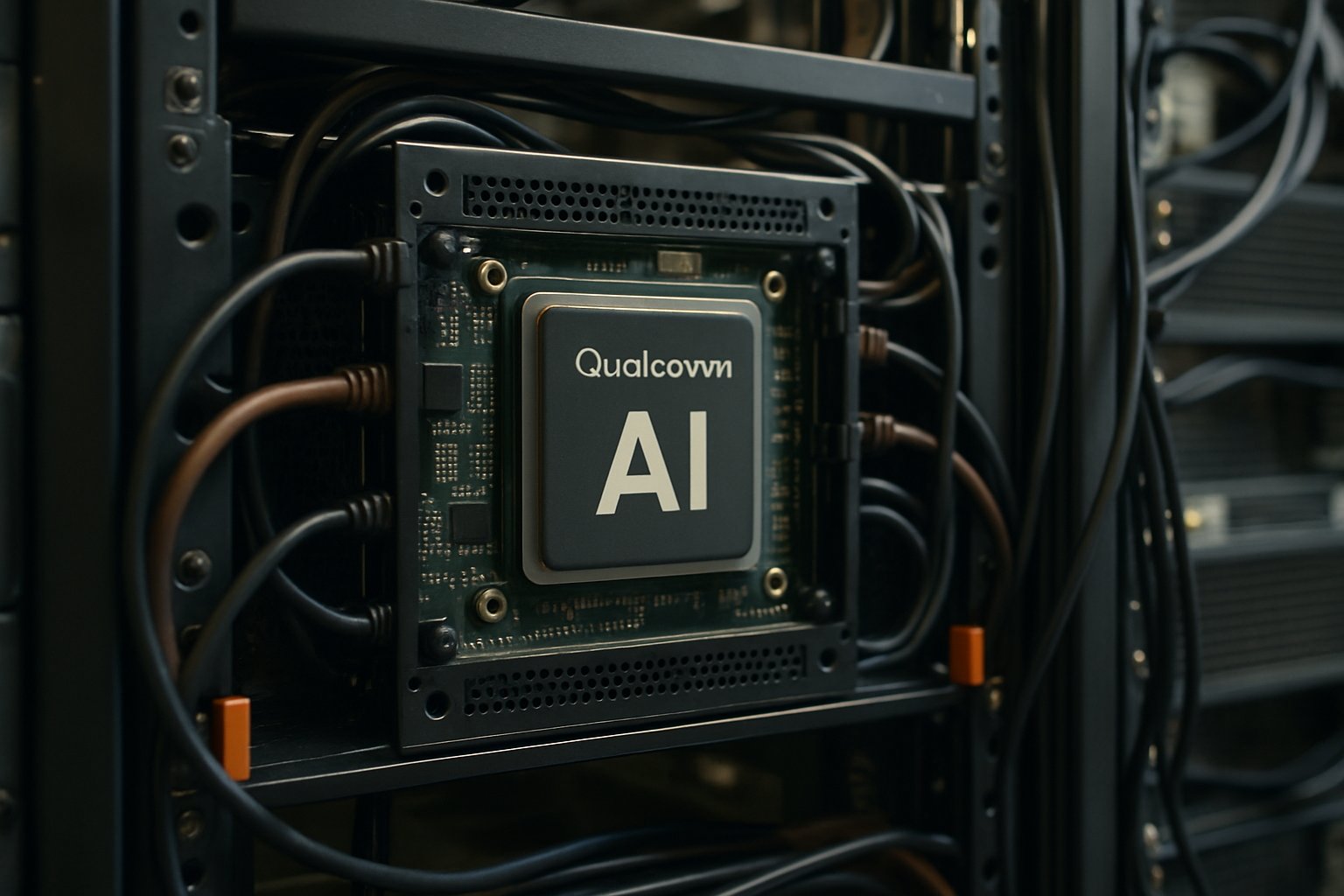
October’s announcement reframed the investment thesis. Qualcomm unveiled AI200 and AI250 rack-scale accelerators optimized for inference. Moreover, the company disclosed a 200 MW deployment partnership with Saudi firm HUMAIN. That order, while regional, validated the new AI chips in a production roadmap. Subsequently, several analysts upgraded long-term earnings models.
In contrast, Bernstein’s Stacy Rasgon withheld changes, citing absent hyperscaler commitments. Nevertheless, he conceded the pivot diversifies revenue beyond the fragile mobile market. Therefore, investors now weigh near-term handset erosion against multiyear AI upside. The following section dissects technical differentiation claims.
Key Technical Differentiation Details
AI200 cards support up to 768 GB LPDDR memory. Consequently, capacity per accelerator outstrips many GPU boards using expensive HBM. Moreover, racks integrate direct liquid cooling handling 160 kW workloads. Such engineering targets inference throughput and power efficiency, not heavy training.
The design builds on Hexagon NPU heritage from smartphones. Therefore, Qualcomm claims industry-leading performance-per-watt for AI chips. Additionally, lower LPDDR costs could improve total cost of ownership metrics. Nevertheless, real-world benchmarks against Nvidia remain pending. Independent labs must validate latency, throughput, and software maturity. Hardware advantages look promising. However, competitive dynamics create formidable obstacles.
Evolving Competitive Landscape Challenges
Nvidia commands more than 85% of data-center accelerator revenue. Furthermore, its CUDA software stack locks developers into familiar workflows. AMD, Intel, and hyperscale in-house silicon add further fragmentation. Consequently, qualification cycles extend, delaying supplier switches.
Meanwhile, HBM shortages inflate memory pricing across the AI chips ecosystem. In contrast, Qualcomm’s LPDDR approach eases capacity constraints but lowers bandwidth. Therefore, workload suitability will dictate adoption momentum. Moreover, cloud providers demand robust software libraries matching training pipelines. Competitive hurdles remain high. Next, we assess execution risks developers spotlight.
Critical Execution Risks Ahead
Software ecosystem depth tops investors’ watchlists. Qualcomm must deliver mature compilers, APIs, and frameworks supporting mainstream models. Furthermore, hyperscaler proof-of-concepts must translate into repeatable volume contracts. Supply chain resilience also matters amid foundry and memory volatility.
Additionally, handset revenue slide could constrain R&D spending if AI revenue lags. Therefore, balancing cash flow between the mobile market and data centers is critical. Professionals can upskill through the AI Security Compliance™ certification. Consequently, skilled teams accelerate secure deployment of new AI chips. Execution will decide long-term valuation. Finally, we review investment implications.
Forward Investment Outlook Summary
Wall Street models still treat AI revenue as out-year optionality. UBS estimates every 1% Qualcomm inference share could add $2 billion annual sales. However, handset declines remain visible, pressuring near-term multiples. Consequently, valuation hinges on execution milestones such as hyperscaler design wins.
Moreover, regulatory tariff decisions may swing gross margins several points. Retail investors should monitor quarterly disclosures for order-book color. Institutional funds appear split between momentum traders and long-term secular growth believers. Investment cases therefore carry binary elements. Nevertheless, disciplined observation of roadmap progress can mitigate uncertainty.
Qualcomm now straddles uncertainty and opportunity. Mobile market headwinds dent near-term visibility. However, AI chips and rack systems unlock sizable diversification potential. Execution across software, supply, and customer wins remains paramount. Therefore, investors should track hyperscaler pilots, tariff rulings, and handset share trends. Moreover, technical professionals may prepare for this shift. They can deepen compliance skills via the earlier linked certification. Staying informed today positions teams for tomorrow’s silicon evolution. Consequently, balanced portfolios could capture upside while limiting downside. Meanwhile, continuous learning ensures readiness for fast-moving architectures. Explore further analyses and certification pathways to stay ahead.


