

AI CERTs
4 hours ago
India Defense deploys homegrown AI in Operation Sindoor
A quiet admission at Davos signalled a strategic tech milestone. Union Minister Ashwini Vaishnaw revealed that India deployed a sovereign AI model in a recent defense mission. Observers immediately linked the statement to Operation Sindoor, the May 2025 precision strikes across the Line of Control. The disclosure underscored growing momentum within India Defense to wean critical systems off foreign technology. Furthermore, it spotlighted national investments in Homegrown AI designed for combat decision loops. Such capability promises faster situational awareness and lower collateral damage for future Military engagements. However, officials offered few technical details, citing operational secrecy. Independent analysts therefore urge transparency, verification, and robust ethical safeguards. This article unpacks the context, technology, benefits, and risks behind that bold claim. It also examines how India Defense strategy may evolve as sovereign models mature.
Strategic Context Driving Adoption
Operation Sindoor followed the April 2025 Pahalgam terror attack that killed 26 civilians. Consequently, leaders needed a rapid, precise, and politically calibrated response. India Defense planners sought technological force multipliers that could strengthen deterrence without triggering escalation.
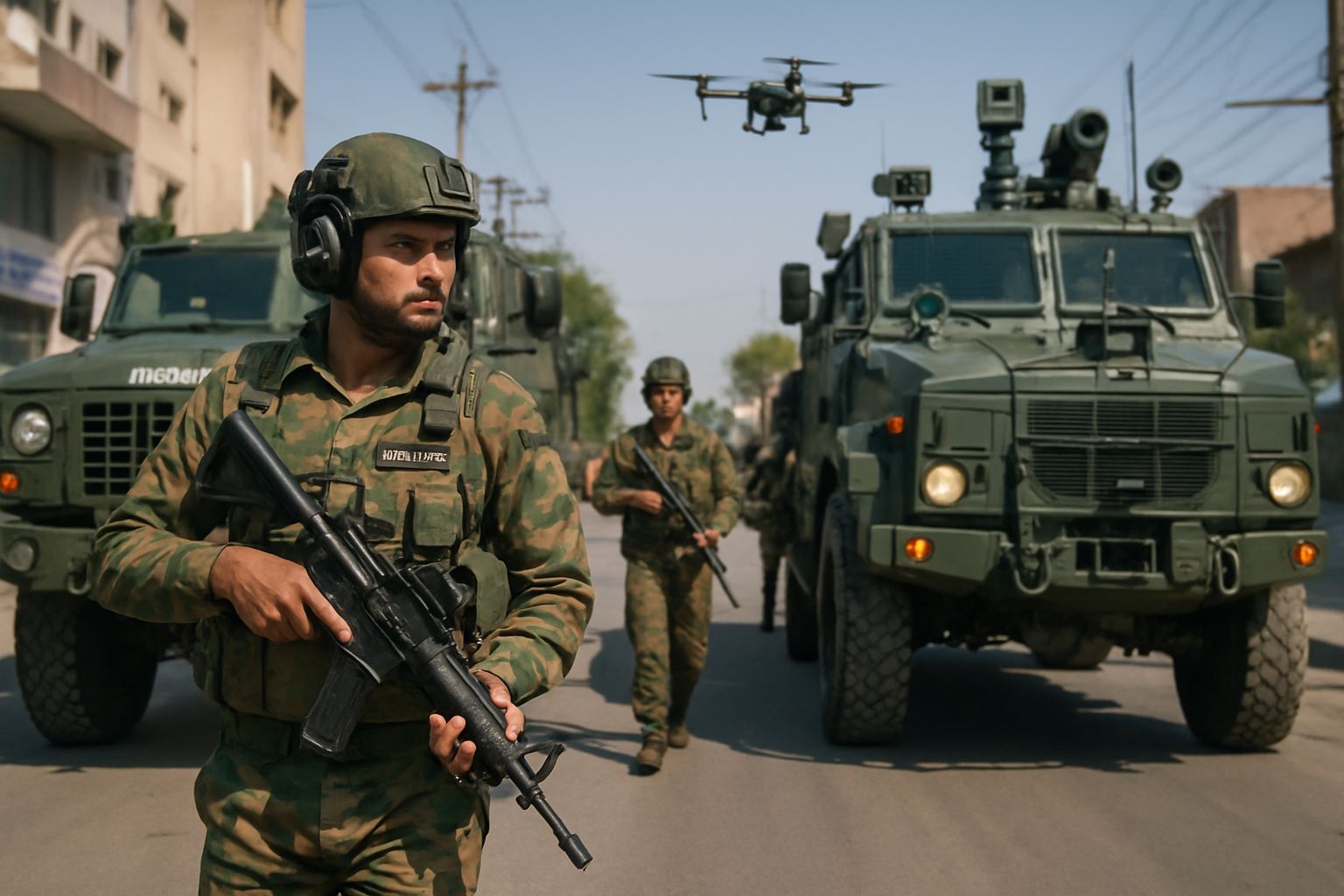
Meanwhile, Vaishnaw’s ministry had been funding AIRAWAT, a shared 38,000-GPU compute backbone. That initiative nurtured multiple startups and at least one IIT building sovereign models. Moreover, the Defence AI Council and DAIPA coordinated pilot projects across services.
In short, security shocks converged with maturing infrastructure to hasten adoption. Therefore, the mission provided an ideal proving ground for Homegrown AI at scale. The next section examines what we know about the strike itself.
Operation Sindoor Key Facts
Official statements framed the 7 May 2025 action as focused and measured. Nine terrorist infrastructure sites were struck across Pakistan-administered territory. Army, Air Force, and Navy assets coordinated through a unified command chain.
- Targets hit: nine distinct camps.
- Collateral damage: government claims minimal.
- Loitering munitions and precision-guided weapons employed.
- Reported AI applications: sensor fusion, intel collation, predictive logistics.
Reports in Times of India cited around 23 indigenous AI applications supporting commanders. Nevertheless, technical parameters stayed classified. India Defense communication teams released limited imagery to support precision claims. Military officials credited integrated planning for the swift execution. These facts sketch the operation’s scope and the complexity of coordination. However, understanding the AI layer demands a closer look at model roles.
Role Of Homegrown AI
Vaishnaw described the sovereign model’s output as phenomenal while withholding its name. Analysts infer a task-specific large language model fine-tuned on classified intelligence. Furthermore, edge AI likely processed drone feeds to maintain continuity amid jamming.
Homegrown AI probably assisted human staff by summarising sensor data and ranking targets. In contrast, legacy workflows required multiple analysts and longer cycles. Therefore, commanders gained quicker situational clarity before approving kinetic actions.
Evidence remains circumstantial because the ministries have not released logs or model cards. Subsequently, investment narratives shift toward strengthening technical foundations. India Defense officials maintain that humans retained final authority despite automation.
Technology And Infrastructure Investments
AIRAWAT’s 38,000 GPUs form the compute nucleus for sovereign experimentation. Moreover, India Defense agencies share secure clusters through a zero-trust architecture. India Defense procurement policies now prioritise domestic GPUs and software. Twelve startups receive grants to build domain-specific models under DAIPA oversight.
IIT research groups contribute datasets, evaluation frameworks, and adversarial testing suites. Additionally, DRDO labs integrate these models with command, control, communications, computers, intelligence, surveillance, and reconnaissance platforms. Consequently, development cycles shorten and deployment frequency increases.
Collectively, these investments anchor strategic autonomy. The following section weighs their battlefield payoffs.
Benefits And Operational Outcomes
Senior officers claim AI input improved target discrimination and meteorological prediction. Moreover, fused dashboards reduced cognitive load for decision makers across services. Times of India quoted one brigade commander calling the tool set a game changer.
- Decision cycle cut from hours to minutes.
- Collateral damage reportedly near zero.
- Resource allocation optimized through predictive logistics.
- Sovereign hosting avoided foreign data exposure.
Nevertheless, independent audits are absent, limiting empirical certainty. Therefore, confidence in results hinges on official transparency. India Defense leaders touted the mission as a validation of indigenous modernization. Early indicators suggest meaningful advantages, yet verification gaps persist. Consequently, ethical and escalation risks demand scrutiny, as discussed next.
Risks Ethics Future Roadmap
AI driven targeting compresses decision time, raising miscalculation risk. In contrast, traditional approval chains allowed broader deliberation. Moreover, accountability under international humanitarian law remains unresolved when algorithms influence lethal force.
India Defense recently drafted non-binding ethical principles for Military AI. However, critics argue enforcement mechanisms and explainability standards stay vague. Think-tank analysts therefore urge mandatory human-in-the-loop requirements and public reporting.
These challenges highlight critical governance gaps. Nevertheless, officials plan iterative doctrine updates and expanded red-team exercises. Professionals can enhance their expertise with the AI+ Government™ certification. Subsequently, sustained oversight will shape trust in future operations.
Davos remarks mark a watershed for India Defense ambitions and global perception. Operation Sindoor showed that sovereign tools can influence outcomes without widening conflict. Moreover, investments in compute, startups, and doctrine signal enduring commitment to Homegrown AI. Nevertheless, verification, explainability, and ethical enforcement remain work in progress. Consequently, stakeholders must push for transparent metrics and independent audits. Professionals seeking to contribute should consider the AI+ Government™ certification and sharpen policy skills. Future evaluations will determine whether India Defense can balance speed, sovereignty, and safety at scale.


