

AI CERTs
4 months ago
Microsoft Rho-alpha Deep Dive into Autonomous Robotics AI
Industrial floors are buzzing with fresh ambitions. On January 22, 2026, Microsoft Research revealed Rho-alpha, its first Physical AI foundation model. The debut signaled a decisive leap for Autonomous Robotics AI. Consequently, venture capital, manufacturers, and developers rushed to evaluate the possibilities. Rho-alpha promises to translate chat-level instructions into precise, tactile robot movements. Moreover, the model learns continually from human corrections, shrinking deployment timelines. This deep dive unpacks the technology, business context, and open challenges. Readers will gain practical insight, market figures, and guidance on upskilling for the coming wave. Throughout, we track how Autonomous Robotics AI intersects with enterprise roadmaps and safety frameworks.
Why Rho-alpha Model Matters
IFR data shows 542,000 industrial robots installed in 2024, with 74% in Asia. Therefore, incremental efficiency gains can unlock sizable returns. Rho-alpha targets that opportunity by adding touch to vision-language models. Industry watchers label these capabilities core Rho-alpha Features. Microsoft Tech leadership framed adaptability as the primary benefit.
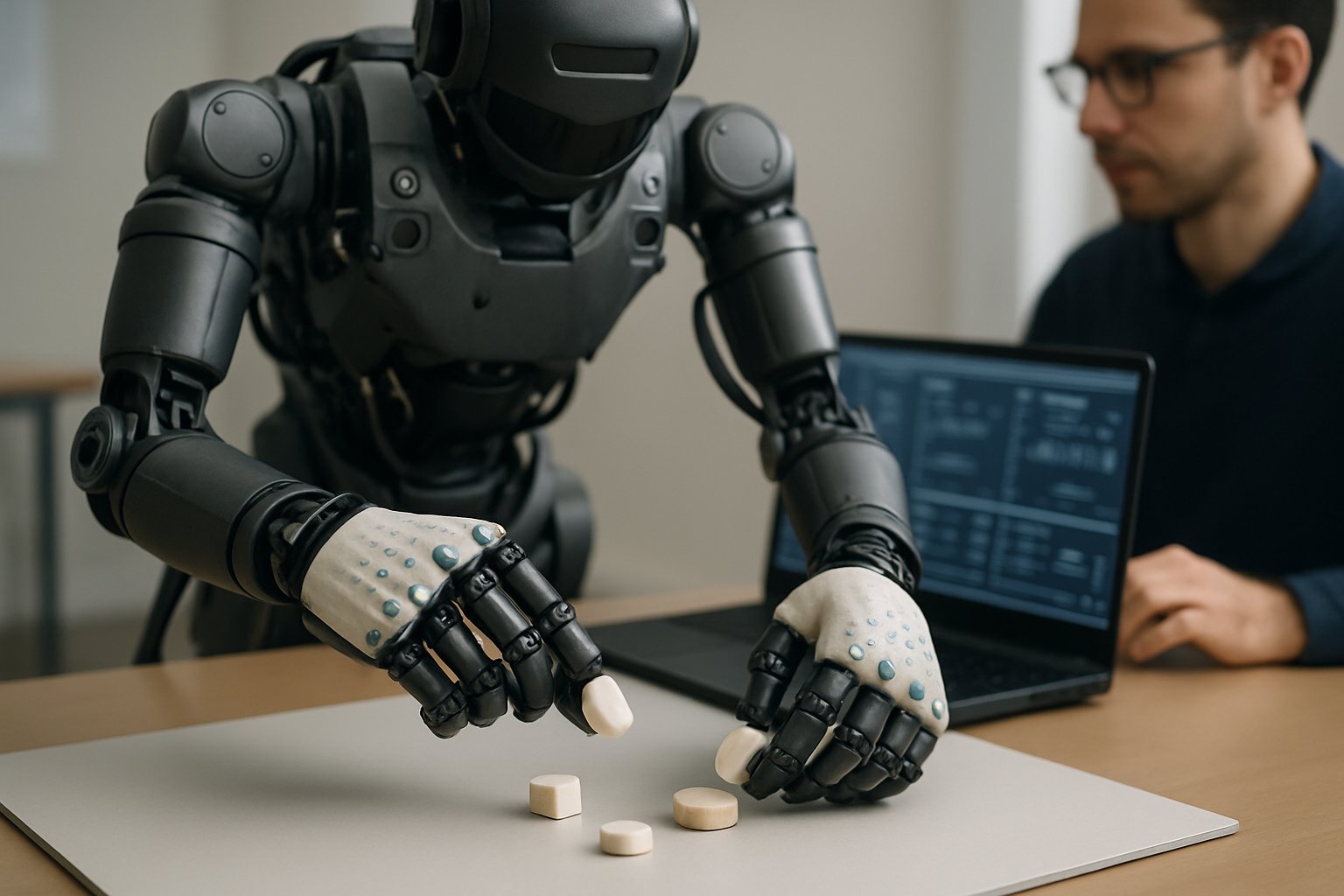
- Multi-modal sensing grants richer context, enabling safer Autonomous Robotics AI in cluttered cells.
- Synthetic trajectories reduce data costs, supporting rapid experimentation with new Rho-alpha Features.
- Continual feedback simplifies deployment, keeping Microsoft Tech aligned with evolving production lines.
Pilot projects already involve electronics assembly, warehouse picking, and precision lab work. Early testers report setup times falling from days to hours using concise language prompts. In short, Rho-alpha lays a flexible intelligence layer over existing hardware. However, understanding its architecture clarifies how that promise materializes.
Inside The VLA+ Stack
The model extends traditional VLA design with tactile signals. Consequently, robots can sense contact forces rather than guess from camera frames. Microsoft blends three training sources to achieve this fusion. Such integration marks a new bar for Autonomous Robotics AI latency and stability. Latency benchmarks indicate 50 millisecond control loops on Azure edge hardware. Such responsiveness remains critical for high-speed pick-and-place operations.
Tactile Sensing Integration Breakthrough
Tactile sensors mounted on UR5e grippers stream pressure maps at kilohertz rates. Meanwhile, NVIDIA Isaac Sim produces synthetic tactile images that mimic those maps. Consequently, training scale rises without hardware wear.
Microsoft Tech engineers co-train language, vision, action, and touch embeddings within one transformer. That architecture keeps latency below real-time thresholds cited in demo videos. These technical layers collectively define core Rho-alpha Features touted during launch.
Therefore, VLA+ adds a tangible sense of feel to instruction following. Next, partnerships reveal how Microsoft aims to scale those capabilities.
Ecosystem And Partner Strategy
No single lab can industrialize Autonomous Robotics AI alone. Microsoft announced alliances with Hexagon Robotics, RLWRLD, and NVIDIA. Furthermore, University of Washington researchers supply academic rigor on data generation. Each collaborator targets complementary Rho-alpha Features such as simulation or hardware integration. Azure forms the cloud spine, while Microsoft Tech tools manage orchestration. NVIDIA executives emphasized cloud-simulation economics during the launch livestream.
Satya Nadella's posts highlight Foundry, a future channel for commercial access. Subsequently, early access participants will shape pricing and safety frameworks.
Partnership breadth signals serious commercialization intent. However, market forces ultimately determine adoption pace.
Market Forces Driving Adoption
Global operational robot stock reached 4.66 million units in 2024. Moreover, analysts forecast double-digit CAGR for embodied foundation models. Manufacturers crave skilled labor substitutes and flexible automation. Consequently, Autonomous Robotics AI stands positioned to tap latent demand.
- IFR projects installations surpass 600,000 units by 2026.
- Market researchers value foundation robotics software at $18 billion by 2030.
- Analysts expect Asia to retain over 70% deployment share through 2028.
These numbers entice vendors to operationalize Rho-alpha Features quickly. Cost compression for sensors and servomotors further boosts deployment feasibility across SMEs. Regional incentives, particularly in Korea and Singapore, subsidize pilot robotics initiatives. Nevertheless, companies still weigh ROI, reliability, and regulatory overhead.
The commercial runway appears vast but conditional. However, we explore obstacles that could narrow that runway.
Risks, Gaps, Safety Outlook
Sim-to-real transfer remains tough despite advanced rendering. In contrast, tactile realism demands high-fidelity sensor modeling. Demo videos show humans intervening when trajectories drift. Continual learning amplifies unpredictability, raising safety certification questions. Security minded engineers can pursue the AI Security 3™ certification. That program teaches governance frameworks for evolving Autonomous Robotics AI deployments. Test labs like NIST’s robot foundry are creating validation suites for continual learners. Nevertheless, stakeholders still debate liability when robots self-modify after certification. Meanwhile, regulators draft ISO updates for online learning robots. Consequently, early adopters must document mitigations and fail-safe protocols.
Unchecked risks could stall market momentum. However, clear guidelines will unlock confident experimentation.
Future Milestones To Watch
Microsoft promised a full technical paper within months. Moreover, Foundry release details will clarify deployment economics. Independent BusyBox tests from universities will stress generalization claims. Subsequently, Hexagon and RLWRLD pilots may showcase factory productivity gains. Autonomous Robotics AI success hinges on those real metrics.
Investors will compare performance against rival models from startups and academia. Therefore, transparent benchmarks and open datasets remain critical.
Upcoming milestones could validate Microsoft Tech leadership for physical AI. Finally, we summarize actionable insights for decision makers.
Rho-alpha signals a pivotal shift from scripted automation to adaptive collaboration. Manufacturers, cloud providers, and startups now share a common north star. Consequently, investment in training data, simulation, and safety will accelerate. Autonomous Robotics AI will shape that acceleration, provided stakeholders align on standards and ROI. Professionals should monitor upcoming papers, pilot results, and regulatory drafts. Furthermore, earning the AI Security 3™ certification strengthens risk governance credentials. Explore deeper analyses, subscribe to updates, and join early access programs today.
Disclaimer: Some content may be AI-generated or assisted and is provided ‘as is’ for informational purposes only, without warranties of accuracy or completeness, and does not imply endorsement or affiliation.


