

AI CERTs
2 months ago
AI Agent Coordination: Anthropic’s MCP Unifies Agents
Developers no longer write every function by hand; agents now draft, test, and ship code autonomously. However, orchestrating these agents reliably across tools remains complex. AI Agent Coordination sits at the center of this challenge and opportunity. Moreover, Anthropic’s open Model Context Protocol, or MCP, offers a shared language for multi-agent communication. Consequently, vendors including OpenAI, Block, and AWS have joined a Linux Foundation initiative to steward the standard. Meanwhile, security researchers warn that new attack surfaces emerge when agents call external tools. This article unpacks the latest developments, risks, and business signals shaping coordinated agents for professional software teams. Additionally, it explains how to start building with MCP while maintaining governance and compliance. By the end, readers will grasp the strategic value of agent standards and concrete next steps. Therefore, prepare to evaluate whether coordinated agents belong in your 2026 engineering roadmap.
Agents Reshape Dev Workflows
Developers increasingly supervise ensembles of autonomous workers rather than single monolithic services. Furthermore, tools such as Claude Code spawn coding agents that open pull requests, run tests, and fix lint errors. Consequently, AI Agent Coordination becomes a first-class engineering responsibility. Teams compose skills like database queries, git operations, and deployment scripts into reusable agent modules. Moreover, early benchmarks show a 30% reduction in cycle time when agents handle repetitive chores.
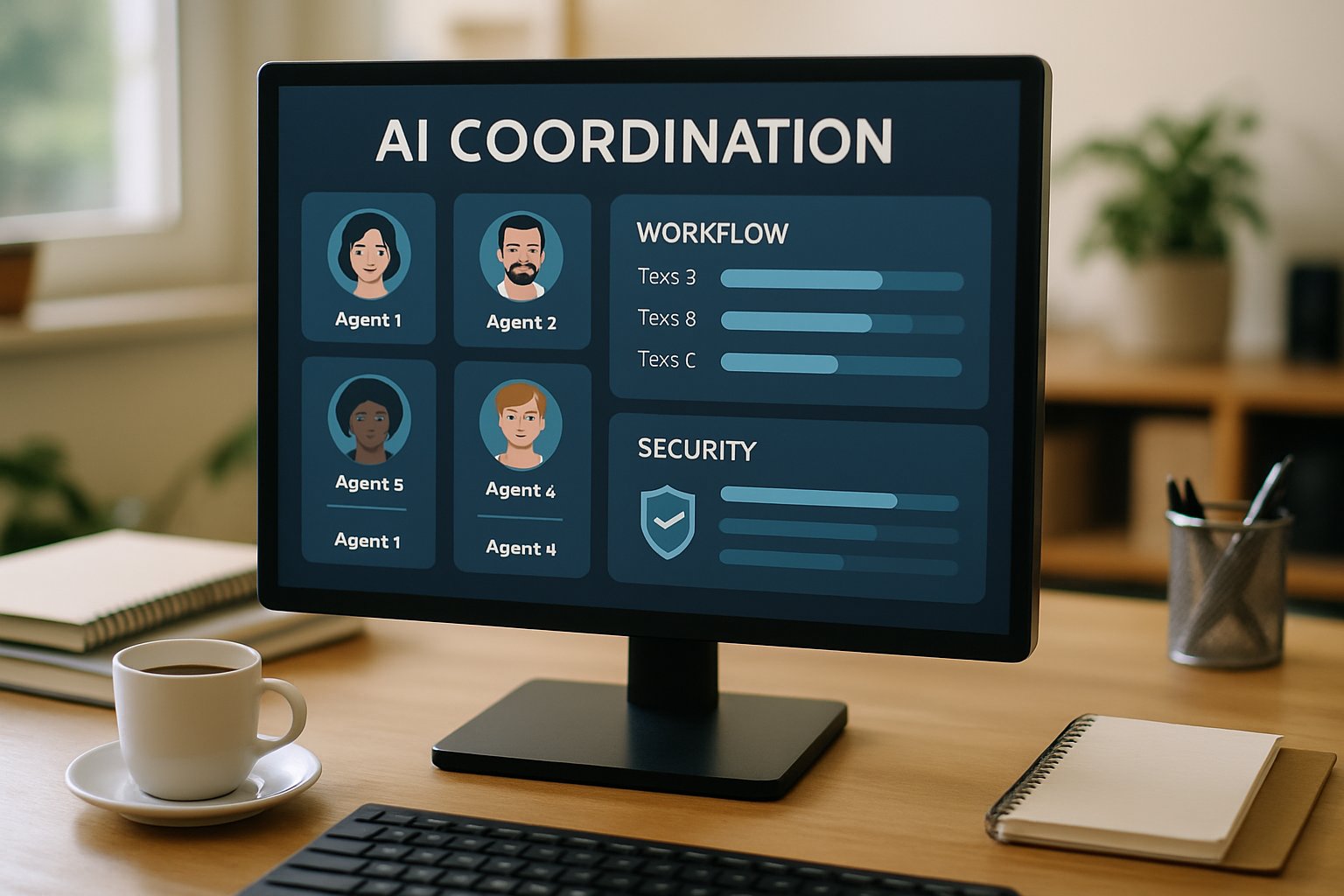
Anthropic reports thousands of Claude Code sessions launched daily since the web rollout in October 2025. In contrast, earlier CLI-only workflows attracted narrower, highly technical audiences. Therefore, integrating agents inside familiar IDEs and chat spaces broadens adoption beyond core platform engineers. These usage signals underscore rising demand, yet operational rigor remains essential. Developers gain speed and focus when agents shoulder routine tasks. However, standard protocols are required to coordinate these helpers across heterogeneous stacks. The next section explores how MCP answers that need.
MCP Standard Gains Momentum
The Model Context Protocol abstracts communication between models and external resources. Consequently, a single MCP server can expose a database, file system, or SaaS API to any compliant agent. Moreover, the protocol removes the N-by-M connector explosion plaguing early agent frameworks. Anthropic open-sourced MCP in November 2024 and saw rapid GitHub uptake, with the servers repo topping 76,800 stars. Subsequently, OpenAI, Block, and Google pledged compatibility, reinforcing cross-vendor viability.
Industry alignment culminated on 9 December 2025 when the Linux Foundation launched the Agentic AI Foundation. Jim Zemlin called MCP a potential “USB-C moment” for agents, emphasizing neutrality. Therefore, enterprises can invest without fearing abrupt proprietary changes. AI Agent Coordination benefits directly because interoperable connectors simplify handoffs among specialized agents. MCP’s momentum shows the community prefers open pipes over bespoke bridges. Consequently, the standard lays crucial groundwork for safe, scalable orchestration. Yet governance alone cannot eliminate risk, as the next section explains.
AI Agent Coordination Risks
Security researchers from Johns Hopkins audited MCP implementations in April 2025 and uncovered troubling exploits. In contrast, earlier RPC schemes lacked tool-level authentication, but agents also lacked destructive capabilities. Now, an ill-formed prompt can trigger shell commands, leak credentials, or delete critical data. Therefore, practitioners must apply least-privilege design, input validation, and rigorous audit logging. The open-source MCPSafetyScanner automates many checks, yet manual reviews remain non-negotiable.
Anthropic has responded by adding Compliance APIs and admin dashboards for enterprise plans. Moreover, features like Claude Cowork restrict tool scopes when operating on local files. These controls improve posture, but defensive engineering must extend to every custom MCP server. Unchecked agents amplify impact when something goes wrong. Nevertheless, disciplined design keeps AI Agent Coordination resilient. Next, we examine market appetite despite these challenges.
Enterprise Adoption Indicators Rise
Analysts track three tangible signs of real adoption. Recent Software Development Trends show executives reallocating budgets toward agent research. First, MCP GitHub stars climbed from zero to 42,000 followers in one year. Second, Claude Code usage spiked after Anthropic bundled it into enterprise tiers on 20 August 2025. Third, AAIF membership lists AWS, Microsoft, and Bloomberg, signaling C-suite commitment.
- 76,800 stars on MCP server repo
- 21,000 stars on Python SDK
- Slack preview enables instant agent spawning
Furthermore, partners like Sourcegraph and Replit report faster feature shipping after integrating agent skills. These early metrics indicate broad momentum for AI Agent Coordination across toolchains. Market traction suggests benefits outweigh initial friction. Consequently, developers seek guidance on starting safely. The next section supplies that playbook.
Practical Getting Started Guide
Begin by cloning the reference MCP server in your preferred language. Then, register tools with explicit scopes, outputs, and allowed arguments. Additionally, enable OAuth or signed tokens for every sensitive endpoint. After basic wiring, connect an agent through the Messages API using the MCP connector flag. Therefore, you can test simple tasks like summarizing a private repository without exposing secrets. Effective AI Agent Coordination also depends on detailed documentation and sample tests.
Next, integrate observability hooks that log each tool call, arguments, and result hashes. Moreover, run MCPSafetyScanner in your CI pipeline to catch unsafe patterns before deployment. Professionals can enhance their expertise with the AI+ Foundation™ certification. Nevertheless, human code review should remain part of your release checklist. Following these steps jump-starts adoption while containing risk. In contrast, skipping governance tasks jeopardizes production environments. Next, consider broader policy and stewardship questions.
Governance And Future Outlook
AAIF governance documents mandate open technical steering and trademark rules similar to Kubernetes. Therefore, no single vendor can unilaterally steer the protocol. Nevertheless, working groups could still fork if progress stalls. Meanwhile, regulators examine autonomous software from safety and labor perspectives.
Forward-looking Software Development Trends suggest agents will become baseline, much like CI pipelines today. Moreover, Gartner predicts 40% of net-new code will emerge from agentic systems by 2028. AI Agent Coordination thus shifts from experiment to necessity. Robust AI Agent Coordination will influence future regulatory frameworks. Open governance and measured policy will determine the speed of this shift. Consequently, technology leaders should monitor AAIF mailing lists and draft internal guardrails. The final section recaps actionable insights.
Key Takeaways And Actions
MCP delivers a common connector layer that simplifies multi-agent integration. Anthropic, OpenAI, and peers back its neutral governance through AAIF. However, new capabilities introduce new threats, demanding rigorous least-privilege design and audit. Early metrics confirm rising enterprise investment, pointing to lasting change. Software Development Trends forecast mainstream agent use within three years. Therefore, prioritize staff training, code review, and certified knowledge. Leaders seeking structured foundations should explore the AI+ Foundation™ certification today.
Consequently, adopting AI Agent Coordination now positions teams ahead of the inevitable standards wave. Nevertheless, rushing without safeguards could erode trust and budgets. Balanced strategy, continuous monitoring, and community collaboration unlock sustainable gains. Act today by joining AAIF discussions and piloting secured agents in a controlled sandbox. Finally, consider formal certification to validate your expertise and accelerate organizational confidence.


