

AI CERTs
4 months ago
Tesla Optimus Production faces slow yet strategic scale-up
Robot ambitions are leaping from concept videos to factory floors. Tesla Optimus Production now occupies that crucial transition space. The company says its humanoid units will soon leave pilot status. However, executives caution that the initial ramp will be painfully slow. Meanwhile, analysts, investors, and veteran roboticists are watching every actuator. Additionally, public fascination with Humanoid Robots keeps headlines brisk. Tesla Optimus Production continues to anchor Elon Musk Robotics narratives across social channels.
Current Market Context Now
Global automation budgets are rising despite economic uncertainty. Moreover, supply-chain strains push manufacturers toward flexible robotic labor. Tesla claims its physical-AI stack gives Optimus a unique edge. Nevertheless, rivals like Hyundai and Figure also publicize aggressive roadmaps. Industry research firm ABI expects annual Humanoid Robots shipments to exceed 150,000 units by 2028. Consequently, executives frame 2026 as a decisive inflection year.
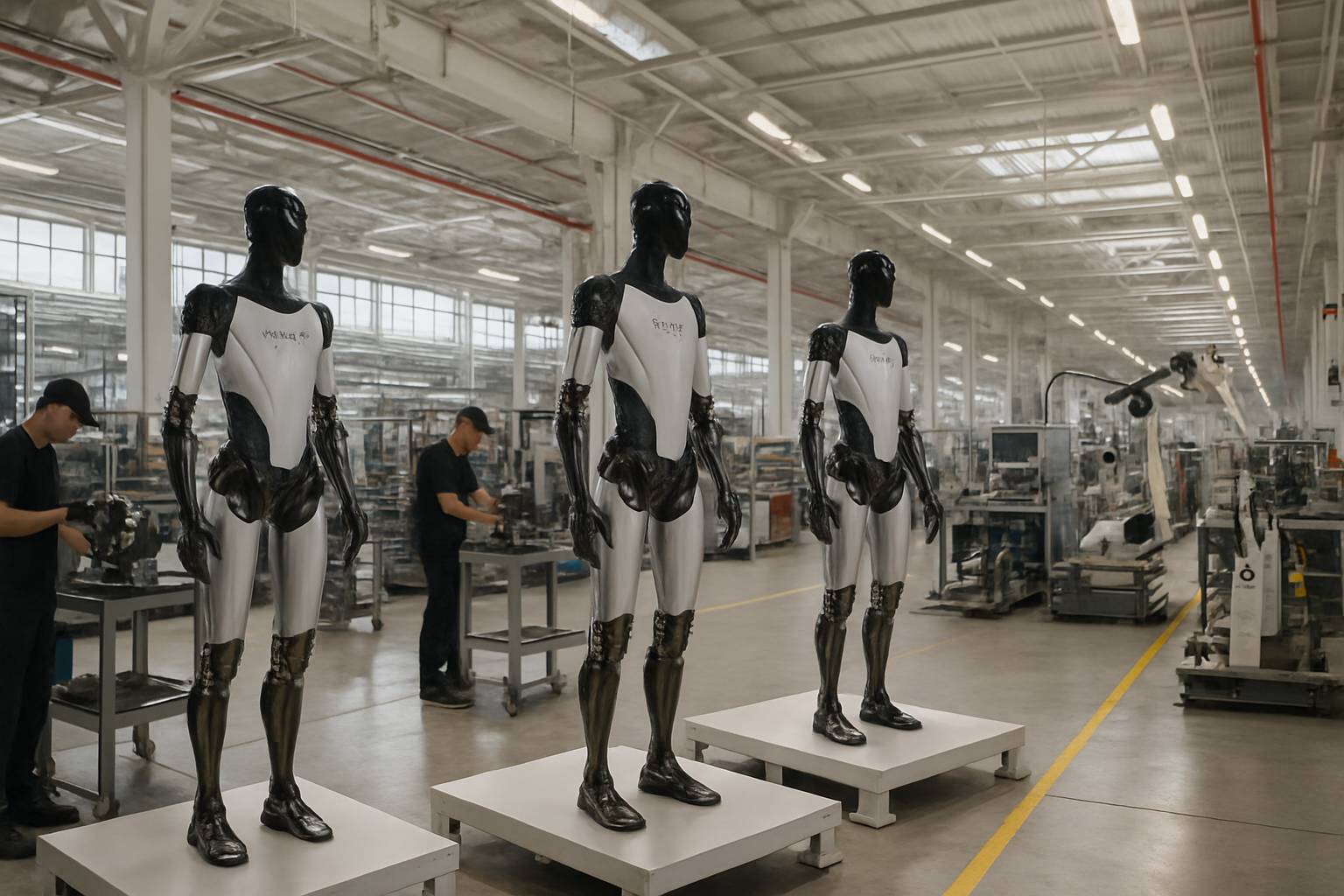
These signals confirm growing demand. Consequently, deeper timeline scrutiny becomes essential. The next section dissects market impact details.
Humanoid Robots Market Impact
Proponents argue that general-purpose bots can slot into unmodified human workplaces. Therefore, procurement managers could sidestep costly facility redesigns. Furthermore, Musk suggests each mature robot could cost under $20,000 at scale. Analysts model dramatic productivity gains if that price sticks.
- Factory tasks: parts picking, screw driving, pallet loading
- Logistics roles: warehouse sorting, last-meter deliveries
- Service jobs: eldercare assistance, hazardous inspections
In contrast, skeptics highlight regulatory, safety, and liability fog. Rodney Brooks calls the optimism “pure fantasy thinking” because dexterous manipulation remains unsolved.
Market expectations thus swing between exuberance and caution. However, real production numbers will ultimately control sentiment. The ensuing timeline reveals why.
Optimus Timeline Unpacked Now
Elon Musk Robotics presentations once promised 10,000 robots in 2025. Subsequently, guidance softened to “several thousand.” January 2026 remarks projected a late-2026 ramp toward 50,000–100,000 units. Long term, Tesla touts a million units yearly. Yet Musk warns the curve will start “agonizingly slow.”
Key milestones include:
- 2025: Pilot lines in Fremont produce factory-only robots
- 2026 Q4: Broader internal deployment, limited external pilots
- 2027+: Third-generation design targets cost reduction
Tesla Optimus Production thus blends ambition with admitted uncertainty. Therefore, investors monitor each quarterly update. Execution gaps now hinge on engineering hurdles, explored next.
Persistent Technical Barriers Persist
Dexterity challenges top every risk list. Vision-only imitation learning struggles with fine manipulation. Moreover, tactile sensor datasets remain scarce. Battery life imposes further limits; continuous bipedal motion drains packs quickly. Supply chains present additional friction because most actuators are bespoke.
Nevertheless, Tesla claims Dojo supercomputers speed simulator training and zero-shot transfer. Additionally, professionals can enhance their expertise with the AI Developer™ certification to understand robotics AI stacks.
Technical gaps must close before volumes soar. Subsequently, leadership stability becomes critical for momentum.
Leadership And Talent Moves
The Optimus group lost key engineer Milan Kovac in 2025. He now advises Hyundai’s robotics arm. Nevertheless, Musk amplified recruiting pushes, citing Tesla’s mission appeal. Furthermore, cross-pollination from Autopilot and Dojo teams accelerates algorithm sharing. However, high turnover could still slow integration tasks and extend test cycles.
Leadership churn therefore injects execution risk. Consequently, competitive positioning deserves examination next.
Competitive Landscape Rapidly Shifts
Hyundai owns Boston Dynamics and funds Atlas development. Figure raised fresh capital for its Figure-01 humanoid. Consequently, giants and startups alike chase similar labor-replacement promises. Meanwhile, forward contracts for warehouse pilots already surface in press releases.
Elon Musk Robotics storytelling remains powerful, yet first-mover bragging rights may erode without shipped units. Moreover, diversified conglomerates might offset burns longer than venture-funded entrants.
Competitive heat pressures Tesla Optimus Production to meet timelines. Therefore, investors scrutinize valuation models, as the next section explains.
Investment And Valuation Debate
Bank of America assigns roughly 19% of Tesla’s equity value to robotics. Morgan Stanley cites even higher upside in bull cases. However, analysts warn that optimism may already sit in the share price.
Moreover, delayed Tesla Optimus Production milestones could trigger re-rating events. In contrast, rapid progress might open new recurring revenue streams via robot leasing. Some models assume 30% gross margins by 2028.
Financiers thus weigh risk against potential exponential payoff. Consequently, strategic clarity gains importance heading into 2027. The final section outlines future possibilities.
Future Outlook And Steps
Observers expect transparent pilot data within 12 months. Therefore, journalists seek unit counts, battery endurance logs, and maintenance statistics. Furthermore, regulators may issue draft safety frameworks for workplace humanoids. Additionally, Tesla might license Optimus subsystems to partners, creating new revenue paths.
Meanwhile, industry talent will likely keep circulating among leading labs. Humanoid Robots research communities plan shared benchmarks that could accelerate comparative testing.
Concrete numbers will either validate or puncture hype. Nevertheless, the promise of scalable physical AI remains alluring.
These forward steps anchor strategic roadmaps. Consequently, readers should track quarterly disclosures for fresh signals.
Tesla Optimus Production stands at a pivotal threshold. Ambitious volume targets meet stubborn engineering and organizational realities. However, market appetite for adaptable Humanoid Robots continues to grow. Moreover, Elon Musk Robotics narratives keep investor attention locked on Fremont’s pilot lines. Consequently, the coming two years will reveal whether Tesla can convert prototypes into millions of reliable units. Professionals seeking deeper competence should consider advanced credentials and monitor every production update.
Disclaimer: Some content may be AI-generated or assisted and is provided ‘as is’ for informational purposes only, without warranties of accuracy or completeness, and does not imply endorsement or affiliation.


