

AI CERTs
2 months ago
India AI Plan targets third global AI rank
At the World Economic Forum, India outlined an ambitious roadmap to ascend the AI hierarchy. The initiative, branded the India AI Plan, seeks to secure the nation’s spot just behind the United States and China. Moreover, policy leaders promised measurable milestones, including massive compute pools and indigenous chips. Consequently, investors and analysts monitored every claim made at Davos, eager to gauge credibility. Nevertheless, the program’s success will hinge on execution, energy supply, and private collaboration.
India AI Plan Funding
The Union Cabinet approved ₹10,372 crore to finance core pillars. Furthermore, officials confirmed the budget spans five years and covers compute, datasets, innovation, and safety. In contrast, prior digital missions rarely combined hardware, models, and governance under one roof. The India AI Plan therefore signals integrated thinking uncommon in earlier programs.
- ₹10,372 crore total outlay
- Public–private compute facility funded under PPP
- Innovation Centre grants for foundational models
- Dedicated platform for open government datasets
These allocations offer early momentum. However, actual disbursements will decide project velocity. The funding framework highlights the government’s intent. Subsequently, investors may match public spending with larger private bets.
National Compute Capacity Ambitions
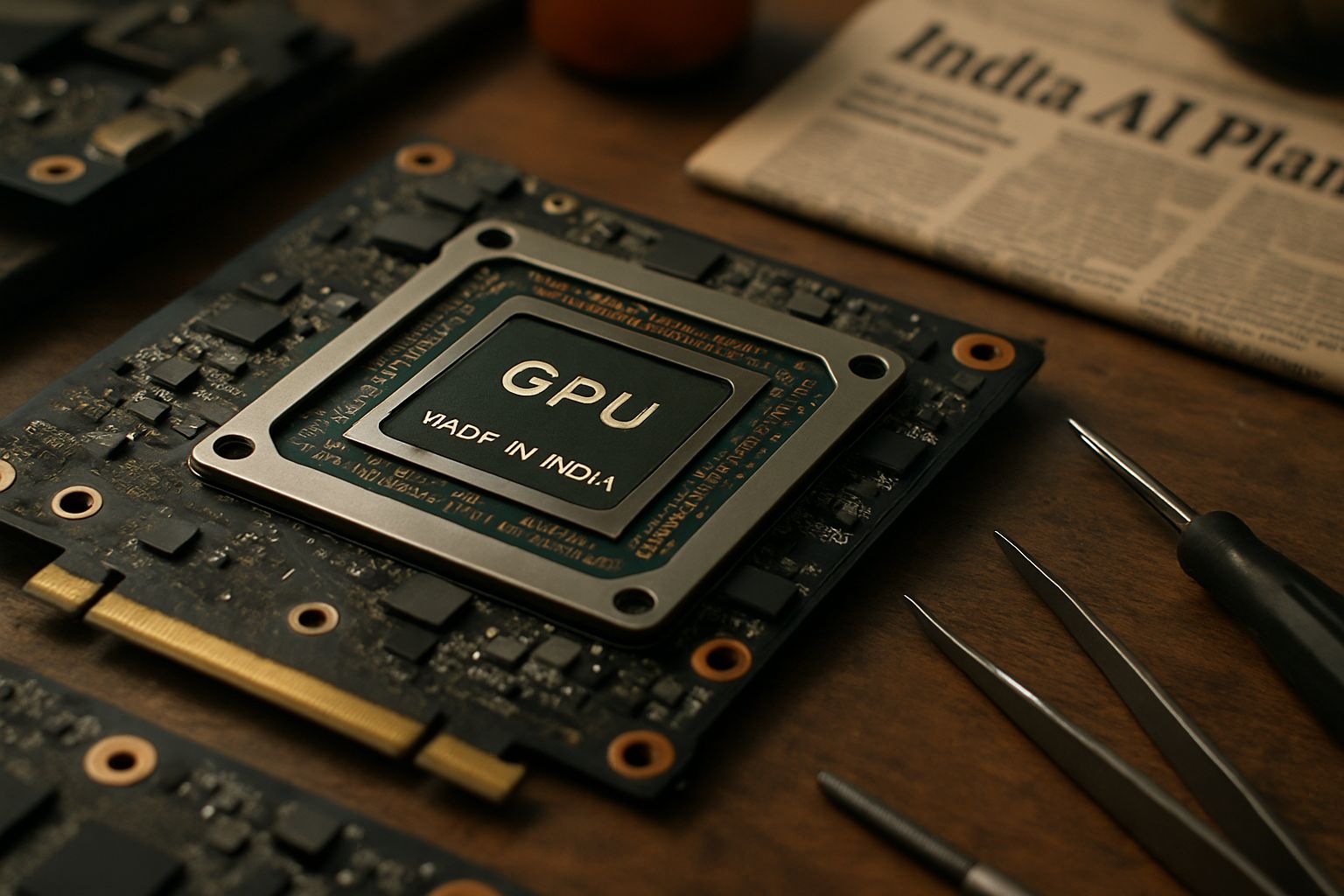
Minister Ashwini Vaishnaw told Davos media the nation will pool 10,000 GPUs within months. Moreover, officials promised a shared interface that startups and researchers can book on demand. The India AI Plan appears calibrated to democratize expensive infrastructure now dominated by hyperscalers.
However, Nvidia controls roughly 80 percent of datacenter accelerators, creating supply bottlenecks. Consequently, procurement schedules remain vague. Nevertheless, several state governments signed data-centre MoUs during Davos sessions. Together, public and state actions could lift India toward Global AI Power status.
Compute breakthroughs will unlock new research. In contrast, delays would stall indigenous model training. Therefore, timely GPU deliveries remain mission-critical.
Domestic Chip Development Timeline
Vaishnaw pledged a first “Made-in-India” AI accelerator by 2026. Additionally, Tata and semiconductor partners are studying fab options. The India AI Plan references design incentives, yet fabrication will likely involve overseas foundries initially. Nevertheless, partial local design still sharpens talent.
Davos observers welcomed the announcement. However, analysts cautioned that tap-out, verification, and yield cycles could stretch timelines. Consequently, India may rely on imported silicon while prototypes mature. Meanwhile, energy-efficient architectures remain a priority because data-centre power costs threaten margins.
Progress on chips will influence India’s claims of becoming a Global AI Power. Therefore, transparent milestone reporting will matter.
Private Sector Momentum Surge
Reliance, AdaniConnex, and Google unveiled multibillion-dollar data-centre projects. Moreover, Reliance’s Jamnagar campus promises renewable-anchored power to curb inference expenses. State governments such as Uttar Pradesh also inked agreements for AI-ready facilities at Davos.
These moves complement the India AI Plan by adding commercial muscle. Nevertheless, long construction lead times could slow compute availability. Consequently, companies are exploring modular builds to accelerate deployment. In contrast, hyperscalers will expand only where stable power and fiber exist.
Private commitments underscore confidence in India’s ascent as a Global AI Power. Subsequently, cross-sector partnerships may multiply.
Projected Economic Impact Forecasts
NITI Aayog and McKinsey estimate AI could add up to $600 billion to GDP by 2035. Moreover, optimistic scenarios push gains near $1.7 trillion. The India AI Plan foresees a sizeable share stemming from sovereign models that address local languages.
Consequently, policy makers frame AI as a growth driver mirroring past IT services success. However, macro benefits presuppose inclusive adoption across small firms and rural services. Therefore, skilling programs accompany infrastructure spending.
These projections entice financiers. Nevertheless, they also raise expectations. Subsequently, each milestone will face scrutiny.
Major Execution Risks Ahead
Several obstacles threaten timelines:
- GPU shortages amid global demand spikes
- Grid constraints for multi-gigawatt data centres
- Talent gaps in advanced chip design
- Ethical oversight for large language models
Moreover, power tariffs could inflate operational costs. In contrast, renewable integration may cut long-run expenses. Consequently, firms explore solar-plus-storage contracts near coastal hubs.
Execution risks require proactive mitigation. Therefore, transparent dashboards and public audits can bolster trust in the India AI Plan.
Governance And Talent Strategies
MeitY promises Safe & Trusted AI guardrails. Additionally, bias mitigation guidelines will apply to each publicly funded model. Professionals can enhance their expertise with the Chief AI Officer™ certification.
Moreover, universities will receive grants for curriculum updates. Consequently, graduates should enter the workforce ready for AI product roles. Meanwhile, industry groups plan apprenticeships aligned with compute availability.
These strategies interlock with national goals. However, sustained funding across electoral cycles remains critical. Subsequently, multi-stakeholder governance boards may institutionalize oversight.
The governance agenda completes the ecosystem view. However, its impact depends on enforcement rigor. Consequently, stakeholders will monitor forthcoming rulebooks.
India’s blueprint blends public capital, private investment, and regulatory foresight. Moreover, coordinated actions at Davos signaled unified messaging. Nevertheless, success will depend on hardware deliveries, energy economics, and skilled talent. The India AI Plan could redefine the nation’s economic trajectory. Therefore, readers should track upcoming RFPs, pilot launches, and certification opportunities.


