

AI CERTs
4 months ago
Nadella’s Davos Alert: Avoiding AI Bubble via Global Adoption
Investor euphoria around generative models is palpable, yet warning lights flashed in the Swiss Alps last week. Satya Nadella, Chief Executive of Microsoft, told the World Economic Forum in Davos that discipline is essential. He argued the current excitement could morph into an AI Bubble if benefits stay locked within wealthy hubs. The comment struck a chord among policymakers, investors, and engineers. Many attendees recalled past technology manias that collapsed when adoption lagged valuations. However, Nadella said diffusion across sectors and regions can convert hype into lasting productivity. Global adoption figures published by Microsoft’s AI Economy Institute reveal both progress and persistent inequality. Consequently, the debate now extends beyond model accuracy toward energy costs, workflows, and workforce skills. This article unpacks the warning, the numbers, and the strategic implications. Furthermore, readers will see how certifications and targeted policies can help organizations avoid headline risk. Understanding these dynamics lets leaders spot early signs of froth and steer budgets toward sustainable value.
Global Bubble Warning Context
Nadella’s remarks came during a plenary discussion moderated by BlackRock CEO Larry Fink. He told the Davos audience that a tell-tale sign of an AI Bubble would be constant focus on technology suppliers. In contrast, sustainable value appears only when hospitals, farms, and factories translate algorithms into productivity gains. Moreover, Nadella warned that early winners might hoard compute and data, freezing out late adopters. Microsoft’s diffusion study formed the backbone of his argument by quantifying regional divides. Consequently, he urged governments to support open access infrastructure and workforce skilling. Meanwhile, investors listened closely, mindful that earlier internet and telecom booms had ended abruptly. These historical memories amplified the headline, sparking debates across social platforms within hours. Failure to spread benefits could leave the AI Bubble bursting in spectacular fashion.
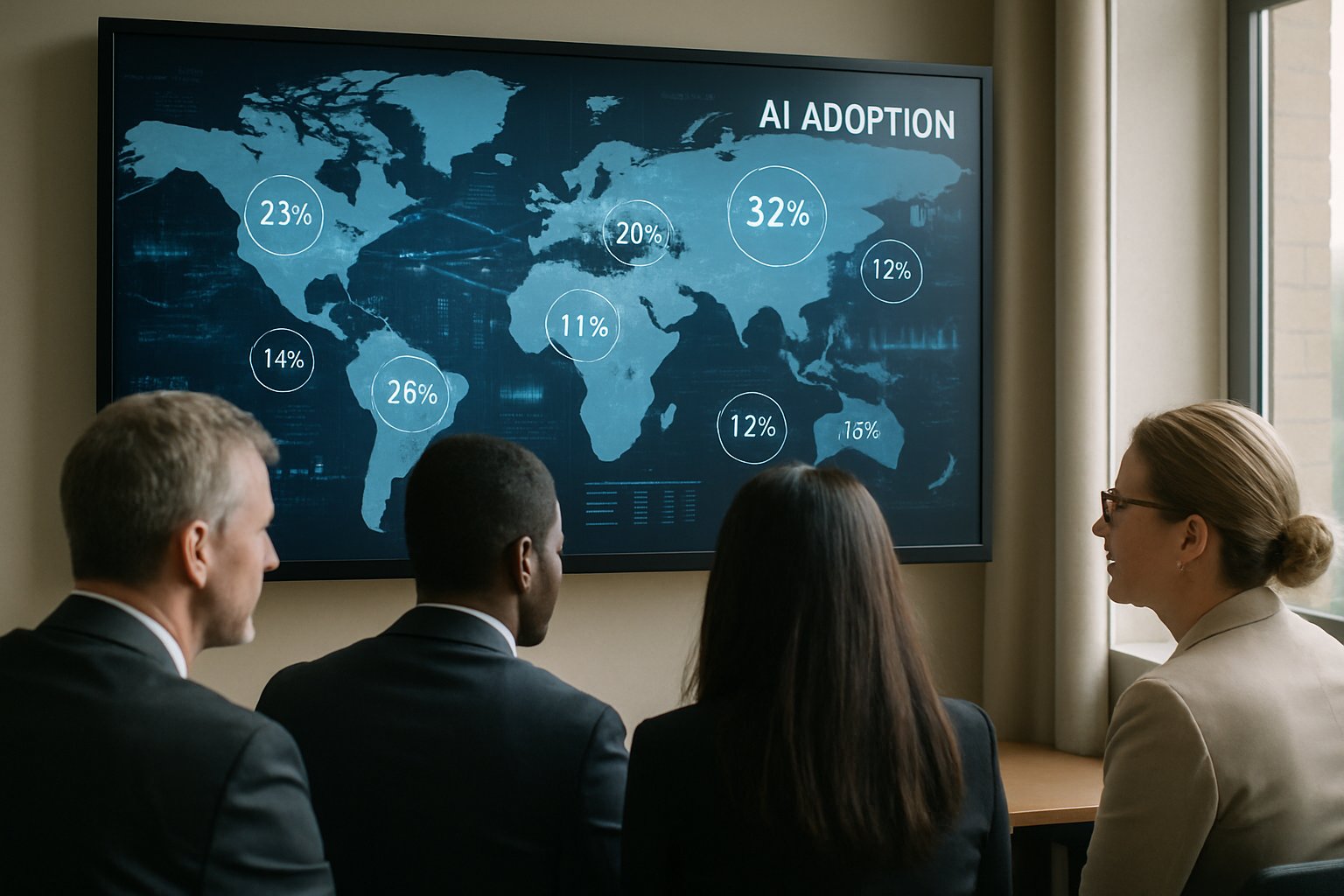
The warning links hype to adoption realities. However, numbers tell the deeper story that follows.
Key Adoption Gap Data
Fresh statistics from the Microsoft AI Economy Institute quantify diffusion with uncommon granularity. According to the January report, 16.3% of the world’s population used generative tools during 2025’s second half. However, usage splits sharply along income lines.
- Global North working-age usage: 24.7%.
- Global South working-age usage: 14.1%.
- Country leaders: UAE 64.0%, Singapore 60.9%.
Moreover, the gap widened compared with the previous half-year. Researchers warn that unequal uptake could inflate the AI Bubble by masking limited on-the-ground impact. In contrast, fast-moving economies like the UAE already embed language models in customs, healthcare, and public services. Consequently, diffusion now depends on energy costs, skills pipelines, and enterprise change management.
These figures expose adoption fault lines. Therefore, understanding token economics becomes crucial.
Core Token Economics Explained
Token economics refers to the price and availability of computational tokens generated by large models. Nadella told Davos participants that national growth will hinge on producing tokens cheaply and cleanly. Moreover, the cost stack spans silicon, energy, data centres, and cooling. Countries with abundant renewables can undercut rivals, capturing downstream software and service revenues. Consequently, policymakers now treat chip fabs and grid upgrades as strategic assets. Failure to invest risks fueling the AI Bubble through scarce capacity and soaring inference costs. Nevertheless, Microsoft promotes model distillation to lower compute needs and broaden access. Such technical advances could narrow diffusion gaps if paired with human capital initiatives.
Token costs shape inclusion prospects. Next, we examine supportive voices boosting adoption momentum.
Main Supportive Industry Arguments
Not everyone embraces the bubble narrative. OpenAI executives at Davos described AI as the next electricity, citing explosive user and developer growth. Furthermore, early case studies showcase tangible gains. Drug discovery timelines have shortened, and legal research hours have fallen. Banks report improved fraud detection accuracy by layering large-language reasoning onto transaction rules. Consequently, supporters argue valuation multiples reflect genuine productivity expansion rather than speculative heat. They contend the AI Bubble label obscures transformative momentum and may deter necessary capital.
Success stories reinforce optimism today. In contrast, critics warn of overlooked pitfalls.
Key Leading Skeptical Counterarguments
Skeptics accept progress yet remain wary of frothy investment cycles. They highlight persistent diffusion gaps and limited workflow redesign inside traditional enterprises. Moreover, energy consumption keeps rising, intensifying environmental and cost concerns. Researchers point to historical precedents where hardware booms delayed broad productivity, including early mainframe eras. Consequently, some investors now hedge AI exposure with diversified portfolios, recalling the dot-com bust. Regulators also voice concern about concentration of compute power among a few Western cloud operators. They warn such dominance could sustain an AI Bubble even while main-street productivity remains flat.
Skeptics demand evidence of inclusive gains. Policies and market signals now shape that evidence path.
Policy And Market Impacts
Government responses increasingly target infrastructure, skills, and energy incentives. Norway recently announced green-hydro datacentres tied to public cloud credits for small manufacturers. Similarly, Singapore extends training grants for prompt engineering roles. Furthermore, central banks monitor capex levels to gauge whether an AI Bubble threatens financial stability.
- Expand renewable generation near datacentres.
- Subsidize open-source model research.
- Modernize labor laws for hybrid cognition.
Markets already price utilities positioned to deliver low-carbon electrons to new server farms. Consequently, energy futures and GPU contracts trade together on some exchanges.
Policy choices will determine adoption speed. Therefore, workforce upskilling becomes the final piece.
Global Upskilling For Diffusion
Broad skills remain crucial for translating algorithms into everyday processes. Additionally, World Economic Forum surveys show talent shortages in data science and design thinking. Companies now blend technical bootcamps with domain-specific workflow labs. Professionals can enhance their expertise with the AI+ UX Designer™ certification. Moreover, such credentials link creative prototyping to responsible deployment. Human-centered design helps avoid narrow solutions that would reinforce an AI Bubble. Meanwhile, industry consortia draft common curricula, easing global talent mobility.
Skill programs multiply inclusive value. Finally, we synthesize the journey so far.
Global Conclusion And Outlook
Generative AI now stands at a critical diffusion crossroads. Nadella’s warning resonated because historical bubbles shared the same adoption mismatch. However, supportive case studies reveal undeniable progress in medicine, finance, and logistics. Consequently, leaders must balance prudence with experimentation. They should track energy costs, skills pipelines, and workflow redesign metrics to avoid an AI Bubble. Strategic policies, renewable infrastructure, and rigorous education can convert excitement into shared productivity. Moreover, certifications empower professionals to drive responsible implementations that scale globally. Act now, embrace inclusive strategies, and turn transformative technology into sustainable performance.
Disclaimer: Some content may be AI-generated or assisted and is provided ‘as is’ for informational purposes only, without warranties of accuracy or completeness, and does not imply endorsement or affiliation.


