

AI CERTs
2 months ago
DeepMind’s Two-Year Robotics Horizon: What Comes Next
Breakthrough talk around Robotics is intensifying after bold predictions from Google DeepMind chief Demis Hassabis. In recent interviews, he forecast useful humanoid demonstrations within two years, spurring industry debate. However, credible experts caution that engineering gaps remain stubborn. Meanwhile, investors are watching hardware partnerships and hiring moves for concrete signals. This article unpacks the timeline, technology, markets, and risks shaping the coming chapter. Additionally, it contrasts upbeat forecasts with sobering research on manipulation and safety barriers. Consequently, leaders can calibrate strategy and talent planning before the next headline-grabbing demo. Moreover, professionals eyeing product roles should prepare now for cross-disciplinary demands that unify software and mechanics. Therefore, forward-looking readers will find practical actions and cautionary notes throughout. In contrast with hype cycles of the past, data cited here is sourced from primary interviews and global statistics. Subsequently, the narrative moves from predictions to hard numbers and then to strategic implications. Finally, the piece closes with career resources, including a certification link for aspiring product managers. Many headlines label this prospect the next big AI Breakthrough for physical automation.
Robotics Timeline Predictions Ahead
During the segment, he called Robotics another big area poised for rapid progress. He added that useful humanoid tasks could emerge within a couple of years. Consequently, many watchers interpreted the remark as a 2027 deadline for a public showcase.
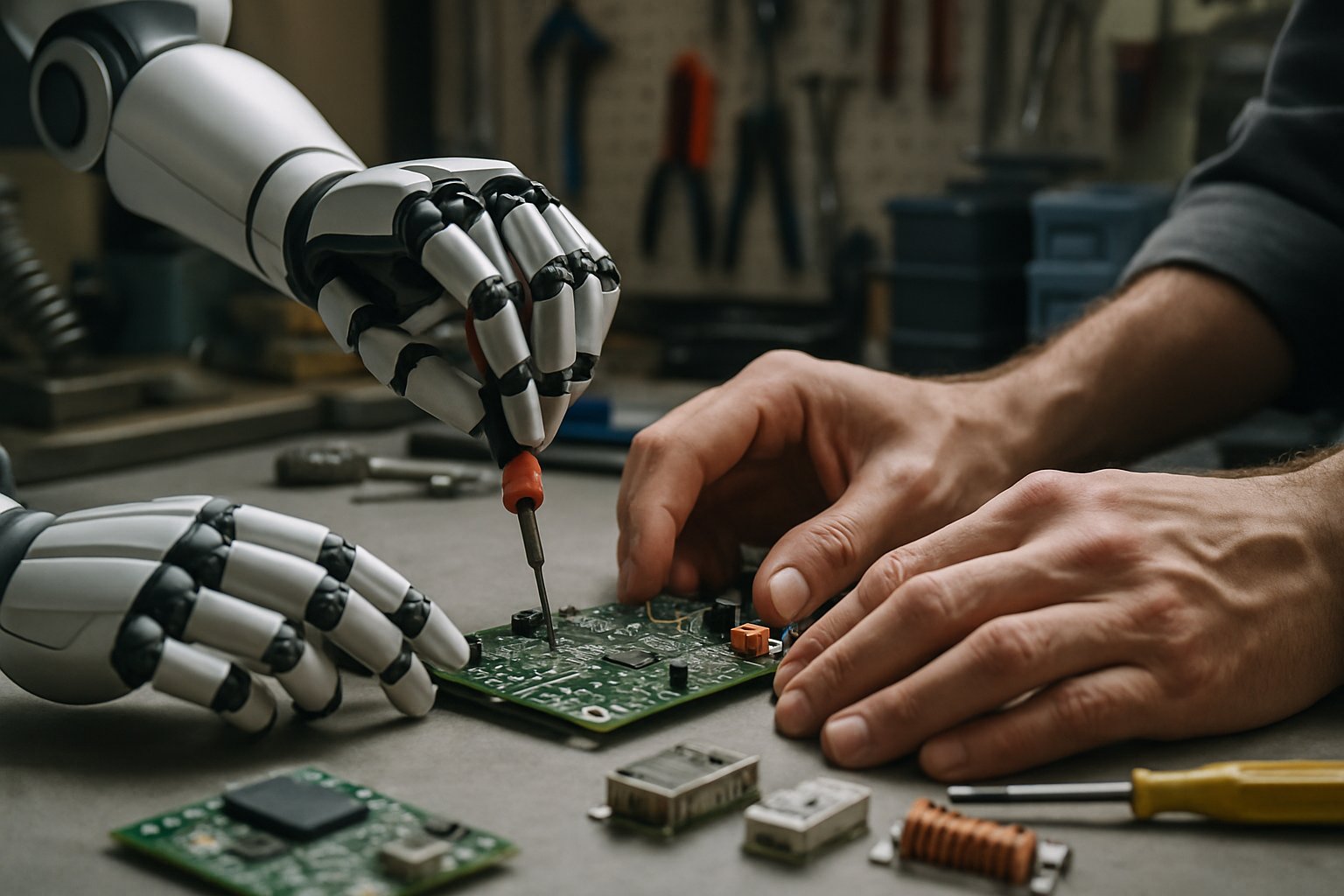
At Davos 2026, the estimate narrowed to 18–24 months, reinforcing the sense of urgency. Moreover, Bloomberg coverage linked the timeline to ongoing Gemini model expansion into mechanical control. Therefore, teams inside and outside Google are racing to align research milestones with that window.
These converging statements suggest a visible demo is likely before 2028. However, translating one demo into production scale requires distinct advances, discussed next.
Tech Stack Convergence Drivers
Robotics research now benefits from huge multimodal datasets harvested from simulation and real sensors. Modern language-vision models now parse scenes, reason, and output tokenized action plans. Additionally, DeepMind researchers emphasize world models that let agents predict physics before moving motors. Consequently, the gap between perception and control is shrinking.
Hardware costs also fall as actuator suppliers scale automotive and consumer lines. Moreover, cloud training credits give smaller labs access to trillions of simulation frames. Therefore, innovative startups can iterate on embodied reinforcement learning without owning expensive facilities.
Nevertheless, two notorious gaps still threaten timelines. First comes the sim-to-real mismatch. In contrast, the second gap involves dexterous, stable manipulation of varied everyday objects.
These technical hurdles could delay widespread utility even if a demo impresses investors. Subsequently, the conversation shifts to market realities underpinning investment decisions.
Market Data Snapshot Today
The International Federation of Robotics counted 542,000 industrial installations during 2024. Meanwhile, operational stock reached 4.66 million units worldwide, dominated by Asian factories. Consequently, a mature base exists for software upgrades once embodied intelligence stabilizes.
Grand View Research pegs the humanoid market at roughly $4 billion by 2030, growing 17.5% annually. However, other consultancies forecast tenfold higher revenue, revealing deep uncertainty. Therefore, executives should stress-test plans against multiple adoption curves.
- 2024 industrial installations: 542k units (IFR)
- Global operational stock: 4.66 million units
- Projected 2025 installations: 575k units
- Humanoid market 2030: ~USD 4 billion (Grand View)
Robotics startups cite these numbers when pitching growth funds. Additionally, hiring data shows Alphabet recently lured a Boston Dynamics veteran to accelerate mechanical integration. Such moves signal serious budget commitment beyond academic curiosity.
These figures highlight both momentum and volatility within commercial forecasts. Nevertheless, technology alone cannot guarantee adoption, as the next section explains.
Challenges Temper the Hype
Peer-reviewed surveys still classify in-hand manipulation as an open Robotics research frontier. In contrast, perception benchmarks have reached near-human accuracy on many datasets. Consequently, physical dexterity, not vision, dictates readiness for service deployment.
Moreover, safety and liability frameworks lag behind software-only governance models. Regulators will demand documented fail-safes before approving robots in hospitals or homes. Therefore, companies must invest early in standards bodies and insurance partnerships.
Cost is another limiting factor. Nevertheless, component prices fall yearly, and volume could accelerate the curve once reliability improves.
These obstacles underscore why optimistic timelines often slip by several years. Subsequently, we examine who may win or lose when breakthroughs arrive.
Potential Winners And Losers
DeepMind, Tesla, and Boston Dynamics possess deep capital and expertise, positioning them as early beneficiaries. Additionally, startups like Figure and Agility can exploit agility and focused roadmaps to capture niches. Hardware suppliers, notably NVIDIA, could enjoy demand spikes for edge GPUs.
However, labor unions may resist rapid automation in logistics and care sectors. Consequently, policymakers will balance competitiveness with social stability. Therefore, firms should engage government early to shape talent reskilling programs.
Robotics platform integrators will also compete for scarce supply chain capacity. These stakeholder dynamics influence governance debates discussed in the next section.
Safety And Governance Balances
Physical agents demand stricter oversight than chatbots because they can damage property or people. Moreover, Hassabis himself urges proactive guardrails and transparency around test protocols. In contrast, some competitors push faster, arguing that market forces will self-correct.
Nevertheless, government agencies worldwide draft standards for certification, logging, and emergency stop mechanisms. Consequently, compliance engineering becomes a hiring priority alongside reinforcement learning expertise. Professionals can enhance their expertise with the AI Product Manager™ certification. Robotics compliance standards are still emerging across regions.
These governance frameworks could slow reckless deployments yet build public trust for sustainable growth. Therefore, strategic alignment with regulators may define competitive advantage as breakthroughs near.
Strategic Conclusion And Outlook
Robotics momentum is undeniable, yet history warns against linear extrapolation. DeepMind and its rivals may showcase headline demos within two years, validating many AI Breakthrough claims. However, scaling dependable fleets across industries will demand patient engineering, partnership building, and regulatory coordination. Consequently, executives should budget for iterative pilots rather than overnight replacements. Moreover, product managers can future-proof careers by gaining cross-domain skills in mechanics, software, and compliance. Professionals seeking structured learning can pursue the earlier-mentioned certification to bridge strategic and technical gaps. Therefore, the best preparation blends cautious optimism with disciplined execution and continuous education. Ultimately, when Robotics finally crosses the lab threshold, the prepared organizations will capture the greatest value.


