

AI CERTS
4 hours ago
Indoor Training Effect Shakes Up Robotics Research
Wind, dust, and sensor glitches still haunt field robots. Nevertheless, a fresh MIT-Harvard-Yale study suggests a surprising path to robustness. The authors call it the indoor-training effect. Their experiments reveal that agents schooled in pristine simulations often outperform peers trained amid noise. Consequently, long-standing advice about matching lab and field conditions demands reconsideration. For enterprises racing to commercialize AI control stacks, the finding could reshape design schedules and budgets. This article unpacks the evidence, contrasts rival techniques, and examines what it means for Robotics deployments. Along the way, we outline practical steps, expert insights, and certification resources for forward-leaning teams.
Indoor Training Effect Insights
Historically, engineers assumed agents should master the same Environment they will later face. However, Serena Bono and colleagues challenged that orthodoxy with a controlled Noise-Injection protocol across 60 Atari variants. They perturbed the Markov transition function with calibrated Gaussian noise yet kept reward structures intact. Surprisingly, policies first optimized in a clean simulator then tested in noisy conditions posted higher mean rewards. Moreover, the effect appeared across Q-learning and SARSA, independent of exploration hyper-parameters. The team coined the phrase indoor-training effect to evoke human practice: master basics inside, then venture outdoors. Quantitatively, generalization agents beat learnability agents on most grids, including 26 of 33 PacMan scenarios. Effective Training duration also shortened, shaving thousands of Atari steps.
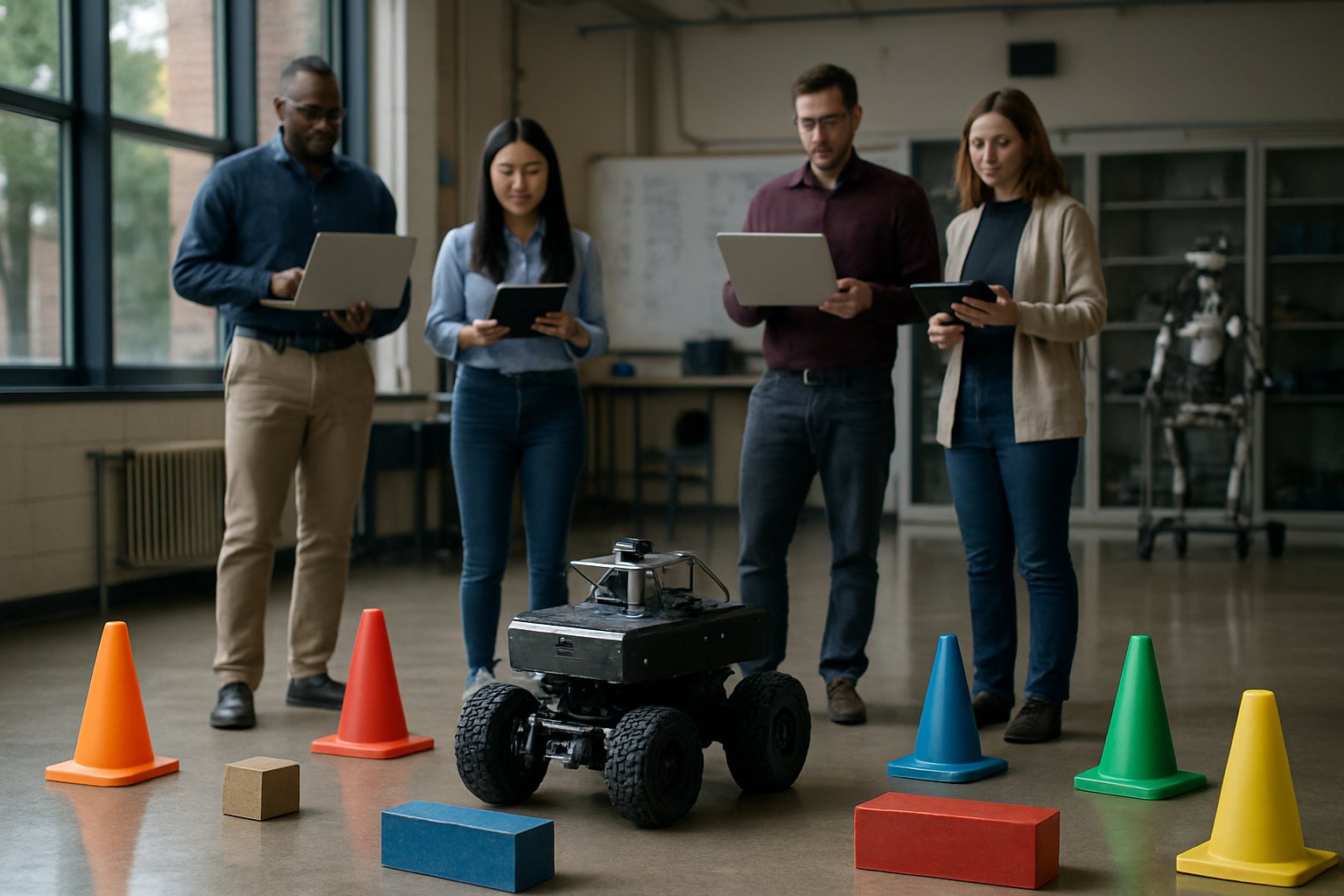
Clean baselines can seed broader skills than noisy baselines. Therefore, the study reframes initial simulation priorities. Next, we explore why pristine worlds help agents generalize.
Why Clean Worlds Matter
Intuitively, noisy states can mislead exploration. In contrast, clean states expose core dynamics without distracting stochasticity. Consequently, early Training time focuses on value structure rather than noise memorization. Bono’s ablation study measured state-action overlap between policies. Higher overlap correlated with stronger test performance, reinforcing classical bias-variance tradeoffs. Moreover, training noise sometimes drives agents toward conservative strategies that plateau early. Humans adopt similar curricula, practicing tennis serves indoors before braving wind. The analogy resonates with industrial simulation pipelines where physics fidelity competes with rendering speed. Yet, a purely clean Environment rarely mirrors production reality. Industry case studies in agricultural Robotics already mirror the pattern. Therefore, staged curricula that add randomness later can blend speed and realism.
Clean stages cultivate foundational policy gradients. Subsequently, incremental noise polishes robustness. The next section compares this curriculum with other robustness tactics.
Comparing Robustness Approaches Today
Teams already deploy domain randomization, system identification, and distributionally robust RL. However, each method carries trade-offs. Domain randomization sprays parameters across huge ranges, forcing invariances but inflating sample budgets. System identification narrows simulator gaps through real data, yet demands instrumentation on prototypes. Distributionally robust RL optimizes worst-case value, consequently producing cautious policies. The indoor-Training effect offers a cheaper complement rather than a replacement. Moreover, curriculum schedules can mix clean stages, moderate randomization, and brief real fine-tuning. Industry success stories often integrate NVIDIA Isaac Sim domain randomization with targeted lab data. Researchers now test hybrid pipelines on Robotics quadrupeds, manipulators, and aerial drones. Key comparison metrics include convergence time, final reward, and zero-shot transfer accuracy.
No single recipe solves uncertainty alone. Therefore, blended toolkits dominate practice. We now examine what this blend means for Robotics engineers.
Key Implications For Robotics
Clean-first curricula can reshape Robotics project timelines. Initially, developers may cut simulator complexity, accelerating iteration cycles. Furthermore, hardware procurement can wait until later phases, reducing cash burn. The approach also influences risk modeling. Enterprises must track when the simulated Environment diverges dangerously from hardware reality. Consequently, coverage metrics such as state-action overlap and disturbances catalog become governance artifacts. Additionally, procurement teams can stagger sensor purchases until robustness checkpoints pass. Regulators might welcome documented phase gates that show incremental hazard exposure. Nevertheless, managers should budget for final validation because unmodeled friction or latency surprises remain. Robotics integrators that operate in hazardous sectors, like mining, may still need extra redundancy. Teams should decide when to Deploy on hardware using data-driven readiness thresholds.
Clean-first planning offers speed and cost benefits. However, diligent tracking prevents overconfidence. Next, we outline a practical deployment guide.
Practical Deployment Playbook Guide
This playbook synthesizes research findings into actionable steps.
- Start with a clean Training simulator reflecting nominal dynamics.
- Measure exploration coverage every epoch.
- Inject calibrated transition noise once performance plateaus.
- Deploy a small batch to the target Robotics Environment for system identification.
- Fine-tune with limited real rollouts, then Deploy widely.
Furthermore, Robotics teams should version control disturbance profiles to support reproducibility. Professionals can enhance their expertise with the AI Cloud Engineer™ certification. The credential signals familiarity with scalable inference pipelines and monitoring. Additionally, certified owners grasp cloud cost models critical when simulations burst compute. Teams should log each Deploy decision with justification tags to aid audits.
A disciplined playbook converts theory into repeatable field wins. Consequently, it aligns scientists, engineers, and executives. We close by spotlighting open questions that still challenge researchers.
Pressing Open Questions Ahead
Several scientific puzzles remain unsolved. First, does the effect scale to contact-rich Robotics tasks like hammering nails? Second, how sensitive is performance to noise type beyond Gaussian perturbations? In contrast, real factories experience structured disturbances such as delayed actuation. Moreover, theoretical work warns of hardness zones where robustness becomes intractable. Researchers must map which transition families permit efficient learning. Meanwhile, practitioners crave benchmarks that involve complex 3-D Environment models and real hardware resets. Subsequently, community adoption will hinge on shared datasets, tools, and reproducibility suites.
Important gaps span theory, benchmarks, and scaling. Nevertheless, collaboration can accelerate answers.
Relevant Certification Path Forward
Teams seeking structured upskilling can pursue the AI Cloud Engineer™ pathway. Consequently, they gain validated knowledge in scalable simulation orchestration and secure release pipelines.
The indoor-training effect challenges a core assumption of applied AI. Clean simulators, when used wisely, can breed agents that survive messy realities. Moreover, blended curricula, robust baselines, and disciplined metrics now define competitive engineering. Industry leaders have started integrating these ideas into Robotics roadmaps, pairing them with cloud certifications. Nevertheless, unanswered questions about scale, noise structure, and theory warrant deeper research. Consequently, readers should evaluate their pipelines, run clean-versus-noisy trials, and seek verified skills. Begin by exploring the AI Cloud Engineer™ certification and accelerate your team’s advantage.


