

AI CERTS
2 months ago
Climate Science Meets AI in Arctic Subseasonal Forecasting
Arctic weather swings challenge energy grids, shippers, and governments. Consequently, the search for sharper subseasonal insight has intensified. Recent advances in artificial intelligence promise faster and more accurate guidance. Moreover, national centers now trial machine-learning models alongside traditional physics codes.
The convergence of data-driven algorithms and polar diagnostics marks a turning point for Climate Science. MIT Research teams, for instance, have demonstrated weeks-ahead signals for continental cold. ECMWF competitions have turbocharged innovation by exposing models to real-time scrutiny. Meanwhile, operational sea-ice systems deliver daily updates to mariners navigating treacherous lanes.
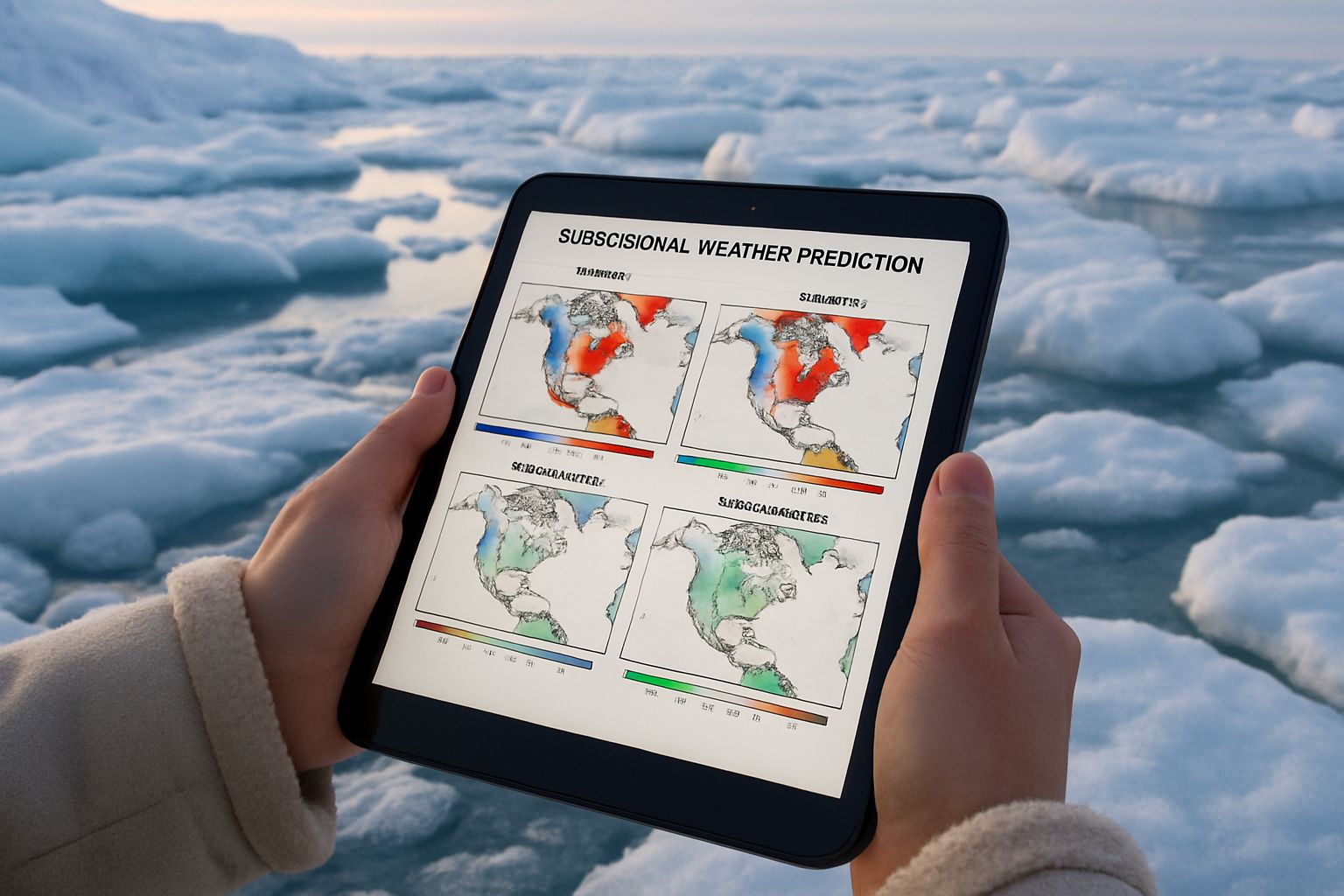
Therefore, professionals must understand how Arctic AI forecasting works, what benefits it brings, and which gaps remain. This article unpacks the landscape, citing peer-reviewed numbers, expert quotes, and verified project milestones.
Arctic Winter Forecasts Advance
Subseasonal forecasting traditionally faltered beyond ten days. However, 2025 marked a breakthrough for Winter outlooks. An MIT Research group led by Judah Cohen topped ECMWF's AI WeatherQuest competition. Their hybrid model fused machine-learning pattern recognition with classic Arctic predictors like Siberian snow and polar vortex strength.
The system issued an accurate Prediction of a mid-December cold surge along the U.S. East Coast three weeks ahead. Consequently, energy traders adjusted gas positions before prices spiked. ECMWF published leaderboard data confirming the model's superior skill in Weeks 2-4 temperature accuracy.
Concurrently, ECMWF released early results from its AI Forecasting System, or AIFS. Hybrid nudging experiments showed 15–20 percent skill gains for upper-air fields, reinforcing momentum behind data-driven approaches. These successes illustrate how Climate Science is entering a speedier, information-rich era.
Multi-week Arctic achievements now move from lab tests to competitive validation. Nevertheless, many questions about robustness linger.
In contrast, understanding the subseasonal window itself helps gauge remaining hurdles.
Subseasonal Window Explained Clearly
Weeks 2-4 represent a predictability valley between weather and climate. Furthermore, atmospheric memory fades quickly, while ocean and ice feedbacks act slowly. Consequently, model errors amplify faster than in short-range forecasts.
Researchers exploit Arctic teleconnections to extend skill across this gap. October snow cover, early sea-ice retreat, and stratospheric vortex wobbling provide precursor signals. Therefore, combining these diagnostics with machine learning elevates Climate Science into a decision-relevant timeframe.
Understanding the window clarifies why accurate Prediction remains difficult. Data scarcity north of 70° N, coupled interactions, and extreme event rarity complicate training sets.
Subseasonal dynamics require both physics insight and statistical agility. Consequently, the community invests in diverse AI architectures.
This investment is visible across several high-profile projects now advancing rapidly.
Key Projects And Prediction
Several initiatives showcase measurable progress. Moreover, the operational MET-AICE system has delivered sea-ice concentration forecasts with 31 percent lower RMSE than persistence baselines. Ice-edge positions improved by roughly 32 percent across 1–10 day horizons.
Google DeepMind’s GraphCast demonstrated medium-range skill surpassing ECMWF’s deterministic model at 10 days. Meanwhile, ensemble transformers like FourCastNet and FuXi extended skill by days for upper-air heights, exciting Climate Science investors.
NOAA’s S2S program lists AI bias correction and post-processing as strategic pillars. Additionally, national meteorological services race to integrate similar pipelines before the next Winter.
Notable Verification Metrics Listed
- MET-AICE: 31 % lower sea-ice RMSE, 32 % sharper ice-edge placement.
- AIFS hybrid runs: 15–20 % improvement in large-scale hemispheric skill scores.
- AI WeatherQuest: 35 teams, 170 participants, 60 models evaluated weekly.
- FuXi: Anomaly correlation above 0.6 for 14.5 day Winter Prediction of surface temperature.
These figures come from peer-reviewed papers and public dashboards. Therefore, they provide a transparent baseline for comparing new entrants. Nevertheless, verification protocols must remain consistent.
Projects now document tangible performance gains across ice, temperature, and circulation indicators. However, physical realism and edge cases still demand scrutiny.
The next section weighs these opportunities against well-documented limitations.
Opportunities And Limitations Discussed
Speed tops the opportunity list. Once trained, neural forecasts run in seconds, enabling massive ensembles for probabilistic Prediction. Consequently, grid operators can sample thousands of potential Winter states rather than dozens.
Moreover, models sometimes surpass classical systems on key metrics, as Climate Science case studies now reveal. Faster inference also lowers computing costs and carbon footprints.
Nevertheless, pure data-driven models risk physical inconsistency. In contrast, extremes like sudden stratospheric warmings remain challenging, because training data contains few analogs. Additionally, Arctic observation gaps hinder generalization.
Governance and data access raise further concerns. Proprietary holdings could limit reproducibility and undercut public scientific benefit.
Opportunities look compelling, yet unresolved risks cannot be ignored. Therefore, stakeholders need balanced investment strategies.
The practical impacts of these technologies highlight why balanced decisions matter.
Impact For Arctic Stakeholders
Shipping firms already exploit improved ice charts to shorten voyages through the Northern Sea Route. Furthermore, earlier warnings of polar lows aid search-and-rescue teams operating in darkness and extreme cold.
Energy utilities value three-week lead time on prolonged freezes. Consequently, they can pre-stage fuel and reinforce vulnerable infrastructure before Winter stress peaks.
Indigenous communities welcome clearer guidance for subsistence hunting trips across fragile sea ice. Moreover, insurance analysts use probability curves from ensemble Prediction to refine risk models; modern Climate Science demands such quantification.
Professionals can enhance their expertise with the AI Network Security™ certification. Such credentials demonstrate fluency in responsible AI deployment, a growing requirement inside operational forecasting centers.
Stakeholders experience tangible safety, financial, and social benefits from stronger subseasonal capability. Nevertheless, sustained progress demands coordinated research and policy action.
The roadmap section outlines priority steps for the coming years.
Roadmap For Future Progress
Researchers plan fully coupled atmosphere-ocean-ice AI systems for the Weeks 2-4 horizon. Additionally, independent audits of the MIT Research winning model will confirm transferability across seasons.
Open verification scorecards, common data hubs, and shared code repositories rank high on community wish lists. Consequently, transparency will accelerate trustworthy Climate Science advances.
Economic valuation studies must quantify benefits for shipping, energy, and insurance sectors. Moreover, policy frameworks should safeguard open data while encouraging private innovation.
Finally, next-generation hardware and cloud platforms will slash training times. Subsequently, operational agencies can iterate models weekly, adapting to rapid Arctic change.
Consensus on open benchmarks, coupled models, and ethical guardrails will define success. Therefore, proactive collaboration remains essential.
The conclusion distills key insights and invites continued engagement.
AI is reshaping Arctic subseasonal forecasting with speed, skill, and new diagnostics. Consequently, Climate Science now delivers actionable insights weeks before disruptive events. Verified metrics from MET-AICE, AIFS, and MIT Research underscore measurable gains.
Nevertheless, physical consistency, data equity, and extreme event performance require sustained attention. Moreover, open benchmarks and coupled architectures will anchor future breakthroughs.
Professionals should monitor ongoing audits, support transparent data practices, and pursue specialized training. Therefore, explore the linked certification to strengthen your role in this evolving domain.


