

AI CERTS
5 months ago
Why Venture Capital Now Tracks AI API Calls Over Valuations
Investors once stared at share tickers when sizing up artificial-intelligence winners. Today, many professionals in Venture Capital scan usage dashboards instead. Consequently, Vinod Khosla’s latest podcast appearance ignited conversation across boardrooms. The veteran financier claimed that soaring API Calls offer the clearest window into real adoption, not frothy valuations. Moreover, his stance arrives as “AI Bubble” chatter surges 740 percent on earnings calls, according to AlphaSense. Understanding why usage volume now rivals price-to-sales ratios is crucial for deal makers navigating 2026’s volatile landscape.
This article unpacks Khosla’s argument, contrasts competing Metrics, and outlines what disciplined capital allocators should monitor next. Professionals can enhance their expertise with the AI+ Healthcare Specialist™ certification.
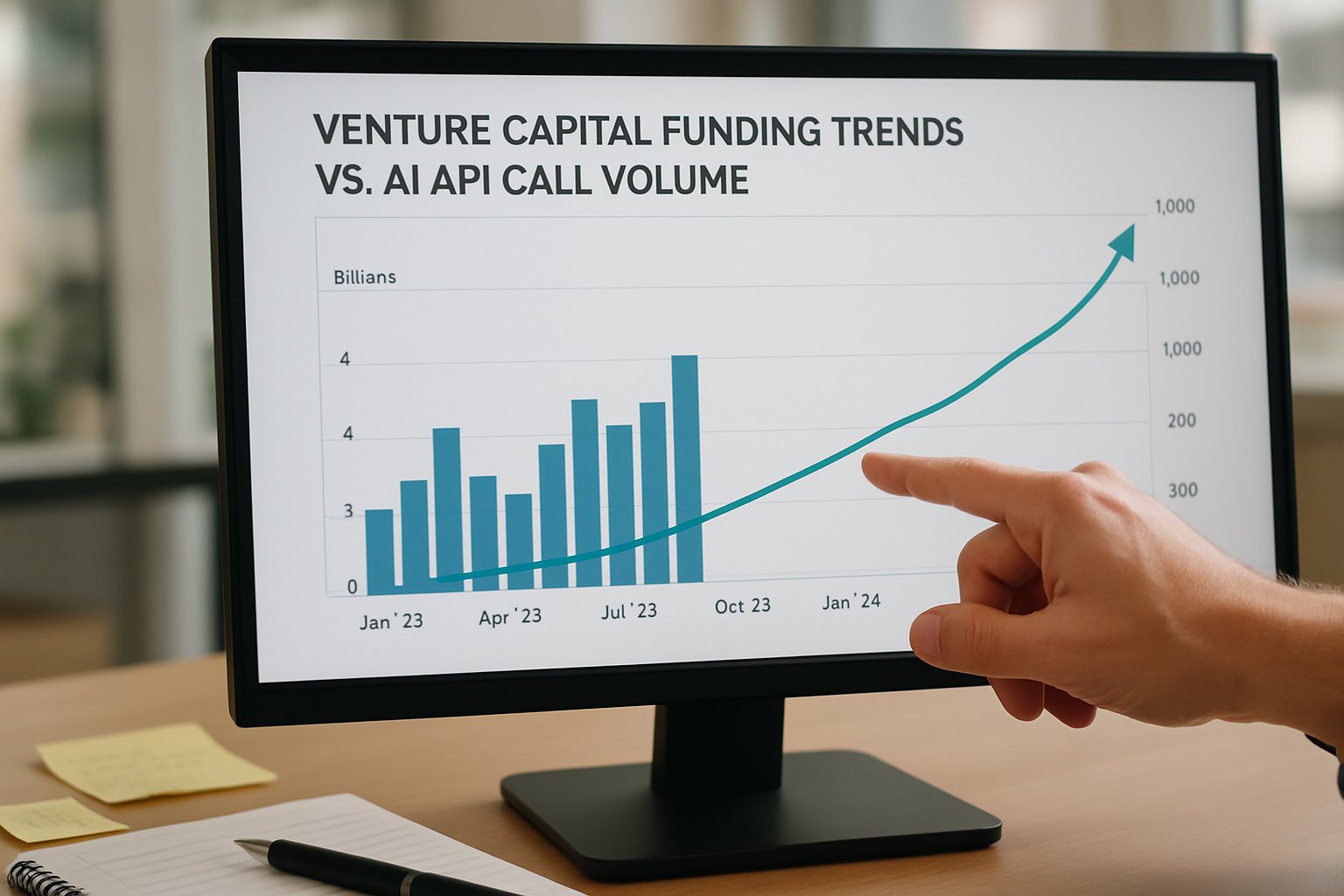
Khosla API Usage Benchmark
Khosla told OpenAI’s “State of the AI Industry” that “bubbles should be measured by the number of API Calls.” Therefore, he urged peers to ignore short-term price swings. Historically, public markets mix fundamentals with sentiment. In contrast, authenticated requests hitting inference servers reveal whether developers integrate models into workflows. Nevertheless, not all calls are equal. A drug-discovery prompt consumes far more compute than a meme generator. Still, absolute volume trends expose adoption momentum earlier than quarterly revenue prints.
Khosla’s view resonates because usage data updates almost in real time. Furthermore, call counts cannot be easily massaged by creative accounting. For Venture Capital scouts, daily traffic charts feel like a heartbeat monitor for portfolio health. These benefits explain why usage dashboards now flash across partner meetings.
Such enthusiasm highlights one takeaway: operational telemetry increasingly guides investment pacing. However, the next section shows sentiment signals painting a different picture.
Market Sentiment Signals Rise
While usage climbs, macro discourse hints at discomfort. Business Insider reports “AI Bubble” mentions jumping 740 percent last quarter. Additionally, analysts question whether expensive data-center buildouts will deliver acceptable returns. Consequently, some hedge funds trimmed positions in infrastructure suppliers.
Despite fears, OpenAI revealed annualized revenue above $20 billion for 2025. Moreover, compute capacity expanded to 1.9 GW, triple last year’s figure. Those numbers suggest producer confidence. Nevertheless, skeptical voices like Michael Burry highlight capital intensity outpacing free cash flow. Their caution reminds Venture Capital firms that usage alone cannot weigh profitability.
These sentiment clashes underline a core issue: investors grapple with mixed signals. The following section dives into concrete growth data.
Provider Growth Numbers Surge
Sarah Friar’s blog clarifies OpenAI’s traction. Revenue jumped from $2 billion in 2023 to more than $20 billion within two years. Meanwhile, compute capacity expanded roughly tenfold. Furthermore, daily active users grew in lockstep with API Calls.
Anthropic published a complementary dataset. Its Economic Index categorizes usage by geography, task complexity, and automation level. In contrast to raw volume, these multidimensional Metrics track economic impact. Moreover, the index shows enterprise customers leaning toward automation-heavy workloads via APIs, while consumer chat skews toward augmentation.
Such disclosures equip Venture Capital analysts with fresh diligence material. However, single-dimension gauges still dominate headlines. The next section critiques that habit.
Debating Single Volume Metrics
Volume appears objective, yet pitfalls persist. Firstly, incessant agent polling can inflate API Calls without adding value. Secondly, prompt length and model size drive cost variation. Therefore, two calls may yield wildly different margins. Thirdly, free-tier traffic occasionally balloons during hackathons, masking paying demand.
- One million short completions may generate minimal revenue.
- Ten thousand high-complexity calls can exceed that income.
- Unmonetized calls still burn compute budget.
Consequently, disciplined investors triangulate volume with price-per-call and gross margin data. The Anthropic Economic Index illustrates how richer Metrics spotlight value per task. Nevertheless, many headlines still reduce adoption to counts alone, fueling talk of an AI Bubble.
These caveats suggest multi-factor dashboards are essential. The subsequent section explores composite frameworks gaining traction.
Toward Composite Adoption Metrics
OpenAI combines four indicators: DAU, WAU, revenue, and call volume. Moreover, it links each to available compute capacity. In contrast, Anthropic overlays “economic primitives” such as task success and autonomy. Consequently, analysts can rank workloads by strategic importance, not mere volume.
Several funds now pilot blended scoring models. One popular formula weights paid API Calls at 40 percent, margin at 30 percent, retention at 20 percent, and compliance at 10 percent. Additionally, providers experiment with “calls-per-dollar” charts to visualize efficiency.
For Venture Capital committees, composite dashboards reduce false signals during funding cycles. However, implementation requires data transparency from founders, which is still evolving. The next section translates these ideas into practical investor actions.
Implications For Investors Today
Capital partners must refine diligence checklists. Firstly, request raw and normalized Metrics, including revenue per thousand calls. Secondly, benchmark unit economics against leaders like OpenAI and Anthropic. Moreover, model downside scenarios where compute pricing spikes.
Thirdly, analyze qualitative indicators: task complexity mix, geographic diversity, and automation ratio. In contrast, relying on headline volume risks funding unsustainable load-burning loops that fuel a speculative Bubble. Additionally, invite technical advisors to audit logging systems, verifying that reported API Calls map to real workloads.
Venture Capital firms adopting these steps protect portfolios and gain negotiation leverage. These practices also encourage founders to embrace transparent reporting.
Key takeaways emerge: composite metrics enhance clarity, and disciplined requests strengthen governance. Consequently, the ecosystem shifts toward healthier growth signals.
Checklist For Deal Teams
Deal teams can streamline reviews using the following five-point agenda.
- Compare paid versus free call ratios.
- Track revenue per call trend.
- Assess compute cost elasticity.
- Examine task success analytics.
- Validate retention across industry cohorts.
Applying this list embeds rigor into every term sheet discussion.
These investor practices reflect a mature approach. However, the broader community still debates the best indicators. More longitudinal data will ultimately resolve which signals predict durable value.
Professionals seeking deeper analytical skills can pursue the AI+ Healthcare Specialist™ program to sharpen their data-driven decision making.
Composite strategies will evolve. Nevertheless, consistent transparency remains central to healthy market function.
Conclusion And Next Steps
Vinod Khosla’s focus on raw API Calls reframes traditional valuation talk. Nevertheless, pure volume ignores economics, complexity, and strategic depth. Consequently, blended Metrics that pair usage with margins and task outcomes offer superior foresight. Moreover, sentiment data warns that an AI Bubble narrative still influences capital flows.
Therefore, forward-looking Venture Capital teams should demand granular dashboards, run scenario tests, and stay alert to compute pricing shifts. Additionally, continuous learning remains vital. Professionals can elevate their analytical edge through the linked specialist certification. Act now to future-proof investment decisions and lead the conversation on responsible AI growth.
Disclaimer: Some content may be AI-generated or assisted and is provided ‘as is’ for informational purposes only, without warranties of accuracy or completeness, and does not imply endorsement or affiliation.


