

AI CERTs
3 months ago
Nvidia’s BioNeMo Push Redefines Pharma Partnerships
Investors expected bold news at this year’s J.P. Morgan Healthcare Conference.
However, NVIDIA exceeded predictions by unveiling a sweeping expansion of its BioNeMo platform for life sciences.
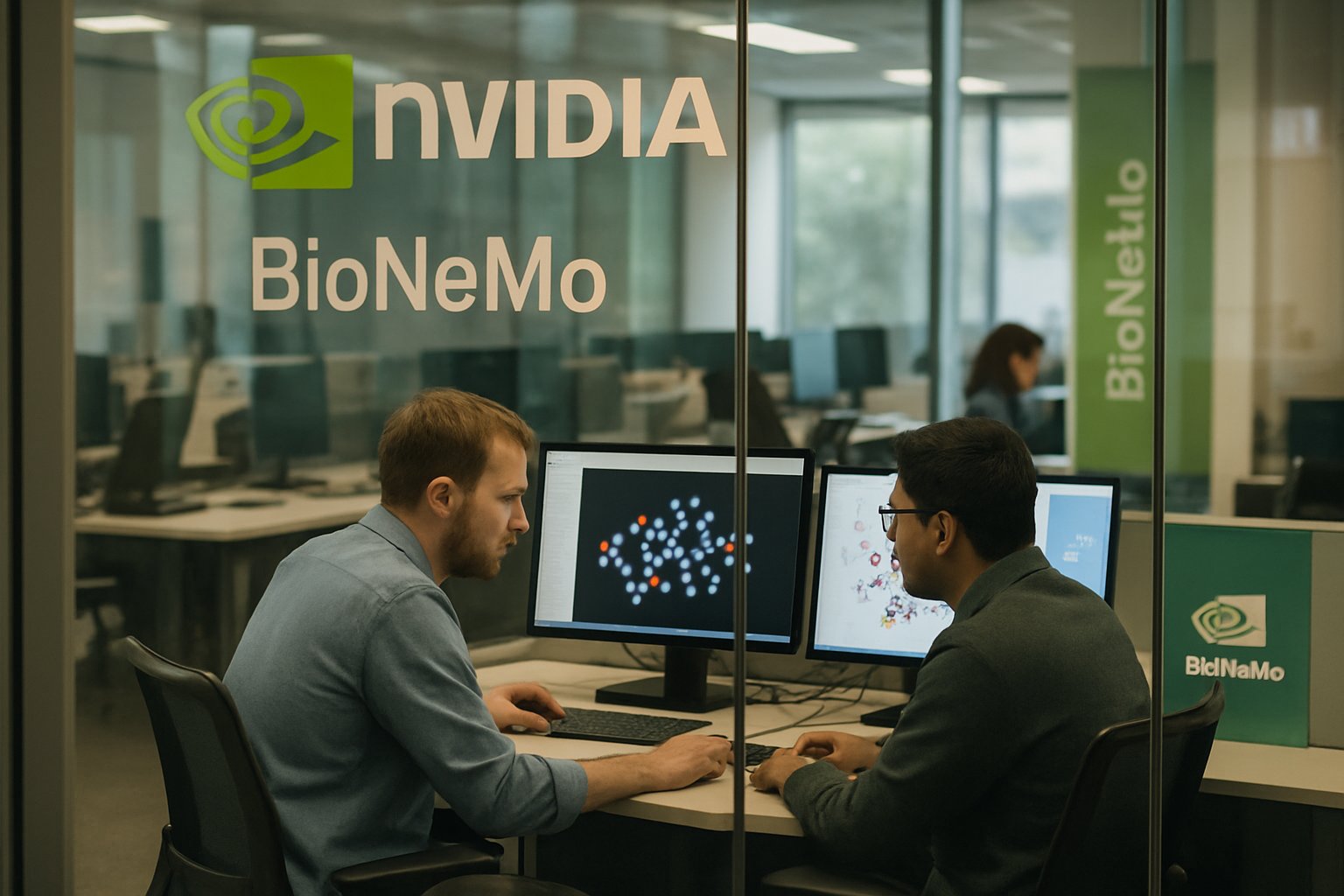
The announcement, delivered on January 12, 2026, paired fresh technology with heavyweight pharmaceutical partnerships.
Consequently, industry leaders now view NVIDIA as a primary catalyst for AI-enabled Drug Discovery schedules.
Eli Lilly, Thermo Fisher, and several biotech innovators joined forces with the GPU giant in headline deals.
Moreover, Lilly and NVIDIA pledged up to $1 billion toward a Bay Area co-innovation AI laboratory.
Meanwhile, new agentic workflows promise continuous, automated experimentation that shortens cycles from concept to candidate.
These combined moves underscore a wider trend toward integrated compute, models, and robotics within pharmaceutical R&D.
Professional readers need concrete details, quantified impact, and balanced risk analysis to navigate this fast shift.
The following report delivers that context while mapping strategic implications for technology and science teams alike.
BioNeMo Expansion Key Highlights
NVIDIA framed the platform update as the largest BioNeMo release since its 2024 debut.
Additionally, executives showcased new Clara open models, BioNeMo Recipes, and nvMolKit for accelerated cheminformatics.
These components sit on top of DGX infrastructure and NIM microservices to streamline molecular design pipelines.
Key statistics anchored the reveal.
The company cited annual global biopharma R&D spending of $300 billion, signaling vast efficiency opportunities.
Therefore, stakeholders welcomed tools that promise measurable time and cost reductions.
NVIDIA also highlighted new adopters, including Basecamp Research, Dyno Therapeutics, and Terray Therapeutics.
Consequently, the ecosystem now spans startups, established pharma, and laboratory automation vendors.
These highlights set the stage for the marquee collaboration with Eli Lilly.
The expansion introduced fresh models, more partners, and a sharper commercial narrative.
Subsequently, attention turned toward the billion-dollar Lilly alliance.
Co-Innovation Lab Partnership Details
Eli Lilly and NVIDIA will jointly invest up to $1 billion across five years.
Furthermore, the firms will staff a Bay Area facility that colocates model builders with medicinal chemists.
The lab’s compute backbone will run on the forthcoming Vera Rubin architecture coupled with BioNeMo services.
Jensen Huang described the arrangement as a new blueprint for Drug Discovery.
In contrast, Lilly CEO David Ricks emphasized data scale and domain knowledge as complementary assets.
Both leaders stressed closed-loop experimentation where every assay result refines subsequent computational hypotheses.
Prior context matters.
Lilly built a DGX SuperPOD in 2025, laying foundational GPU capacity before agreeing to the co-innovation deal.
Consequently, the new lab focuses on application depth rather than raw compute procurement.
The partnership integrates capital, compute, and expertise under one roof.
Consequently, observers predict accelerated candidate generation timelines within the next eighteen months.
Meanwhile, laboratory automation will determine whether those candidates materialize efficiently.
Autonomous Lab Initiative Explained
Thermo Fisher partnered with NVIDIA to connect instruments, edge compute, and cloud orchestration into an autonomous lab stack.
Moreover, generative agents will schedule experiments, interpret sensor data, and feed findings back into central models.
Such agentic workflows embody the lab-in-the-loop vision outlined by Kimberly Powell.
Physical AI concepts also appear.
Engineers will test robotic protocols in Omniverse digital twins before deploying them on real benches.
Therefore, integration risks decline while throughput rises.
The autonomous stack includes several intertwined layers.
- Instrument control modules running on local GPUs
- Edge inference services for real-time data parsing
- Cloud-hosted BioNeMo models guiding candidate prioritization
- Scheduling agents coordinating robotics and chemistries
Collectively, these layers aim to shorten bench-to-model feedback loops to hours instead of weeks.
Autonomous labs translate compute gains into wet-lab productivity.
Subsequently, platform tools become the decisive differentiator among competing AI strategies.
New Platform Tools Added
Beyond partnerships, NVIDIA shipped important software updates.
RNAPro predicts RNA structures, while ReaSyn v2 flags non-synthesizable molecules.
Additionally, nvMolKit accelerates cheminformatics preprocessing using GPUs.
BioNeMo Recipes package training workflows so researchers can customize foundation models with proprietary datasets.
Consequently, smaller teams gain access to capabilities once reserved for hyperscale labs.
OpenFold and Boltz PBC have already integrated these recipes into internal pipelines.
Developers can also call GenMol and DiffDock NIM services via simple API endpoints.
Therefore, orchestration overhead drops significantly.
Meanwhile, GPU utilization remains high because scheduling is handled automatically.
These new tools reinforce platform stickiness and broaden market reach.
Subsequently, BioNeMo solidifies its position as the default SDK for structural biology.
However, benefits alone do not negate inherent challenges.
Benefits And Industry Impact
Generative models accelerate hypothesis generation across vast chemical and biological spaces.
Moreover, automated labs increase experimental throughput without proportional headcount growth.
Consequently, Drug Discovery programs could move from target validation to lead optimization in months rather than years.
Stakeholders also expect improved portfolio economics.
Shorter cycles reduce capital at risk by quickly eliminating weak candidates.
Therefore, CFOs are watching computational metrics as closely as clinical milestones.
NVIDIA positions BioNeMo as an equalizer for resource-constrained startups.
In contrast, large pharma values its scalability across private GPU clusters.
Professionals can enhance their expertise with the AI Writer™ certification to stay competitive.
AI promises faster, cheaper, and broader candidate searches.
Nevertheless, the next section examines unresolved scientific and regulatory risks.
Risks And Open Questions
Computational outputs still require rigorous physiological validation.
Nature reviews warn of translation gaps between in silico predictions and clinical efficacy.
Therefore, integrating human-relevant datasets remains critical.
Data quality and access inequities may concentrate benefits within already dominant firms.
Additionally, generative systems can hallucinate chemically impossible structures without strict constraints.
ReaSyn v2 reduces this risk yet cannot eliminate it entirely.
Energy consumption is another concern.
Large GPU estates draw significant power, raising sustainability and budget questions.
Moreover, regulators are still drafting guidance on agentic experimentation and AI-generated data packages.
Commercial ownership of co-trained models could spark complex intellectual property disputes.
Consequently, legal teams should engage early during partnership negotiations.
Technical, ethical, and legal challenges persist despite rapid progress.
In contrast, proactive governance can convert potential liabilities into competitive advantages.
Subsequently, strategic leaders must synthesize benefits and risks into coherent execution roadmaps.
Conclusion And Next Steps
NVIDIA’s latest moves place BioNeMo at the center of an accelerating AI transition within biopharma.
The billion-dollar Lilly lab, autonomous workflows, and new toolkits collectively reshape Drug Discovery economics.
However, success hinges on data integrity, experimental rigor, and thoughtful governance.
Technology executives should pilot closed-loop projects while tracking regulatory updates and sustainability metrics.
Researchers should skill-up on GPU-accelerated workflows and continuous learning frameworks.
Meanwhile, investors should monitor milestone velocity rather than headline compute spend.
Professionals can future-proof their roles by earning credentials like the AI Writer™ certification.
Closing the gap between promise and practice will demand collaboration across science, engineering, and policy teams.
Therefore, the coming year offers a pivotal window to build, validate, and scale AI-enabled pipelines.
Seize that window now to secure leadership in the next generation of pharmaceutical innovation powered by BioNeMo.


