

AI CERTs
6 months ago
Edge Computing Accelerators Redefine Real-Time Intelligence
From phones to factory robots, intelligence is shifting outward. Latency, privacy, and bandwidth pressures push inference away from data centers. Consequently, Edge Computing Accelerators have become the cornerstone of this migration. These dedicated ASICs, GPUs, NPUs, and FPGAs now ship inside millions of devices. Furthermore, vendors promise real-time performance without burning battery budgets. On-Device AI assistants, vision pipelines, and language models already run locally on flagship hardware. Meanwhile, Software Development leaders must adapt toolchains and workflows to target diverse accelerators. This article unpacks market forces, technology trends, and practical guidance for engineering teams. Each section ends with concise takeaways and transitions to maintain clarity.
Global Market Growth Drivers
IDC projects edge spending to hit $261 billion in 2025 and $380 billion by 2028. Moreover, analysts link the surge directly to Edge Computing Accelerators embedded in consumer and industrial gear. Regional 5G rollouts enhance distributed computing viability. Additionally, stricter privacy regulation motivates local processing investments.
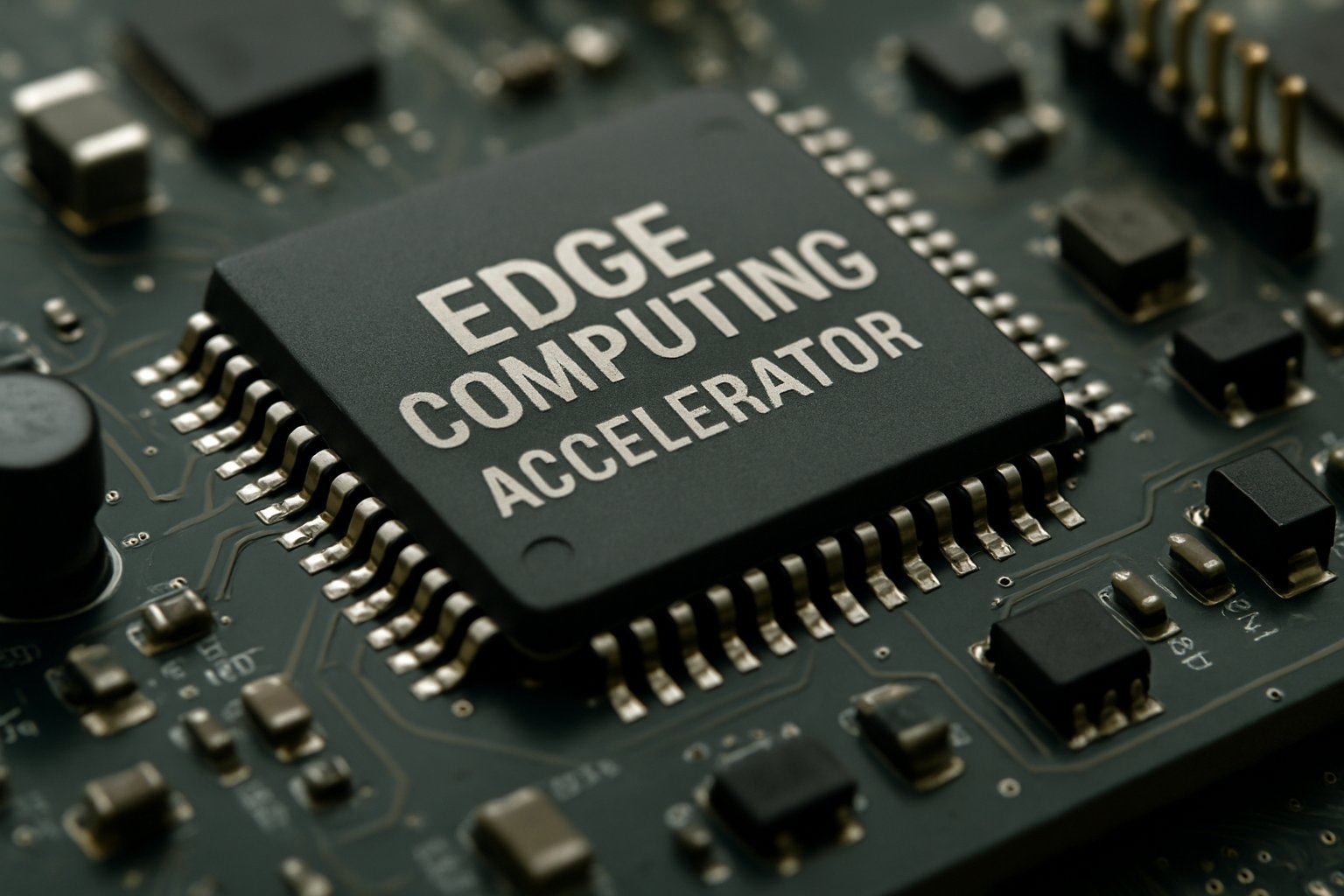
Grand View Research values the broader edge AI segment at $24.9 billion during 2025. Precedence Research forecasts dedicated accelerator revenue topping $90 billion by 2034. In contrast, methodology differences explain the wide numerical gap. Smaller operators also adopt edge nodes to lower cloud egress bills.
Energy efficiency metrics such as TOPS per watt influence purchasing decisions. Therefore, suppliers advertise aggressive performance gains each release cycle. Arm EVP Chris Bergey notes that edge AI is becoming the default expectation for experiences. Carbon reduction goals further favor energy-efficient inference near data origin.
Market indicators confirm sustained investment momentum. However, technical progress drives the story forward.
Hardware Performance Arms Race
Edge acceleration hardware now posts generational leaps in raw throughput. NVIDIA’s Jetson AGX Thor claims 2,070 FP4 TFLOPS within 130 watts. Consequently, robotics platforms gain multi-modal inference with minimal latency. Edge Computing Accelerators now deliver double-digit TOPS per watt year over year. Robotic arms execute closed-loop control at millisecond scale because processing occurs beside sensors.
Qualcomm boosts its Hexagon NPU to power AI PCs and flagship phones. Similarly, Hailo advertises 26 TOPS from a tiny M.2 module drawing single-digit watts. Nevertheless, absolute TOPS figures rarely predict application throughput. Ambarella and Tenstorrent tout transformer throughput for high-resolution perception. Furthermore, AMD positions Ryzen AI blocks for laptop generative assistants.
MLPerf Inference v5.0 adds generative and automotive tests reflecting emerging workloads. Consequently, vendors benchmark FP4 precision and energy metrics more rigorously. Subsequently, MLCommons plans additional mixed-precision tests in 2026. Developers exploit sparsity support to achieve higher effective throughput without raising clocks.
Recent Benchmark Results Data
Thousands of MLPerf submissions reveal rapid efficiency improvements across Edge Computing Accelerators. Benchmark organizers now highlight energy consumption alongside speed. Therefore, buyers can compare devices using objective, workload-specific data. MLPerf’s interactive Llama evaluation measures both latency and quality. Consequently, vendors cannot optimize sheer throughput alone. Energy per token emerges as a favored metric for language models.
Performance races will intensify through upcoming 2026 releases. Meanwhile, software will determine who actually benefits.
Software Stack Maturity Gaps
Cutting-edge silicon requires equally refined toolchains. Developers juggle SDKs, compilers, and runtime delegates for every accelerator. Consequently, Software Development timelines can slip without standardized workflows. Legacy CI pipelines seldom account for device-specific compilers, increasing integration risk.
Qualcomm’s AI Engine Direct, NVIDIA’s Holoscan, and Google’s LiteRT ease model conversion. However, portability between vendors remains difficult. Edge Computing Accelerators need consistent operator APIs to unlock deployment scale. MLPerf Edge advocates shared formats to address fragmentation. Developers often maintain separate code paths for each NPU delegate. Meanwhile, framework updates can break binary compatibility overnight.
On-Device AI models also need quantization and pruning to fit memory budgets. Therefore, integrated profilers and compression tools are essential. Quantization-aware training mitigates accuracy loss on low-precision targets.
Toolchain gaps represent a hidden adoption tax. In contrast, robust ecosystems unlock practical value. Therefore, open standards remain a strategic necessity. Moreover, consistent APIs de-risk multi-sourcing strategies.
Key Edge Use Cases
Robotics leverages sensor fusion, SLAM, and language planning locally. Jetson Thor targets such On-Device AI workloads for autonomous platforms. Consequently, operators reduce latency that impedes safe navigation. Fine-tuned vision transformers guide grasping routines in chaotic warehouses.
Automotive systems run driver monitoring and perception nets inside stringent safety envelopes. Ambarella CVflow chips illustrate deterministic inference for ADAS. Moreover, privacy regulations favor keeping cabin data on board. Edge dashboards alert drivers within milliseconds, enhancing safety margins.
Smart cameras deploy Edge Computing Accelerators to analyze footage without streaming every frame. Meanwhile, AI PCs perform local transcription, summarization, and creative generation offline. Healthcare, drones, and critical infrastructure gain similar resilience benefits. Offshore wind farms employ drones with local inferencing to inspect blades autonomously.
Use cases share common demands for speed and discretion. Therefore, accelerator capabilities must align with domain constraints. Subsequently, vertical solutions accelerate mass adoption.
Persistent Challenges And Risks
Fragmented hardware imposes steep learning curves. Moreover, large models still exceed device memory in many scenarios. Hybrid split inference introduces orchestration complexity and potential attack surfaces. Certification requirements complicate deployment in regulated industries.
Power and thermal ceilings limit sustained performance bursts. Therefore, dynamic voltage scaling and clever scheduling remain mandatory. Security teams must also validate supply chains and cryptographic enclaves. Battery powered devices must throttle inferencing during thermal spikes.
Benchmark interpretation poses another hurdle because marketing metrics can mislead. MLPerf provides guidance; nevertheless, real workloads vary widely. Edge Computing Accelerators also face strict thermal envelopes. Consequently, engineering teams validate workloads under worst-case ambient conditions.
These risks demand holistic planning across teams. Consequently, best practices emerge to streamline adoption. Therefore, proactive mitigation frameworks prove invaluable.
Effective Adoption Best Practices
Start with clear workload baselines using representative datasets. Then profile candidate Edge Computing Accelerators under power limits and thermal constraints. Additionally, evaluate vendor roadmaps to avoid dead-end platforms. Iterative testing uncovers nonlinear performance cliffs at extreme sequence lengths.
Cross-functional Software Development squads should integrate quantization, compilation, and continuous benchmarking pipelines. Moreover, automated CI loops catch performance regressions early. Professionals can enhance their expertise with the AI Educator™ certification. Additionally, infrastructure-as-code templates codify repeatable deployment.
Deploy security hardening such as secure boot and attestation for sensitive models. In contrast, consumer gadgets may balance risk against cost. Benchmark dashboards should expose latency percentiles, not only averages.
Structured methodologies accelerate time to value. Meanwhile, continuing education sustains organizational competence. Consequently, teams sustain agility as hardware generations iterate rapidly. In contrast, ad-hoc efforts invite costly rework.
Edge Computing Accelerators now underpin a decisive shift toward local intelligence. On-Device AI functions are scaling from kilobytes to billions of parameters while preserving privacy. Consequently, disciplined Software Development and hardware benchmarking remain critical. Vendors will continue chasing TOPS per watt leadership through 2026. Moreover, energy budgets will tighten as sustainability targets intensify. Industry collaboration around MLPerf and ONNX should streamline future integration.
Nevertheless, strategic buyers must evaluate ecosystems, security, and supply chain resilience before commitment. Edge Computing Accelerators promise enduring value when paired with robust processes and ongoing education. Therefore, review current benchmarks and pursue the referenced certification to stay competitive. Meanwhile, early movers can capture competitive differentiation through superior user experiences. Regulators may eventually mandate local processing for sensitive biometric data. Consequently, planning today mitigates future compliance risk. Finally, adopting continuous learning strategies will keep teams aligned with rapid change.
Disclaimer: Some content may be AI-generated or assisted and is provided ‘as is’ for informational purposes only, without warranties of accuracy or completeness, and does not imply endorsement or affiliation.


