

AI CERTs
6 months ago
Adaptive Learning Algorithms Reshape Global Education
Few education ideas excite investors and policymakers like Adaptive Learning Algorithms today. Rapid deployments, dramatic trial results, and billion-dollar forecasts signal a sector entering maturity. However, scaling tailor-made instruction remains complex due to equity and governance demands. This article reviews recent market data, field evidence, technical shifts, and policy debates. Readers will gain actionable insights on vendor claims, implementation strategy, and upcoming regulation. Furthermore, the piece highlights certifications that advance leadership careers in data-driven schooling. Consequently, decision makers can approach procurements with sharper questions and clearer expectations. Meanwhile, teachers and designers can align pedagogy with algorithmic strengths and human judgement.
Market Momentum Grows Fast
Global spending on Adaptive Learning Algorithms reached roughly USD 5.1 billion in 2025, according to Mordor Intelligence. Moreover, analysts forecast a near-20 percent compound annual growth through 2030. Coursera’s platform already counts 183 million registered learners, underscoring scale. Additionally, K–12 districts in North America report multi-hundred-percent adoption growth since 2019. EdTech Personalization now represents a core differentiator within vendor product roadmaps. In contrast, slower regions cite bandwidth and device shortages as limiting factors.
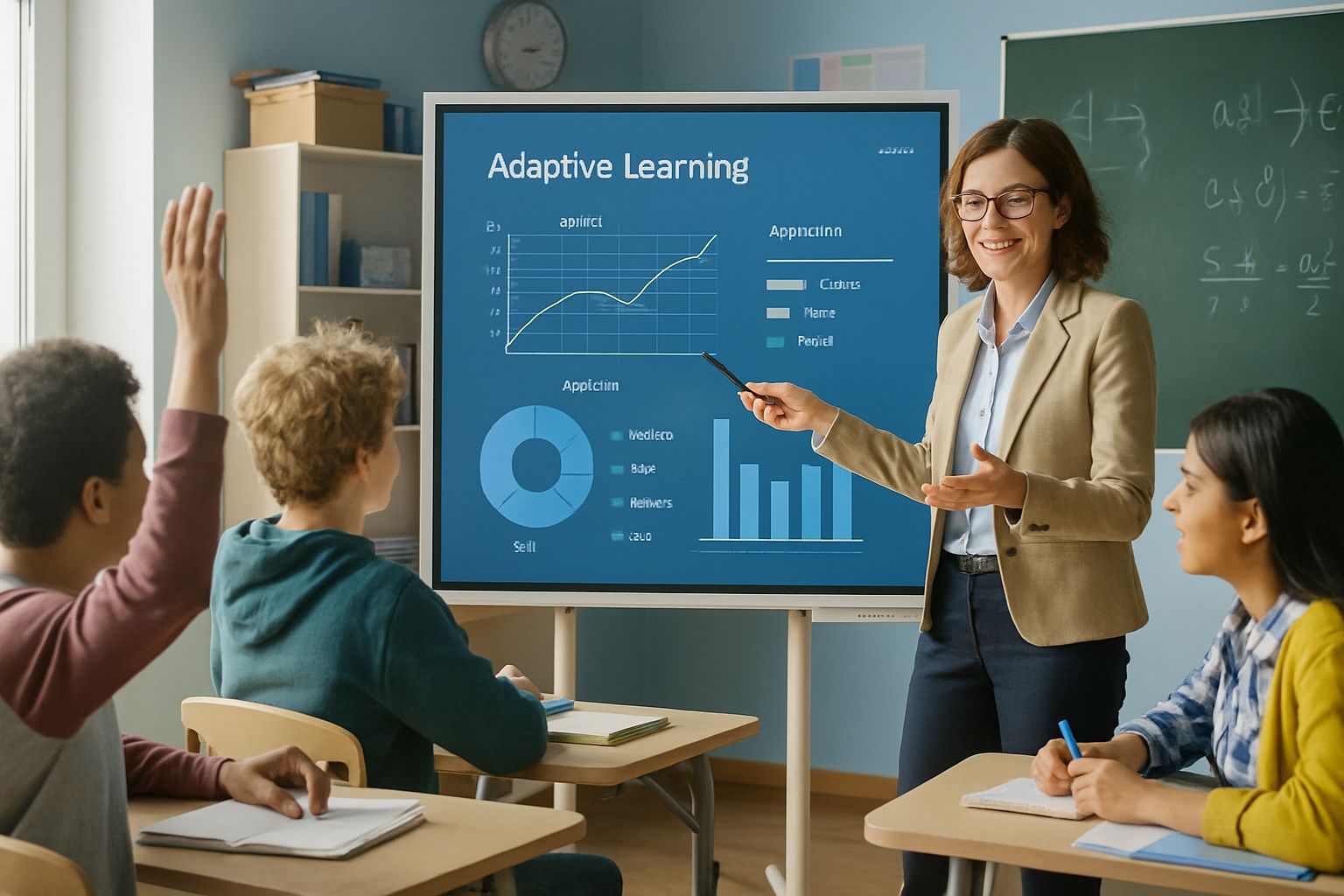
Key market signals include:
- Coursera’s 2025 launch of Skills Tracks for corporate Student Pathways.
- Tech & Learning awards honoring AI-powered classroom tools.
- Start-ups combining knowledge graphs with agentic planners for transparent sequencing.
- OECD guidance encouraging responsible algorithm deployment.
Collectively, these indicators reveal accelerating investment and adoption. Nevertheless, sustainable growth depends on trustworthy evidence and thoughtful governance. Therefore, the next section examines experimental findings.
Evidence From Major Trials
Randomized evaluations increasingly validate Adaptive Learning Algorithms in real classrooms. The University of Chicago’s study of Andhra Pradesh’s Personalised Adaptive Learning program delivered 1.9 additional years of learning in 17 months. Furthermore, replication work shows smaller, yet positive, effect sizes when fidelity declines. Systematic reviews covering dozens of controlled studies similarly report frequent achievement gains, although magnitudes vary by subject. Moreover, experts caution that small pilots often exaggerate impacts when scaled carelessly. Consequently, procurement teams must inspect study designs, subgroup analyses, and attrition rates.
These findings confirm meaningful potential. However, they also highlight that implementation quality determines ultimate outcomes. Subsequently, technology choices are shifting to improve transparency and control.
Technology Shifts Emerging Ahead
Legacy rule-based tutors now give way to graph-grounded planners powered by reinforcement learning. Additionally, multi-modal signals, including voice and handwriting, enrich learner models. Developers embed auditable controllers to satisfy privacy regulators and reassure teachers. Adaptive Learning Algorithms increasingly integrate with learning management systems, reducing setup friction. Meanwhile, item response theory continues informing diagnostic accuracy. EdTech Personalization ecosystems thus rely on interoperable standards and real-time data exchanges.
These technical advances promise deeper insight into Student Pathways and faster content iteration. Nevertheless, complexity raises fresh risks, which we address next.
Benefits And Promising Potential
When executed well, Adaptive Learning Algorithms accelerate mastery while freeing teacher time. Moreover, automated feedback encourages persistence through challenging concepts. Teachers use dashboards to target misconceptions quickly. Corporate trainers appreciate role-aligned Student Pathways that match evolving job tasks. Furthermore, cloud delivery supports continual content updates without large capital outlays.
Main advantages appear in three areas:
- Measured achievement gains, exemplified by the Andhra Pradesh results.
- Operational efficiency from automated diagnostics and monitoring.
- Scalable EdTech Personalization supporting diverse learner cohorts.
Therefore, stakeholders view adaptive technology as a lever for large-scale human capital improvement. Yet rising enthusiasm must not eclipse genuine challenges.
Risks And Persistent Barriers
Unequal device access threatens to widen achievement gaps. Meanwhile, opaque recommendation engines may embed bias against atypical learners. Privacy regulations vary, creating compliance uncertainty for multinational rollouts. Additionally, teachers sometimes mistrust algorithmic suggestions, limiting classroom integration. NBER studies show effect sizes shrink when training and infrastructure weaken. Moreover, overreliance on automated sequencing can sideline broader socio-emotional learning goals.
These challenges highlight critical gaps. However, pragmatic implementation strategies can mitigate many obstacles and build durable trust.
Implementation Best Practice Tips
Decision makers should embed clear success metrics from project inception. Furthermore, pilot phases need rigorous evaluation against control groups. Procurement teams must request detailed model documentation and data-governance statements. In contrast, vendors should provide professional-development modules that empower teachers, not replace them. Subsequently, districts ought to budget for connectivity upgrades and device maintenance.
Professionals can enhance their expertise with the AI Project Manager™ certification. The credential equips leaders to oversee complex EdTech Personalization deployments. Consequently, certified managers often navigate privacy, equity, and technical trade-offs more effectively. These recommendations pave the way for resilient Student Pathways at scale.
Effective execution sets the stage for future developments, which we explore next.
Future Outlook And Roadmap
Industry analysts expect Adaptive Learning Algorithms to embed within national curricula by 2030. Moreover, interoperable data standards will simplify content sharing across platforms. UNESCO and OECD plan to release updated audits, guiding transparent algorithm reporting. Additionally, startups will commercialize multimodal knowledge graphs that personalize across subjects and languages. Meanwhile, local educators will co-design content, ensuring cultural relevance.
Nevertheless, lasting success requires continuous evidence generation and open stakeholder dialogue. Therefore, institutions should finance long-term studies assessing holistic outcomes, including equity and wellbeing. Adaptive Learning Algorithms promise transformative gains when principles of fairness, privacy, and pedagogy align.
Stakeholders ready to lead this transformation now possess the roadmap. Consequently, the next strategic move is clear: build capacity, demand transparency, and pilot responsibly.
Disclaimer: Some content may be AI-generated or assisted and is provided ‘as is’ for informational purposes only, without warranties of accuracy or completeness, and does not imply endorsement or affiliation.


