

AI CERTs
2 months ago
Drug Target Discovery Pipelines Propel Rare Disease Breakthroughs
Rare disease therapy once demanded decades of painstaking work. However, momentum has shifted thanks to converging data, automation, and advanced algorithms. Consequently, Drug Target Discovery Pipelines are compressing timelines and expanding previously unreachable biology. Genomics, single-cell multi-omics, and functional screens now flow directly into AI driven prioritization engines. Meanwhile, generative chemistry platforms translate prioritized hits into optimized leads within months rather than years. Investors, regulators, and patient groups are taking notice as clinical proof appears in peer-reviewed journals. The 2025 Nature Medicine study of rentosertib provided the first randomized confirmation of an AI candidate. Moreover, corporate consolidation shows industry confidence in scalable, data-centric models. This article dissects key scientific drivers, commercial signals, and policy developments underpinning the shift. It also outlines practical implications for teams considering robust, future-proof Drug Target Discovery Pipelines.
Genomics Fuel Target Discovery
Human genetics provides the strongest causal map for disease intervention. Furthermore, large biobanks like UK Biobank and Genomics England host millions of sequenced genomes. In contrast, earlier projects relied on isolated case studies and incomplete pedigrees. Modern platforms integrate locus-to-gene evidence, variant effect predictions, and safety annotations in real time. Consequently, Drug Target Discovery Pipelines prioritize genes with protective loss-of-function variants, lowering clinical risk. Open Targets reports thousands of such genetically validated targets across rare phenotypes. Additionally, single-cell multi-omics reveals disease-specific cell states that genomics alone misses. These insights guide cell-type or tissue-specific intervention strategies. Therefore, teams gain actionable hypotheses quickly, often within weeks of data release. This acceleration marks a departure from the historical 25-year median lag between discovery and approval.
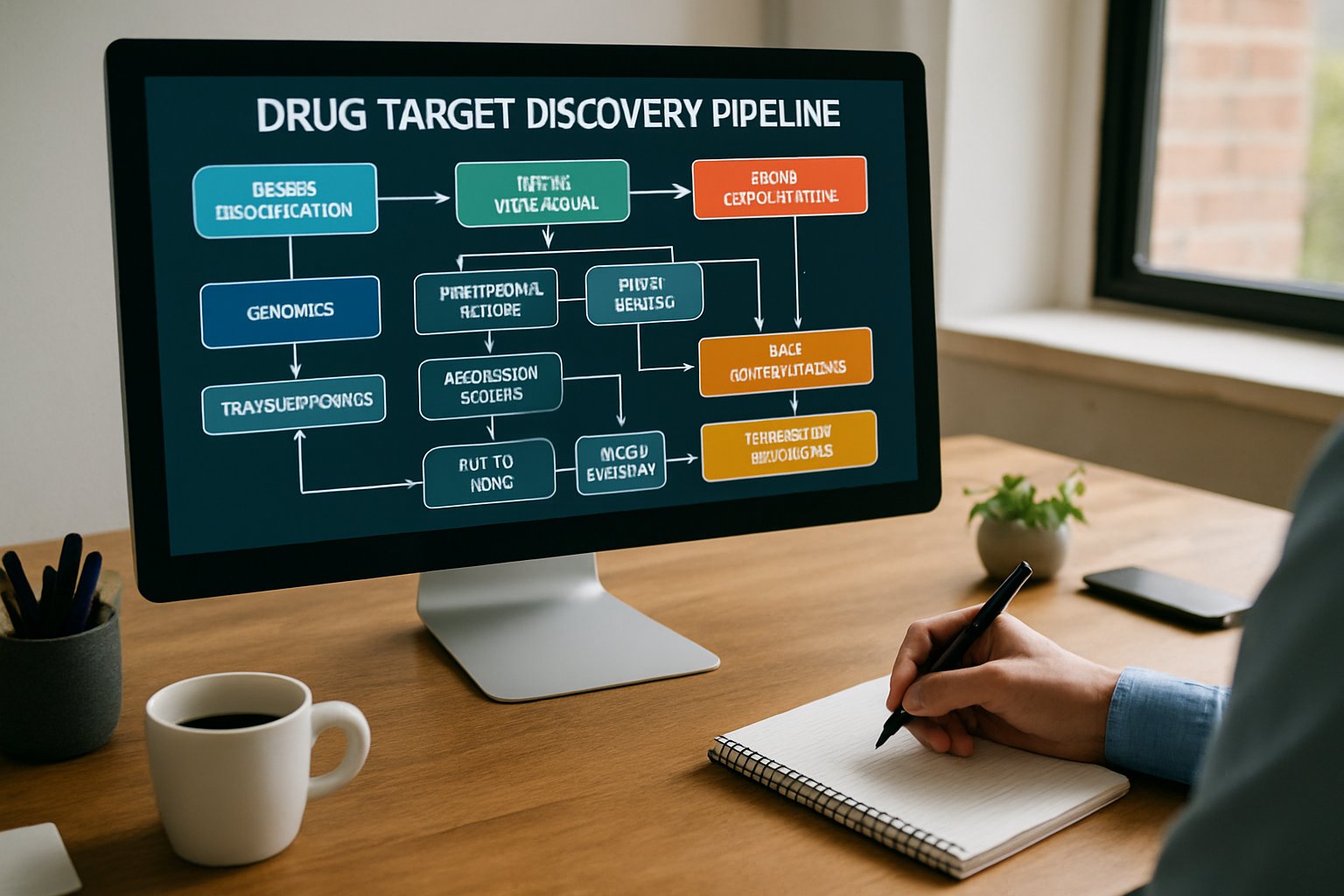
Genetic evidence now enters workflows automatically, boosting confidence early. However, functional validation remains essential, leading naturally to high-throughput screens.
Functional Screens Accelerate Discovery
Pooled CRISPR screens interrogate thousands of genes in parallel using disease-relevant assays. Moreover, image-based phenomics quantifies subtle cellular changes after perturbation, enriching biological context. Recursion pioneered such phenomics, capturing billions of cell images across perturbations. Subsequently, the company merged with Exscientia, adding precision chemistry and stronger search space coverage. Together, they exemplify how Drug Target Discovery Pipelines link screen output to rapid chemistry cycles. Functional genomics also assists academic groups tackling ultra-rare monogenic disorders. Furthermore, screens clarify direction-of-effect, indicating whether inhibition or activation offers therapeutic benefit. Consequently, fewer animal studies are wasted on incorrect mechanism assumptions. These efficiencies shorten preclinical packages, which now often conclude within 18 months. Accelerated screens feed directly into AI design modules, explored next.
High-throughput perturbation data enrich algorithmic models, raising success odds. Therefore, AI engines can design molecules with clearer mechanistic grounding.
AI Designs Novel Molecules
Generative chemistry platforms, sometimes labeled molecular AI, generate billions of virtual structures. Insilico’s Chemistry42 selected rentosertib after only 80 synthesized compounds, illustrating efficiency. Moreover, reinforcement learning loops optimize potency, selectivity, and synthetic accessibility simultaneously. Drug Target Discovery Pipelines then iterate between virtual suggestions and wet-lab confirmations daily. Consequently, median synthesis counts fell from thousands to low hundreds across multiple case studies. Meanwhile, molecular AI handles off-target predictions, reducing late toxicology failures. Recursion uses Exscientia’s deep learning models to propose chemistry while leveraging its phenomic scoring. Additionally, platforms share design data with regulatory documentation modules, supporting future submissions. These integrated feedback cycles form the technical heart of modern biotech innovation. However, commercial viability depends on market dynamics, explored next.
Generative design combines speed with evidence, delivering clinic-ready candidates in record time. Subsequently, industry financing follows proof into rare disease spaces.
Market And Deal Momentum
Evaluate projects orphan drugs will reach twenty percent of global sales by 2030. Furthermore, forecast compound annual growth exceeds ten percent, outpacing broader therapeutics. Consequently, investors prize platforms that unlock niche indications cost-effectively. Recent acquisitions, including Novartis buying Avidity and BioMarin acquiring Amicus, confirm appetite. Drug Target Discovery Pipelines appeal because they generate differentiated assets attractive to large pharma. In contrast, one-asset companies struggle to command similar premiums. Moreover, public valuations reward firms marketing themselves as leaders in biotech innovation.
Key 2025-2026 numbers:
- 503 orphan designations granted since 1983, according to IQVIA.
- Rentosertib moved from concept to Phase 2a within 30 months.
- Recursion-Exscientia projects ten clinical readouts before 2027.
These figures demonstrate that scale and speed now drive competitive advantage. Subsequently, corporate roadshows emphasize pipeline breadth over single experimental therapies.
Capital flows toward data-rich, AI-enabled models. However, regulatory clarity remains vital for sustained confidence.
Regulators Shape AI Adoption
The FDA released draft AI guidance in January 2025, focusing on credibility and reproducibility. Additionally, CDER formed an internal AI Council to coordinate review processes across divisions. Under the proposal, sponsors must document datasets, model versions, and context of use. Therefore, Drug Target Discovery Pipelines now include audit trails from data ingestion to candidate nomination. Companies embedding such controls gain smoother pre-IND interactions. Meanwhile, European regulators signal similar expectations, referencing transparency and bias mitigation. Professional development also evolves; practitioners pursue cloud-centric certifications to manage regulated workflows. Experts can upskill via the AI+ Cloud Architect™ certification. Consequently, workforce readiness aligns with regulatory expectations.
Early engagement and documentation reduce approval risk. Nevertheless, technical challenges persist, as discussed in the next section.
Challenges And Future Outlook
Despite successes, validation gaps remain. Benchmarked AI scores do not always predict in-vivo pharmacology. Moreover, training datasets still over-represent European ancestry, limiting model generalizability. Biased outputs threaten equitable access and may miss population-specific rare variants. Additionally, black-box decisions complicate mechanistic interpretation and biomarker development. Drug Target Discovery Pipelines must therefore incorporate explainability modules and diverse datasets. Academic partnerships and patient advocacy groups can supply under-represented samples. Meanwhile, open science resources like Open Targets continue to raise transparency standards. Further investment in molecular AI interpretability research will enhance trust. Furthermore, sustainable pricing strategies are needed as ultra-orphan assets graduate to blockbuster status.
Key Metrics Evidence Data
Open Targets lists millions of evidence links connecting tens of thousands of targets. Insilico cut preclinical design to 18 months, setting a new benchmark.
- Embed bias audits in data pipelines.
- Publish model cards with reproducibility metrics.
- Engage regulators before pivotal studies.
These actions can safeguard scientific legitimacy and public confidence. Addressing limitations will dictate long-term impact. Consequently, continuous improvement remains non-negotiable for leading teams.
Conclusion
Rare disease research no longer waits decades for actionable leads. Drug Target Discovery Pipelines unite genomics, functional screens, and molecular AI in one continuous loop. Consequently, candidates like rentosertib illustrate credible, early proof of concept. Market data and M&A validate the commercial promise of this biotech innovation trajectory. However, reproducibility, bias, and pricing require constant vigilance. Regulatory guidance and transparent documentation will determine sustained trust in Drug Target Discovery Pipelines. Professionals should align skills with cloud-native, auditable workflows now. Explore certifications and deepen engagement to accelerate safer therapies for underserved patients.


