

AI CERTs
3 months ago
Predictive Maintenance Vision Models Extend Industrial Asset Life
Unexpected shutdowns drain capital and erode trust across industrial plants.
Consequently, operators are embracing predictive maintenance vision models to spot subtle degradation before catastrophe.
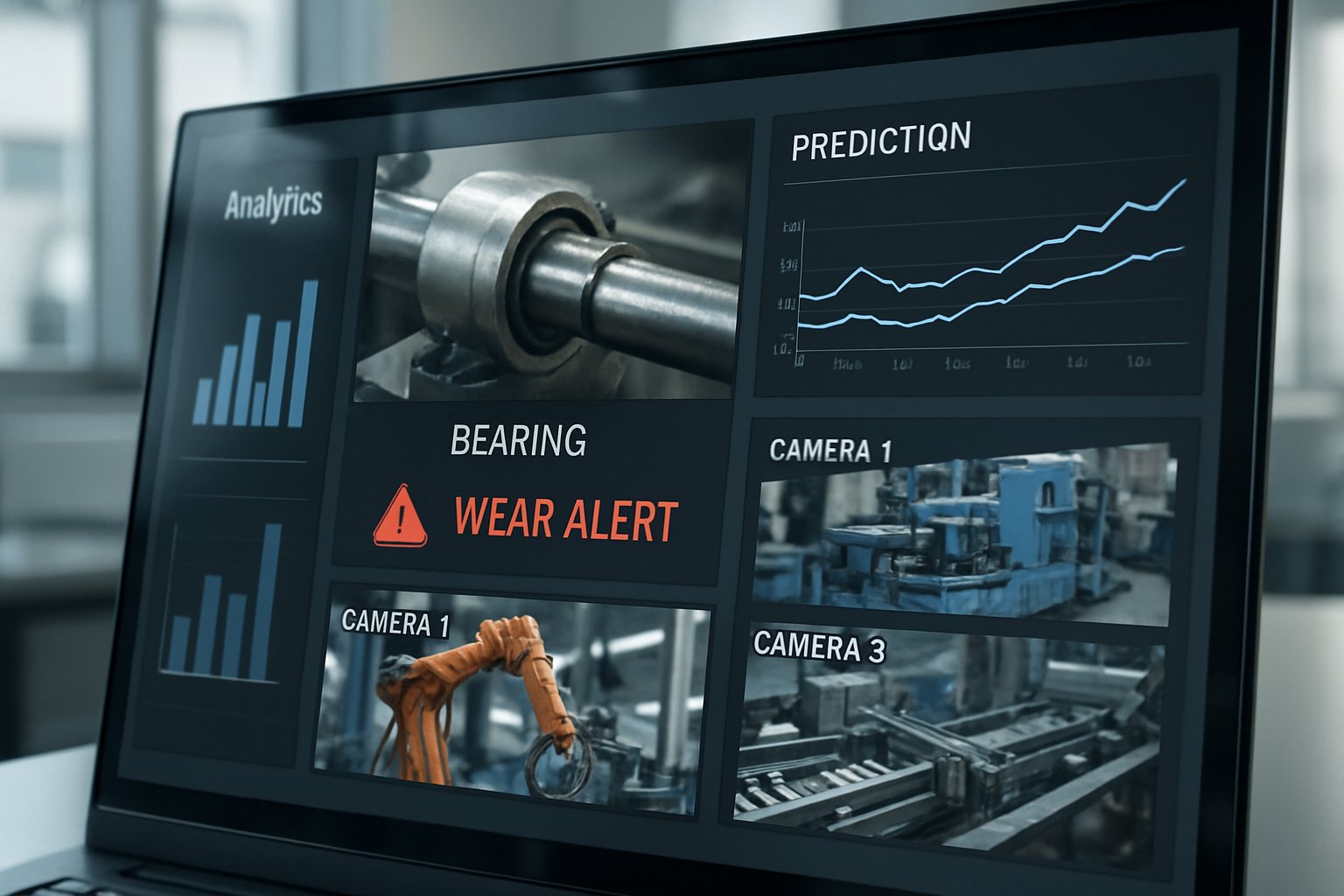
These AI systems analyze images, thermal maps, and spectral signatures to flag anomalies early.
Moreover, analysts estimate the vision-enabled predictive maintenance segment reached USD 1.39 billion in 2024.
That figure is climbing at over 13 percent annually.
Meanwhile, tangible case studies show downtime cuts of up to 50 percent.
This article unpacks the market drivers, technical advances, and operational realities behind predictive maintenance vision models.
It also offers pragmatic guidance for teams pursuing equipment failure forecasting at scale.
Readers will leave with clear next steps and certification resources.
In contrast, traditional time-based maintenance often replaces healthy assets prematurely.
Therefore, vision AI promises longer lifespans and greener capital allocation.
The stakes and opportunities justify a detailed exploration.
Recent launches at CES 2026 and GPU edge stacks underline the commercial momentum.
Furthermore, academic studies highlight dataset gaps, robustness hurdles, and emerging diffusion augmentation techniques.
These developments frame the discussion that follows.
Market Momentum Snapshot Now
Global machine-vision revenue sits near USD 13 billion, with industrial inspection dominating share.
However, the predictive maintenance slice already contributes USD 1.39 billion and is rising fast.
Grand View Research projects a 13 percent compound growth rate through 2030.
Moreover, analysts tie growth to three factors.
First, cheaper thermal sensors bring vision to legacy assets.
Second, managed cloud stacks shrink proof-of-concept timelines.
Third, capital expense deferral wins executive sponsorship amid tight budgets.
All figures rely on predictive maintenance vision models delivering actionable anomaly alerts.
- 25-50 percent unplanned downtime reduction across early adopters
- 10-40 percent maintenance cost savings within two years
- 20-40 percent asset life extension under condition-based programs
These metrics confirm commercial momentum and board-level interest.
Consequently, organisations are evaluating technical enablers next.
Technology Enablers Evolve Rapidly
Recent hardware releases reveal sharper sensors and sturdier edge devices.
Guide Sensmart's ApexVision couples high-sensitivity thermal detectors with on-device inference.
Consequently, micro-cracks and hot spots appear in real time.
Meanwhile, AWS Panorama and Lookout for Vision integrate camera feeds with historian data streams.
The managed pipeline speeds image labeling and model deployment for equipment failure forecasting.
Therefore, pilot projects shift to production within months rather than years.
GPU vendors also contribute.
NVIDIA Jetson modules run complex anomaly detection on vibration-prone factory floors.
Moreover, DGX servers accelerate retraining cycles in the cloud.
Beyond hardware, model research is advancing.
Synthetic diffusion augmentation compensates for scarce fault images and reduces overfitting.
Additionally, self-supervised approaches learn normal patterns without labeled anomalies.
Each innovation strengthens predictive maintenance vision models running at the edge.
Technical progress lowers cost barriers and boosts detection accuracy.
Subsequently, deployment architecture choices gain importance.
Deployment Architectures And Strategies
Architects usually embrace hybrid edge-cloud layouts.
Edge inference minimizes latency and bandwidth.
Cloud layers handle periodic retraining and fleet analytics.
In practice, cameras stream frames to rugged gateways for preprocessing.
Compressed embeddings then travel to central servers for deeper analysis.
Consequently, operators receive hourly RUL dashboards and maintenance tickets.
Digital twins enrich predictions by simulating what-if repair scenarios.
Moreover, integrated CMMS connectors push recommended work orders automatically.
This closed loop drives faster response and verifiable ROI.
- Edge runtime under 100 ms per frame
- Explainable anomaly heatmaps for technicians
- Secure OTA model updates every quarter
Predictive maintenance vision models underpin each trait and anchor system reliability.
Therefore, design decisions must align with equipment failure forecasting goals.
Hybrid architectures balance speed, cost, and governance.
Next, leaders should quantify business impact.
Business Value And KPIs
Boards demand hard numbers before scaling pilots.
Consequently, teams track several core metrics.
Mean time between failures and mean time to repair remain foundational.
Additionally, lead time of prediction shows how early alerts arrive.
Operators prefer weeks, yet many models still deliver days.
Moreover, false positive rate directly affects technician trust.
Case studies illustrate strong economic upside.
Tyson Foods reported 50 percent inspection cost savings after integrating vision into equipment failure forecasting workflows.
Baker Hughes cited multi-month horizon predictions for turbines, avoiding costly unplanned outages.
Industry studies mirror these outcomes.
Average downtime reductions range between 25 and 50 percent.
Maintenance cost cuts span 10 to 40 percent with payback inside two years.
Predictive maintenance vision models hence drive measurable shareholder value.
Nevertheless, challenges still threaten scale.
KPIs validate the promise and guide funding approvals.
However, obstacles remain on the factory floor.
Challenges Confront Broad Adoption
Data scarcity tops the obstacle list.
Fault images are rare, causing class imbalance.
Therefore, many teams explore synthetic generation and unsupervised anomaly learning.
Real factory conditions add further complexity.
Lighting changes, dust, and camera angle shifts break academic benchmarks.
Consequently, regular recalibration and domain adaptation are essential.
Integration remains another hurdle.
Legacy PLCs and siloed historians delay unified data pipelines.
Moreover, regulatory sectors need auditable AI decision trails.
High false alarms also fatigue technicians.
Explainable overlays and confidence scoring can reduce frustration.
Nevertheless, culture change and skills development are still required.
Without robust tuning, predictive maintenance vision models can trigger costly false positives.
Such errors undermine equipment failure forecasting credibility.
Collectively, these gaps stall many pilots.
Subsequently, collaboration between academia and industry is intensifying.
Future Research Collaboration Needs
Researchers call for open industrial datasets reflecting true production variability.
Additionally, standardized evaluation metrics would compare models under latency and robustness constraints.
IEEE conferences are forming task forces to address these gaps.
Improved benchmarks will accelerate predictive maintenance vision models adoption across heavy industries.
Meanwhile, vendors are releasing synthetic data generators for thermal and hyperspectral modalities.
Nevertheless, domain gap issues persist.
Joint validation with plant operators remains crucial.
Collaboration should extend to skills development.
Professionals can enhance expertise with the AI Developer™ certification.
Such programs teach model deployment, monitoring, and governance essentials.
Targeted research partnerships will close robustness and data gaps.
Therefore, strategic leadership must foster open collaboration.
Actionable Steps For Leaders
Executives should begin with a focused asset inventory.
Rank equipment by downtime cost and safety criticality.
Subsequently, select one high-value pilot to validate business assumptions.
Next, create a cross-functional squad including maintenance, IT, and data science.
Clarify KPIs, data governance rules, and escalation protocols early.
Consequently, rollout friction decreases.
Invest in modern historians and edge gateways to unify video and sensor streams.
Additionally, insist on explainable AI overlays to sustain technician trust.
Tie incentives to reduction in unplanned downtime and spare-part spend.
Finally, develop a talent plan.
Offer staff micro-credentials and vendor workshops on equipment failure forecasting skills.
Predictive maintenance vision models will deliver value only with empowered people.
Structured pilots, robust governance, and skilled staff accelerate success.
In conclusion, disciplined execution unlocks sustainable competitive advantage.
Industrial leaders now possess the building blocks for reliable, scalable visual PdM.
Thermal cameras, edge GPUs, and cloud pipelines are maturing rapidly.
Moreover, market data prove significant ROI when projects align with measurable KPIs.
Nevertheless, data gaps, integration friction, and cultural change still demand vigilant management.
Predictive maintenance vision models can extend asset life by up to 40 percent when executed correctly.
Therefore, start small, iterate fast, and train teams through trusted programs.
Explore the linked certification to deepen applied AI skills today.
Ready now to transform maintenance strategy?
Visit the certification portal and equip your organisation for the next reliability frontier.


