

AI CERTs
3 months ago
Why conversational quality assurance engines beat manual audits
Contact centers once relied on small manual call samples to judge quality. Today, conversational quality assurance engines promise complete oversight. These AI systems transcribe every interaction, score agent performance, and surface coaching insight within hours. Moreover, vendors assert dramatic cost savings and stronger CX compliance. Market researchers back the optimism. Grand View Research forecasts conversational AI spending will reach $41.39 billion by 2030, rising 23.7 percent annually. Meanwhile, McKinsey reports automated scoring can exceed 90 percent accuracy while cutting quality costs in half. Nevertheless, decision makers still weigh data privacy, bias, and governance challenges. This article explains why conversational quality assurance engines are overtaking manual audits. It also outlines how the technology works and what leaders must watch. Professionals can deepen their baseline expertise with the AI for Everyone™ certification. Understanding these shifts now helps organizations protect margins, elevate customer experience, and remain compliant amid tightening regulations.
Market Momentum Snapshot Today
Global appetite for automated oversight grows quickly. Moreover, suppliers race to satisfy rising executive expectations. Grand View Research values the conversational AI segment at $11.58 billion in 2024 and projects $41.39 billion by 2030. Consequently, contact-center leaders allocate AI budgets toward auditing capabilities that replace manual sampling.
- Observe.ai launched VoiceAI Agents, extending conversational quality assurance engines into live interaction handling.
- CallMiner added AI Assist features that link scoring to workflow automation.
- Genesys released Supervisor Copilot to shorten QA cycles by hours.
- NICE and Verint published case studies showing multimillion-dollar savings from full interaction coverage.
Rapid vendor releases show mainstream acceptance. Therefore, decision makers must understand technology foundations before scaling.
Core Technology Stack Explained
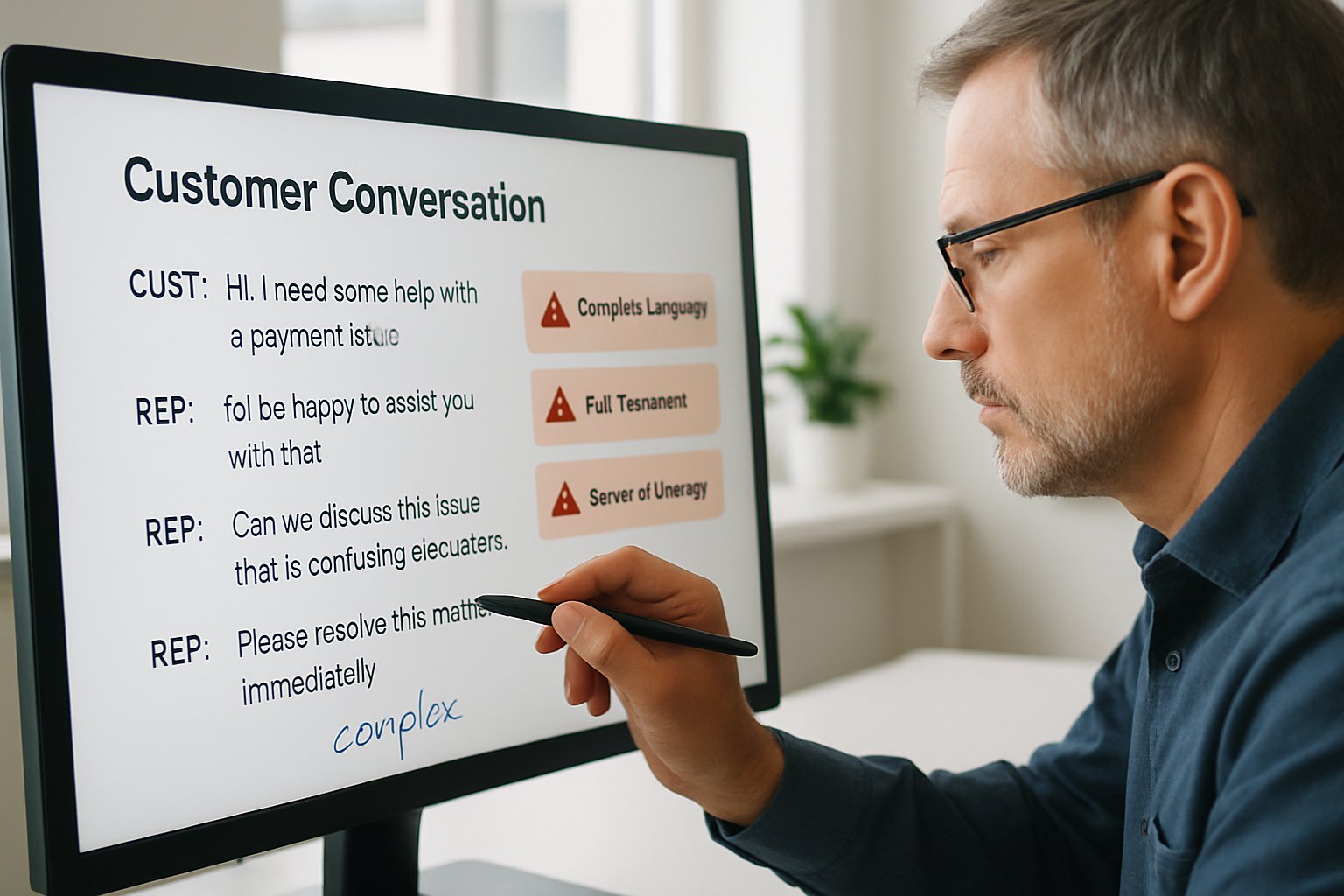
Automated QA platforms combine speech recognition, natural language processing, and machine learning. Additionally, many embed large language models for summarization. The stack starts with high-accuracy ASR that feeds downstream voice analytics classifiers. In contrast, legacy recorders offered only audio playback.
NLP modules detect intent, disclosure phrases, and emotion signals. Subsequently, rule or model-driven logic converts those findings into evaluation scores. Some conversational quality assurance engines employ retrieval-augmented LLMs to populate forms with precise evidence. Furthermore, dashboards push alerts to supervisors in real time.
Tight integration with coaching, workforce management, and CX compliance workflows differentiates mature solutions. Consequently, leaders gain faster feedback loops that correct behavior before customer churn rises. These foundations enable the strategic benefits outlined next.
Business Benefits Quantified Clearly
Replacing sampled reviews with conversational quality assurance engines delivers measurable impact. McKinsey estimates more than 50 percent QA cost savings and 90 percent scoring accuracy. Moreover, Verint cites a $2 million annual saving for one Fortune 500 brand.
Voice analytics insights also unlock upstream value. Consequently, marketing teams spot emerging product issues, and fraud units catch policy violations sooner. Analysts highlight four headline advantages:
- 100 percent interaction coverage eliminates blind spots and bias.
- Real-time coaching boosts agent performance within the same shift.
- Automated CX compliance checks reduce regulatory penalties.
- Trend dashboards inspire data-driven product or policy changes.
Collectively, these gains justify investment outlays. Nevertheless, every organization must weigh accompanying risks.
Risk Factors And Mitigations
Accuracy still varies by accent, jargon, or noisy lines. However, continuous model retraining narrows error margins. Bias and drift present further challenges; therefore, governance councils should monitor fairness metrics regularly.
Data privacy worries intensify when external LLMs process recordings. Moreover, stringent CX compliance regimes such as HIPAA mandate redaction before cloud transfer. Enterprises can deploy private models or encrypt payloads to mitigate exposure.
Over-automation may erode agent morale if metrics become punitive. Consequently, savvy leaders pair machine scores with human coaching reviews. These precautions balance efficiency gains against reputational risk.
Implementation Best Practice Guide
Pilots should start with hybrid scoring. Additionally, teams can benchmark automated outputs against trusted human samples. McKinsey recommends parallel runs until precision and recall metrics surpass 85 percent thresholds.
Governance frameworks must document data lineage, model versions, and audit trails. Subsequently, drift detection alerts signal when retraining is needed. Cross-functional steering groups ensure CX compliance requirements remain front and center.
Change management accelerates adoption. Moreover, clear messaging stresses augmentation, not replacement, of human expertise. Professionals can reinforce their AI fluency through the earlier mentioned AI for Everyone™ certification.
Disciplined rollout steps convert technology promise into lasting advantage. Consequently, leadership attention can turn toward future possibilities.
Future Outlook For Leaders
Analysts expect automated QA penetration to exceed 70 percent of large contact centers by 2028. Meanwhile, conversational quality assurance engines will merge with proactive voice analytics to predict churn before a call ends.
Moreover, regulators will codify transparency rules around scoring logic and data retention. Forward-thinking firms already design explainability layers that satisfy auditors. Consequently, early movers capture customer trust and operational savings simultaneously.
Strategic investment now positions brands for AI-native service landscapes. Nevertheless, success demands vigilant governance as model sophistication grows.
These trends reinforce the imperative to act today. Therefore, leaders should assess readiness and craft phased roadmaps toward full automation.
Conclusion And Next Steps
Conversational quality assurance engines deliver 100 percent coverage, faster insights, and stronger CX compliance while trimming costs. Moreover, integrated voice analytics reveals product and fraud signals that drive additional value. Nevertheless, responsible adoption requires rigorous governance, data protection, and empathetic change management.
Forward-looking executives should launch pilot programs, validate accuracy, and embed cross-functional oversight. Additionally, enhancing personal expertise through the AI for Everyone™ certification builds necessary fluency. Act now to transform quality oversight, protect customers, and secure a competitive edge.


