

AI CERTs
3 months ago
Platform-level agent orchestration layers transform automation
No-code dreams often stall when pilot bots meet enterprise reality. However, platform-level agent orchestration layers now close that gap. These layers combine visual builders, connector registries, and control planes so non-developers can launch governed, autonomous workflows. Moreover, analysts project rapid growth for the emerging AI orchestration market, making 2026 a pivotal year for adoption.
Consequently, technology leaders must understand why these orchestration stacks matter, which vendors lead, and how risks should be managed. The following analysis explores these themes while highlighting agent chaining techniques and SaaS extensibility strategies.
Market Growth Momentum Drivers
Over the last 18 months, vendors shifted from isolated tools toward complete orchestration platforms. OpenAI introduced AgentKit in October 2025, while Microsoft expanded Copilot Studio throughout 2025. Additionally, UiPath repositioned its suite around agentic automation. Gartner responded by defining the BOAT category, and MarketsandMarkets forecasted AI orchestration revenues to hit USD 30.23 billion by 2030.
Furthermore, low-code demand underpins this surge. Gartner once predicted that 70% of new apps would use low-code by 2025. Consequently, platform-level agent orchestration layers meet both AI and citizen-developer trends.
Key statistics underline the momentum:
- AI orchestration market CAGR: ≈22.3% (MarketsandMarkets, 2025)
- Agentic AI market could reach USD 93.20 billion by 2032
- Zapier now offers 8,000+ connectors for no-code agents
These figures reveal mounting investor confidence. Nevertheless, real enterprise value depends on execution quality. Therefore, the next section dissects the architectural ingredients enabling success.
Core Orchestration Layer Elements
A complete stack contains five essential pillars. Firstly, a drag-and-drop agent builder empowers business users. Secondly, a connector registry provides governed access to SaaS APIs and legacy systems. Thirdly, a runtime control plane enforces approvals, audit logs, and human-in-the-loop checkpoints.
Moreover, evaluation tooling measures execution quality. Meanwhile, standard protocols such as Model Context Protocol ensure SaaS extensibility across multiple clouds. When combined, these pillars convert simple scripts into production-grade automations.
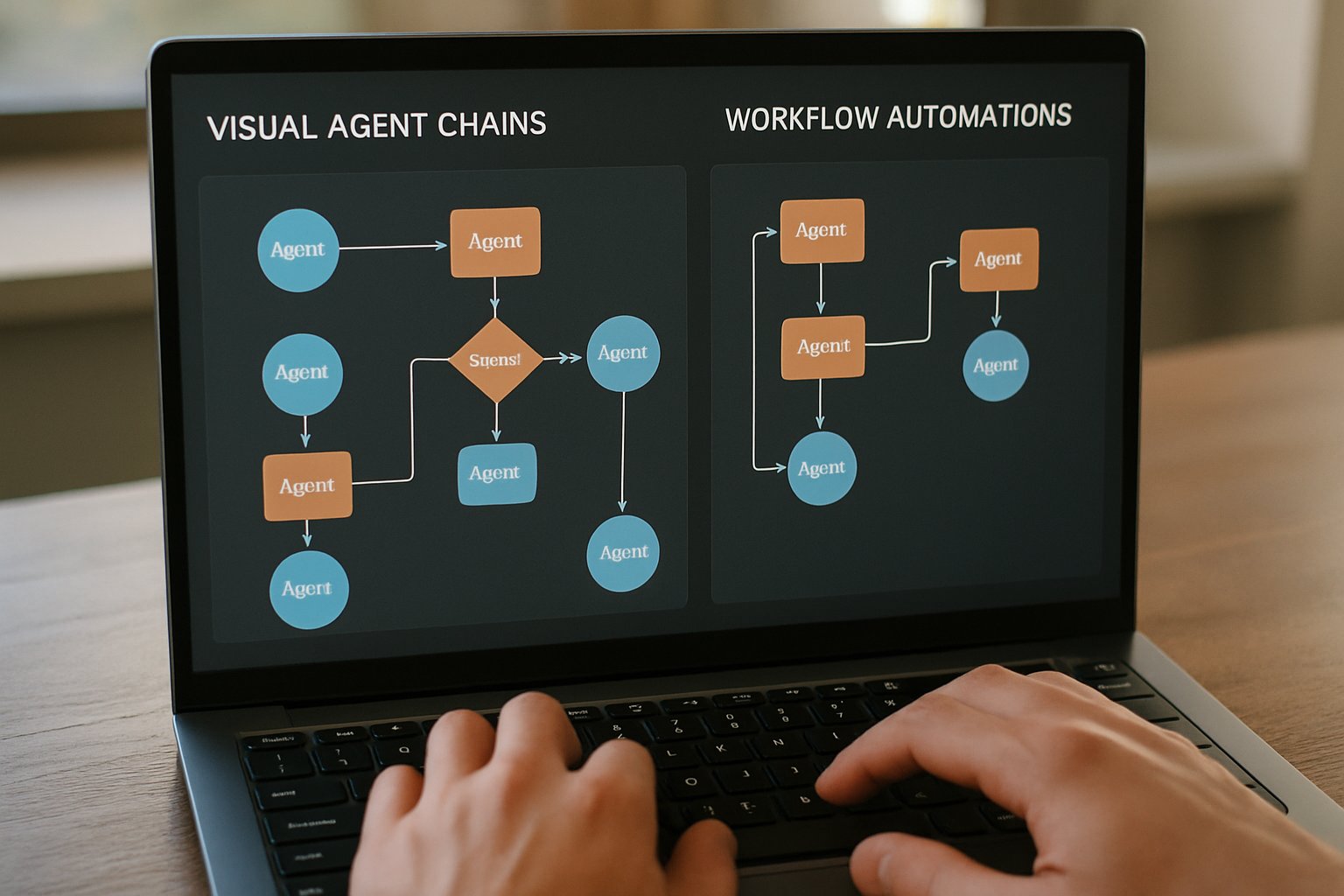
Importantly, platform-level agent orchestration layers harmonize multiple agents through agent chaining. This design lets one agent trigger another, passing context along a secured memory store. Consequently, complex processes—like quote-to-cash—run without manual stitching.
Robust architecture reduces failure rates. Nevertheless, compounded errors remain a concern, as every additional step multiplies risk. Hence, observability and rollback remain mandatory safeguards.
These technical foundations set the stage for competition. In contrast, vendors differentiate through ecosystem depth and governance maturity, explored next.
Leading Vendor Landscape Today
OpenAI, Microsoft, and UiPath currently shape market narratives. OpenAI’s AgentKit bundles Agent Builder, Connector Registry, ChatKit, and Evals. Microsoft Copilot Studio adds generative orchestration, MCP support, and “computer use” UI automation. Meanwhile, UiPath positions Maestro as a centralized command center overseeing robots, humans, and agents.
Integration-first players such as Zapier, Workato, and Make emphasize SaaS extensibility. They expose thousands of connectors and prebuilt templates that speed business adoption. Moreover, Appian and Pega embed orchestration layers within broader workflow suites.
Startups like Stack AI and Lyzr target vertical niches with lightweight orchestration fabrics. Consequently, buyers face a rich but fragmented landscape.
The table below summarizes differentiators:
- Visual builder depth and usability
- Native MCP or proprietary connector support
- Agent chaining orchestration patterns
- Governance, audit, and evaluation tooling
- Total cost and hosting flexibility
Vendor selection should map to enterprise priorities. However, benefits only materialize when platforms meet real business needs, discussed in the following section.
Key Benefits For Businesses
Adopters report faster development cycles and reduced integration backlogs. Moreover, platform-level agent orchestration layers deliver auditability that classic RPA bots often lacked. Klarna, for example, claims a support agent built with AgentKit now handles two-thirds of incoming tickets.
Additionally, SaaS extensibility enables rapid expansion into adjacent processes. A finance team can reuse connectors from a sales workflow without extra coding. Furthermore, agent chaining links previously siloed automations into cohesive journeys, boosting cross-department efficiency.
Professionals seeking formal validation can enhance expertise with the AI Architect™ certification. This credential covers governance, design patterns, and observability best practices for orchestrated agents.
Consequently, enterprises gain agility with compliance. Nevertheless, each advantage introduces new responsibilities, outlined next.
Critical Risks And Caveats
Autonomous workflows magnify small model errors. Therefore, rigorous evaluation is essential. Cloud Security Alliance warns that prompt injection, memory poisoning, and tool misuse expand attack surfaces.
Moreover, cost models remain volatile. Generative orchestration often consumes more tokens than scripted bots. In contrast, savings from faster delivery may offset compute spending. Careful total-cost analyses are still rare.
Vendor lock-in presents another challenge. Proprietary connector registries simplify launches yet restrict portability. Nevertheless, open protocols like MCP aim to mitigate entrenchment by standardizing resource access.
Regulators also watch agent actions. EU AI Act provisions could require transparent logs and risk assessments. Consequently, buyers should demand proof of audit capabilities before production deployment.
These issues highlight due-diligence requirements. However, practical strategies exist to navigate complexity, detailed in the final section.
Practical Strategic Next Steps
Enterprises should start with a narrow, high-value workflow. Subsequently, extend through agent chaining once reliability metrics stabilize. Moreover, insist on granular evaluation traces and rollback support from each vendor.
Interoperability deserves early attention. Therefore, prioritize platforms supporting MCP or comparable open protocols to protect against future migrations. Additionally, train citizen developers through certifications and internal sandboxes.
Governance councils must oversee role-based access, budget tracking, and incident response. Meanwhile, continuous testing frameworks should run synthetic tasks to detect drift.
Finally, document cost per transaction and compare against manual baselines. This practice clarifies ROI and informs scaling decisions.
These steps create a foundation for responsible adoption. Future stories will likely explore independent reliability benchmarks, closing today’s evidence gaps.
In summary, platform-level agent orchestration layers have shifted automation from isolated scripts to scalable ecosystems. Moreover, agent chaining and SaaS extensibility accelerate enterprise innovation while maintaining governance. Nevertheless, security, cost, and vendor lock-in demand disciplined oversight. Leaders who combine robust architectures with skilled teams—and who pursue credentials like the AI Architect™ certification—will capture outsized value. Therefore, now is the time to pilot, evaluate, and iterate on orchestrated agents before competitors seize the advantage.


