

AI CERTs
4 months ago
How Visual Merchandising Intelligence Systems Boost Store ROI
Retailers are racing to close execution gaps on physical shelves. Consequently, many chains now pilot visual merchandising intelligence systems that blend vision and analytics. These AI stacks monitor shelves, track shopper movement, and suggest profitable layout changes. Moreover, recent partnerships among camera, ESL, and robotics providers have accelerated adoption. Market forecasts predict double-digit growth for in-store analytics through 2030. However, privacy regulators and cost concerns still moderate enthusiasm. This feature dissects technology, business value, and governance issues facing decision makers. Throughout, we spotlight data on performance uplift, integration hurdles, and future advances. Readers will gain actionable insights for evaluating pilots and scaling programs responsibly.
Current Market Momentum Trends
Analyst houses peg the retail analytics market at roughly USD 9-10 billion today. Furthermore, projections reach up to USD 63 billion by 2034, depending on methodology. Adoption surveys indicate 30-42% of large chains use footfall analytics for staffing and layout. Meanwhile, grocery and discount banners lead deployment because their margins depend on execution discipline.
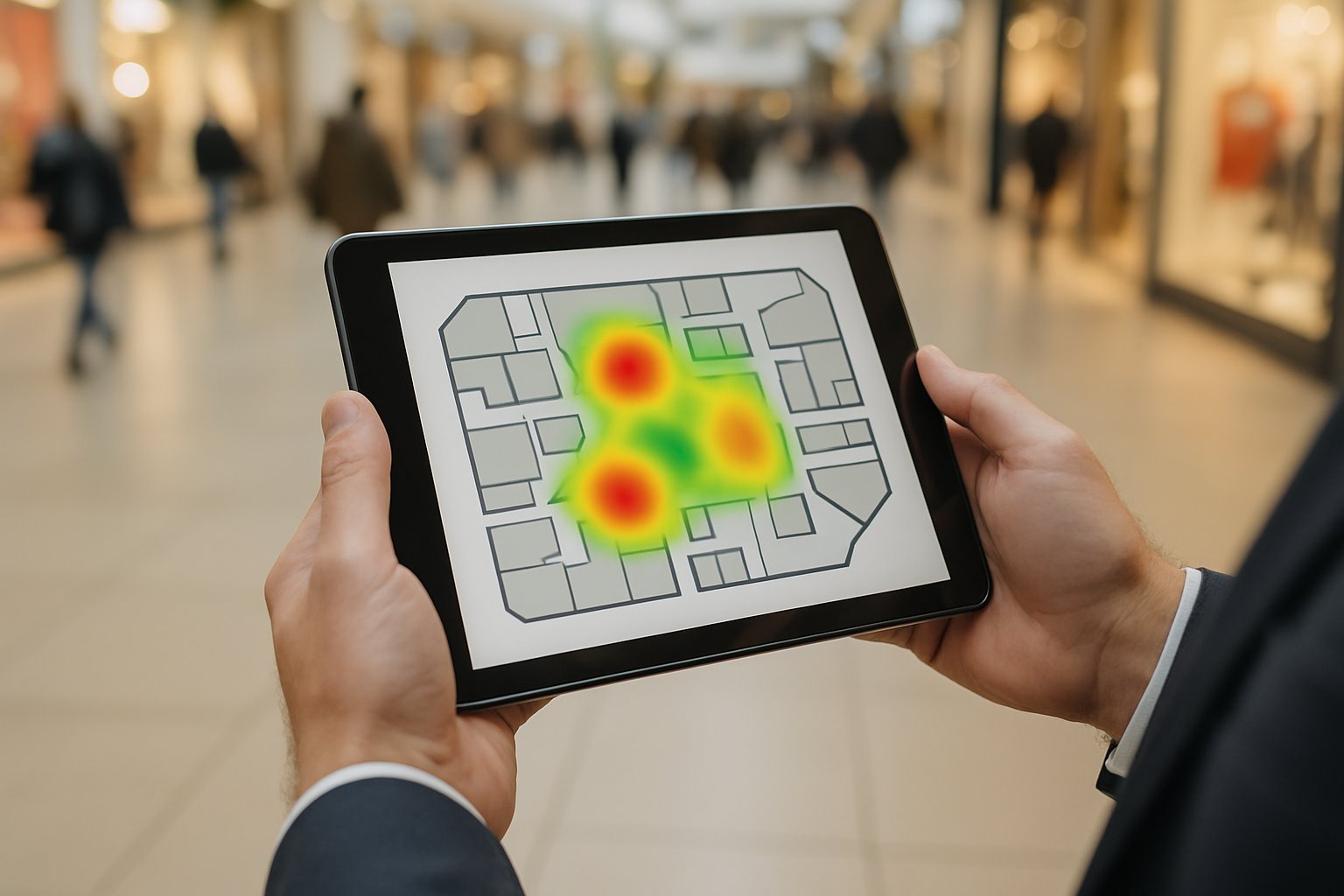
Market momentum shows clear demand signals. Consequently, leadership interest in visual merchandising intelligence systems keeps strengthening.
Core Technology Building Blocks
Hardware forms the visible layer of any deployment. Cameras mounted on shelves or ceilings stream images into cloud or edge processors. At the core, visual merchandising intelligence systems fuse those images with store product masters. Additionally, tuned YOLOv8 models produce SKU bounding boxes with precision and recall often exceeding 90%. Generative diffusion models can now sketch optimal shelf diagrams before human review. Robots, especially Brain Corp units, complement static cameras by scanning aisles autonomously overnight. Consequently, retailers obtain fresh compliance data each morning without extra labor. Some vendors bundle retail design optimization dashboards that visualize heatmap data alongside shelf metrics.
Robotics Shelf Scanning Services
Simbe, Brain Corp, and Pensa market managed services where autonomous mobile robots scan every aisle nightly. Therefore, stores receive continuous availability alerts with minimal labor impact.
These building blocks establish reliable data pipelines. In contrast, business value emerges only when insights change actions.
Proven Business Value Drivers
Numbers tell a compelling story. Trax reports a 3.81x ROI for a water brand after signal-based merchandising interventions. When visual merchandising intelligence systems cut out-of-stocks, incremental revenue compounds quickly. Focal Systems claims 3–5% sales uplift tied to better on-shelf availability. Academic A/B trials have recorded category gains above 20% during short experiments.
- 7-Eleven Taiwan deployment: YOLOv8 precision above 90% across 7,000 stores.
- Frozen fruit brand recovered USD 550k lost sales across 2,000 outlets.
- Retailers often quote labor savings from automated audits of 10–15 hours weekly per store.
Therefore, visual merchandising intelligence systems often pay back capital within months where execution gaps are large. Footfall analytics amplifies gains by linking product exposure to shopper movement. Similarly, retail design optimization tools test alternative adjacencies and measure resulting conversion shifts.
Evidence suggests multi-signal programs outperform siloed efforts. However, privacy concerns can derail initiatives, as the next section shows.
Privacy And Compliance Pressures
Regulators now scrutinize in-store camera deployments with unprecedented vigor. The FTC banned Rite Aid from facial recognition after documented harm to customers. Consequently, visual merchandising intelligence systems must avoid biometric identification or secure explicit consent. Retailers should enforce anonymization, retention limits, and vendor audits to protect shoppers and reputations. Furthermore, accuracy bias can still surface when packaging changes or lighting shifts.
Compliance discipline therefore underpins sustainable programs. Subsequently, implementation teams need structured checklists.
Implementation Best Practice Checklist
Successful rollouts begin with objective baselines covering eight weeks of POS and movement data. Next, teams define KPIs such as on-shelf availability, sales per foot, and remediate time.
- Collect baseline sales and traffic data.
- Install cameras and calibrate models.
- Integrate footfall analytics with POS feeds.
- Set alert thresholds and task workflows.
- Audit vendor ROI with control stores.
Moreover, visual merchandising intelligence systems deliver little value without staff adoption incentives. Professionals can deepen governance skills through the AI Security Level 2™ certification.
Checklists translate strategy into repeatable actions. Finally, innovation keeps expanding capabilities.
Future Outlook And Innovation
Planogram generation using diffusion models now promises rapid scenario testing for retail design optimization. Meanwhile, ESL and camera integration feed visual merchandising intelligence systems, enabling dynamic pricing tied to shelf state. Industry insiders expect wider adoption of robots as a service that bundle hardware, analytics, and support. In contrast, cost pressures may shift focus toward lighter mobile capture in smaller formats. Visual merchandising intelligence systems will likely converge with workforce management to create closed-loop operating systems.
Innovation trajectories point to ever smarter stores. Therefore, executives should monitor pilots closely and iterate fast.
Strategic retailers now recognize shelf data as a competitive weapon, not a science experiment. Consequently, teams that operationalize insights from visual merchandising intelligence systems secure measurable sales and labor wins. Nevertheless, privacy safeguards, rigorous baselines, and transparent ROI audits remain mandatory. Footfall analytics and retail design optimization further magnify returns when coordinated with shelf alerts. Executives should pilot quickly, validate objectively, and scale where benefits justify investment. Explore advanced credentials like the AI Security Level 2™ certification to guide responsible deployments. Act now to turn data-driven layouts into lasting advantage.
Disclaimer: Some content may be AI-generated or assisted and is provided ‘as is’ for informational purposes only, without warranties of accuracy or completeness, and does not imply endorsement or affiliation.


